

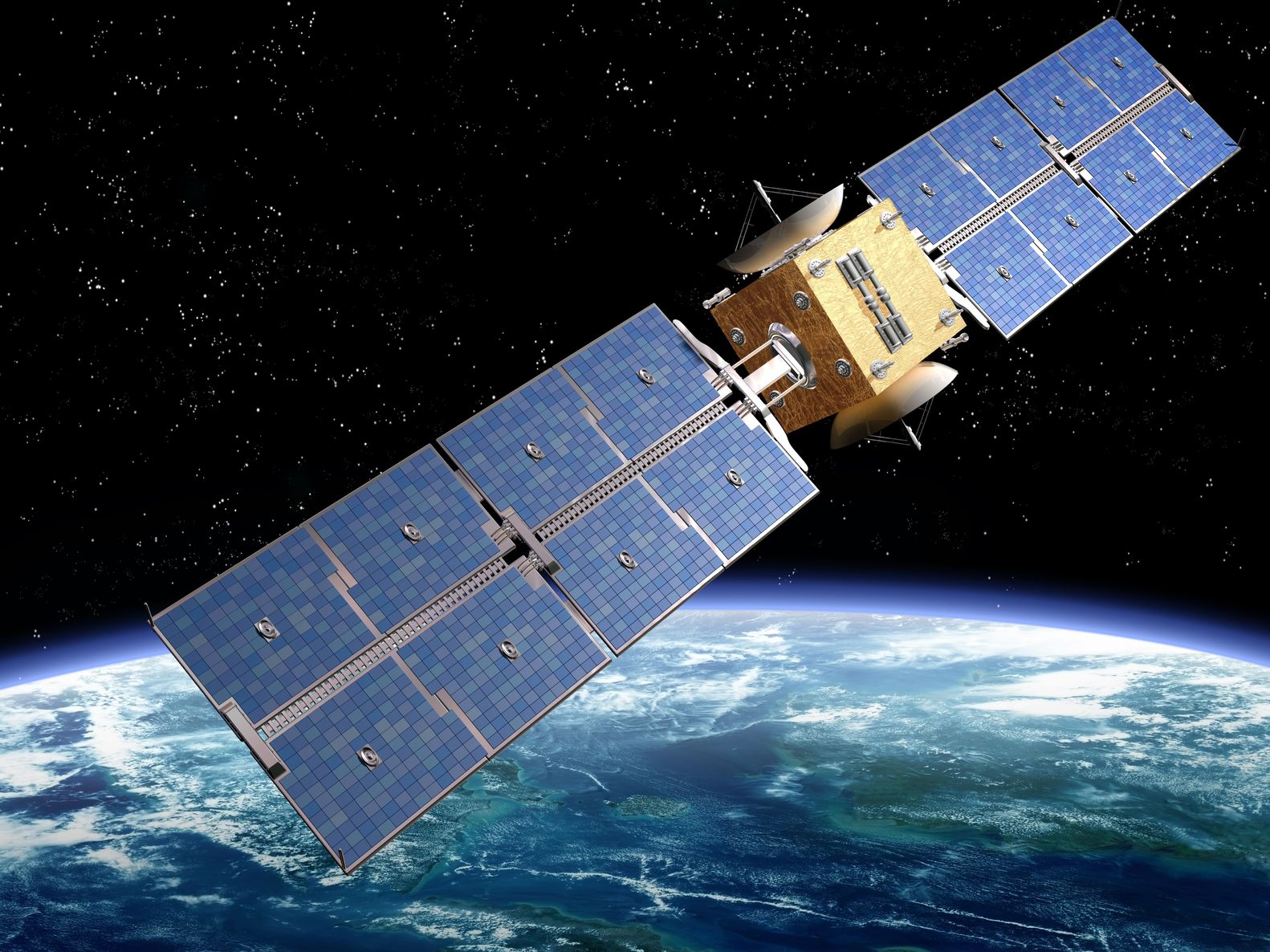
Artist’s rendition of a satellite – paulfleet/123RF Stock Photo
The latest Earth Observation (EO) satellite launches are from Russia, with the next expected launch being from Japan, and details of Synthetic Aperture Radar (SAR) datasets publicly available from America.
Leapling Russia Satellite Launch
On the 29th February the Soyuz-2-1b rocket took off from the Vostochny Cosmodrome in the Far East region of Russia, with several EO satellites on the payload.
- Sixteen SITRO-AIS satellites developed by SPUTNIX for Sitronics Group. These cubesats join an existing constellation for the tracking, surveillance, and monitoring of maritime vessels through their automatic identification system signals. Applications for this data will include vessel monitoring, search and rescue, and preventing illegal activities.
- Meteor-M2-4 is a Russian meteorological satellite in a sun-synchronous orbit at an 820 kilometre altitude. The satellite’s mission is to support operational meteorology and space weather monitoring. The instruments onboard are believed to include:
- Infrared Fourier Spectrometer (IKFS-2)
- High-resolution VIS/IR Radiometer (KMSS)
- VIS/IR Imaging Radiometer (MSU-MR)
- Imaging/Sounding Microwave Radiometer (MTVZA-GY)
- Meteorological Synthetic Aperture Radar (MeteoSAR)
- Radio-frequency mass spectrometer (GGAK-M/RIMS-M)
- GGAK-E / Corpuscular radiation spectrometer (GGAK-E/SKIF-6)
- GGAK-E / Detector of galactic cosmic rays (GGAK-E/GALS-E)
- Zorky-2M EO satellite, also developed by SPUTNIX. This CubeSat has a multispectral camera with a spatial resolution of 2.75 meters per pixel.
- Pars 1 is an Iranian EO satellite. Earth observation satellite. It has three imagers: multispectral (MS), short-wave infrared (SWIR) and thermal infrared (TIR), with a spatial resolutions of 15, 150 and 300 metres respectively. The satellite is focused on imaging Iran, and the TIR camera enables night imaging. It is expected that data from the satellite will be used for applications such as agriculture, forest monitoring, water quality resources, and supporting the monitoring of, and response to, natural hazards and disasters.
Next SAR EO satellite to launch
The Japanese Strix-3 SAR mission’s launch window opens on 9th March, and it is hoped that it will be put into orbit on a Rocket Labs mission from New Zealand. As is common with Rocket Labs, the mission has been named, in this case it is “Owl Night Long,” in homage to Lionel Richie’s “All Night Long”.
This will be fourth satellite in a planned twenty-five strong constellation, and it follows StriX-α, StriX-β and StriX-1, which went into orbit in December 2020, March 2022, and September 2022, respectively.
The Strix satellites use an X-band SAR and offer a ground resolution of 1 to 3 meters with swath modes of between 10 and 30 kilometres.
Publicly Available SAR Data
Umbra, an American company based in California, announced at the beginning of March that, through its Open Data Program, it had made over three thousand of its Synthetic Aperture Radar (SAR) images available to the public.
The company launched its first satellite on the 30th June 2021, and has followed this up with seven other satellites, giving an eight strong constellation, with the latest launches being in November last year. These X-band SAR satellites offer a spatial resolution of 25 centimetres over a 16 square km area.
The data can be accessed directly through the company’s open data catalog, which is available on both AWS and the SkyFi platform. The Open Data Program offers data for over one thousand locations worldwide, including over twenty that are regularly monitored.
Conclusion
New EO satellite launches are continuing worldwide, and it is great to see more commercial datasets being made publicly available to encourage people to use and explore the SAR world.
