

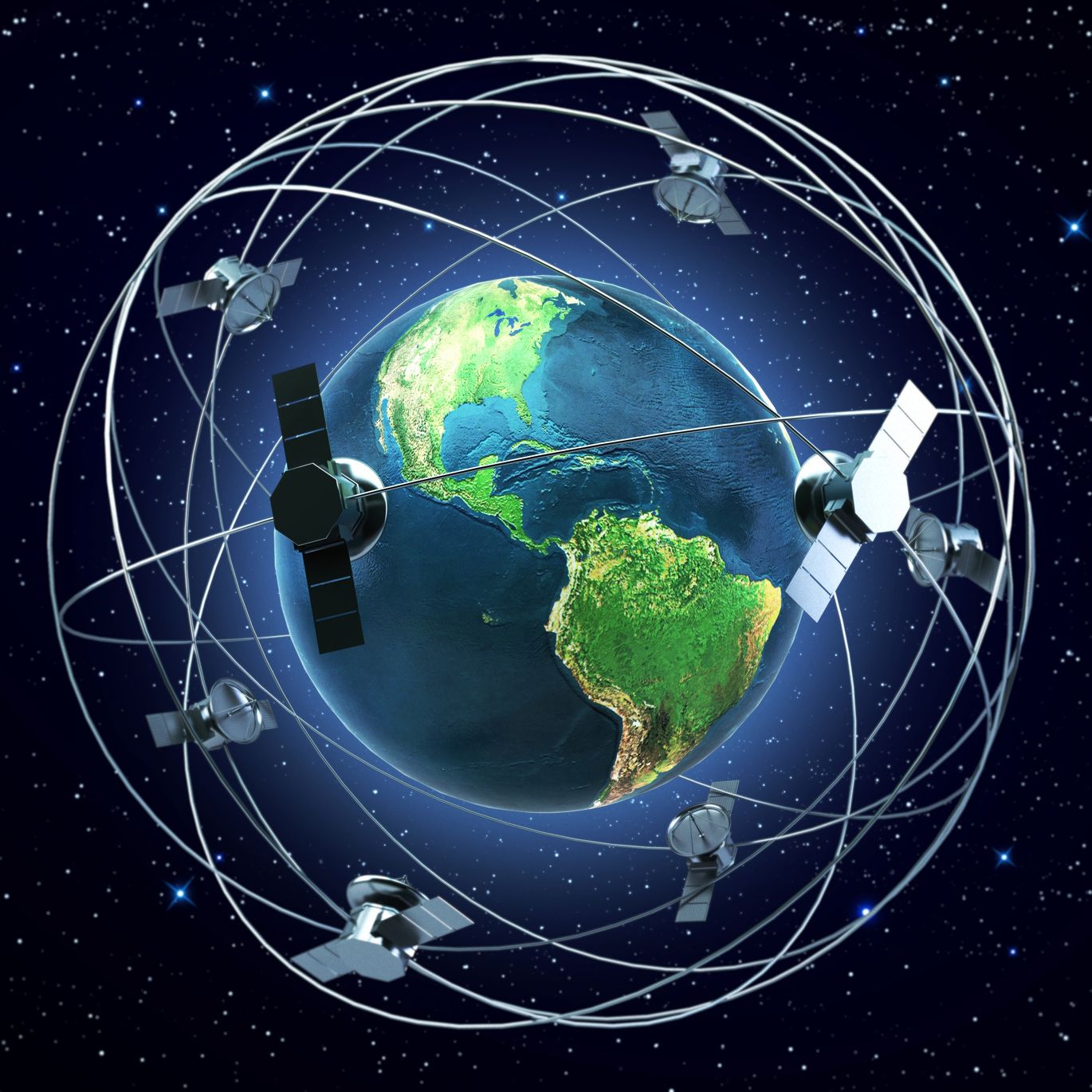
Artist’s rendition of satellites orbiting the Earth – rottenman/123RF Stock Photo
The year has begun in a rollercoaster fashion for Earth Observation (EO) sector, with some up and some downs.
Ups
The first EO launch of the year took place on Friday 2nd January 2026, when the COSMO-SkyMed Second Generation Flight Model 3 (CSG-3) satellite was put into a sun-synchronous orbit, at an altitude of 620 km, by SpaceX with its Falcon 9 rocket from the Vandenberg Space Force Base in California.
COSMO-SkyMed is short for Constellation of Small Satellites for Mediterranean basin observation, and as the CSG-3 name implies, this is the third satellite in this constellation following earlier launches in 2019 and 2022; a fourth satellite is expected to be launched in the future. It is an X-band Synthetic Aperture Radar (SAR) satellite offering a spatial resolution of less than 1 metre for its spotlight mode with a swath size of 10 x 10m, while its Stripmap mode offers a spatial resolution of between 3 and 15 metres on a swath width of 40km. The data is used for applications including environmental monitoring, security, and emergency management, natural hazards assessment, infrastructure monitoring, maritime surveillance, precision agriculture, land use mapping, and defence and security needs.
This was followed on the 11th January by the latest SpaceX rideshare mission, which was also via a Falcon-9 rocket from the Vandenberg Space Force Base. The mission put 40 payloads into a variety of sun-synchronous orbits, and there were several EO missions onboard:
- CarbSAR, a demonstration small satellite developed by UK companies Surrey Satellite Technology and Oxford Space Systems. CarbSAR is carries an X-band instrument offering a ground resolution of 0.5 metres with a swath width of 4 kilometres. The data is expected to be used for defence and security; maritime, disaster response; and environmental applications.
- Two Capella Arcadia small X-band SAR satellites – numbers Arcadia-8 and Acardia-9, offering a spatial resolution of under 0.5 metres, which are part of Capella Space’s wider constellation.
- Two SAR satellites for ICEYE, one of which is for the Finnish Defence Forces.
- Two cubesats for Tomorrow.io, which will join their existing constellation providing low latency weather data for both numerical weather prediction and long-range weather forecasts.
- X-band SAT satellite for US based Umbra Lab. This joins the eleven existing satellites in orbit, and this constellation offers a spatial resolution of 0.25 metres with a swath of 16 square kilometres.
- Eight Lemur-2 satellites for US based Spire, to join its existing constellation, with these cubesats collecting weather data for commercial and Government clients.
Downs
Despite only being two weeks into the year, 2026 has not been without its disappointments. The day after the SpaceX rideshare, a similar rideshare mission by the India Space Research Organisation, sadly, ended in failure, due to an issue with the third stage of its Polar Satellite Launch Vehicle (PSLV). There were 16 satellites onboard, and some of the EO payloads lost included:
- EOS-N1, also known as Anvesha, an Indian hyperspectral satellite that reportedly would have offered a spatial resolution of 12 metres with a swath width of 12 kilometres.
- THEOS-2A was an EO satellite for Thailand, with sub-metre resolution for both images and videos.
- Munal, a satellite built domestically in Nepal under the guidance of high school students for the Nepal Science and Technology Institute. The satellite was intended to be used for vegetation monitoring, testing indigenous technologies, and processing data using artificial intelligence.
Interestingly, although not an EO satellite, the Kestrel Initial Demonstrator capsule for the Spanish company Orbital Paradigm has reportedly sent signals back to the company as it had separated from the rocket before the issue arose; whether it will be fully operational is still being assessed.
Summary
The first two weeks of 2026 show how much of a knife-edge the satellite industry operates on. Everyone designs, builds, and tests their satellites, but until they are successful deployed in space you never know whether you have a success or loss.
