

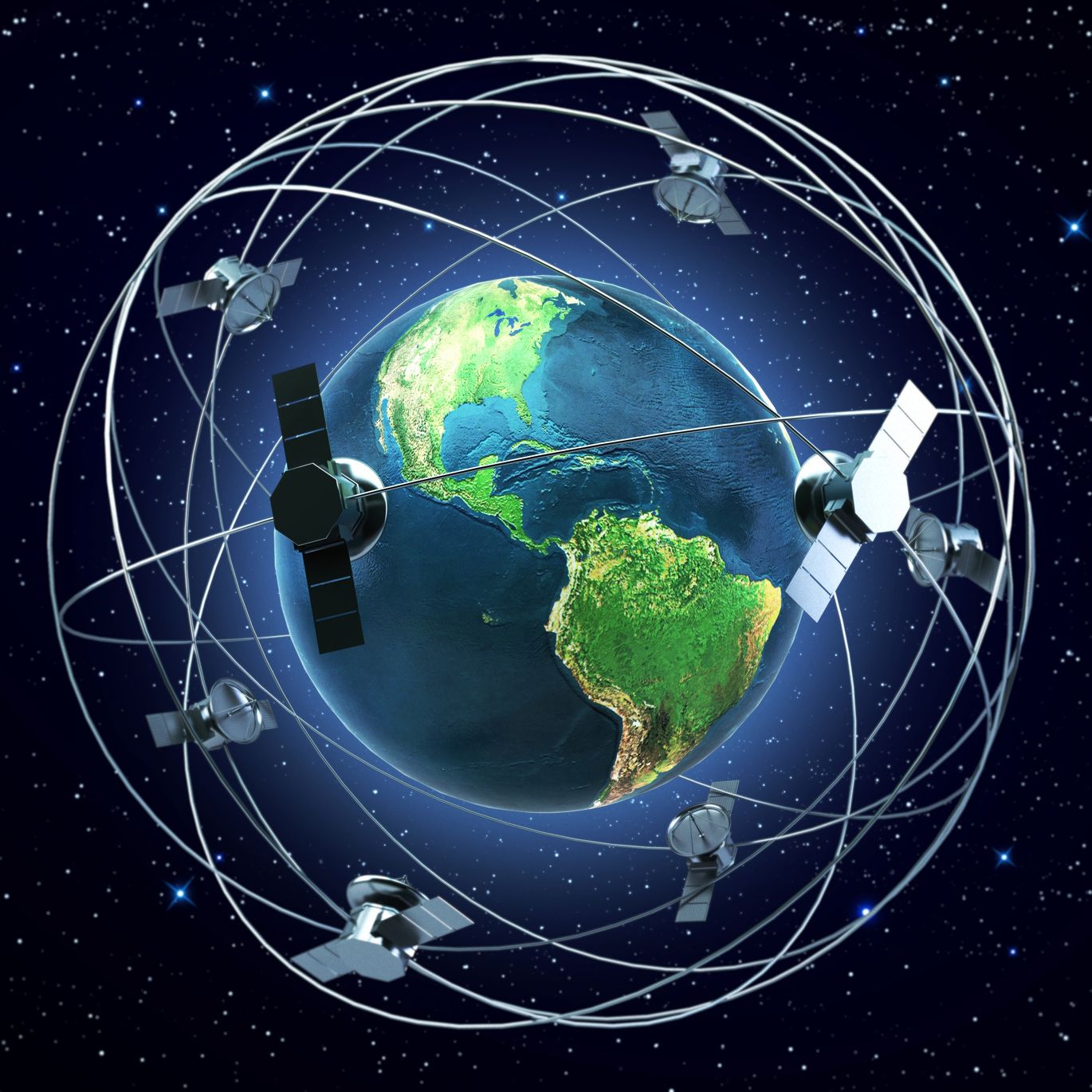
Artist’s rendition of satellites orbiting the Earth – rottenman/123RF Stock Photo
This week we’re going to look at satellite launches happening this week, launches that happened last week and one return to Earth!
Satellite Launches This Week
On Sunday, 7th August, the Indian Space Research Organisation (ISRO) is planning the maiden flight of its new Small Satellite Launch Vehicle from the Satish Dhawan Space Centre in Sriharikota, India.
This launch will be for two satellites. The first is EOS-02 (previously known as Microsat-2A) an Earth Observation (EO) microsatellite carrying two instruments: a mid-wavelength camera and long-wavelength infrared camera, both of which will have a 6m spatial resolution. The data from the satellite will be used for various cartographic applications.
In a great week for female empowerment and achievement – check out the amazing England Lionesses becoming European Champions last Sunday and their amazing celebrations, singing and dancing – the second satellite being launched is the AzaadiSAT which was built by 750 female students from 75 schools across India. It was part of the celebrations to mark the 75th anniversary of Indian Independence, and aims to promote women in STEM (Science, Technology, Engineering and Mathematics).
The small satellite will carry 75 miniature payloads, also called ‘femto experiments’ which include sensors to monitor temperature, humidity, pressure sensors, an accelerometer, gyroscope and a magnetometer. It also has a selfie camera for its own solar panels to monitor how they work in space and long-range communication transponders to undertake experiments to provide low bandwidth connectivity to remote areas.
Satellites Launched Last Week
China launched a group of three Yaogan-35 EO satellites on the 29th July from the Xichang Satellite Launch Center in the Sichuan Province. This is the third launch of such satellites with pairs of satellites being put into orbit in November 2021 and June 2022 respectively. No details on the instruments or specifications have been released, leading to reports that these are military surveillance satellites. Officially, they are described as collecting data for land resource surveys, agricultural product yield estimation, and disaster prevention and reduction.
Starlink continues to launch satellites at pace with 53 satellites put into orbit on the 24th July. This followed launches of 53 satellites on both the 7th and 17th July, together a further launch of 46 satellites on 11th July. Making a total of 205 satellites launched in the last month.
To give a bit of context, SpaceX has launched 967 satellites so far this year. According the Online Index of Objects Launched into Outer Space, maintained by the United Nations Office of Outer Space Affairs, during the sixty five years of space flight there are only 3 years (including 2022) where the entire world launched more satellites in a year than SpaceX has this year. Let that sink in!
Debris Coming back To Earth Last Week
Thinking that all these launches aren’t relevant to you? Well, in a second successful launch last week, China used the Long March 5B rocket to put the second module of the Chinese Space Station into orbit on the 24th July. Whilst the launch went well, on the 30th July China’s Space Agency announced that debris from the Long March 5B rocket had re-entered the atmosphere and landed in the Sulu Sea, close to Palawan Island in the western Philippines.
The rockets taking modules for the construction of the Chinese Space Station do not have the capability to undertake a controlled re-entry, and therefore whilst a significant proportion of the rocket will burn-up on re-entry, not all does. The Chinese Government said that as the rocket would most likely land in the sea, there was little risk to anyone on the ground.
Summary
Satellite launches are increasing rapidly with more internet broadband constellations expected to begin launching soon, space is getting very congested. Plus, you might want to keep one eye up to space as you never know what might be coming back down!
