

The night-sky currently has a special treat as Comet NEOWISE passes close to Earth, and it is visible to many people with the naked eye.
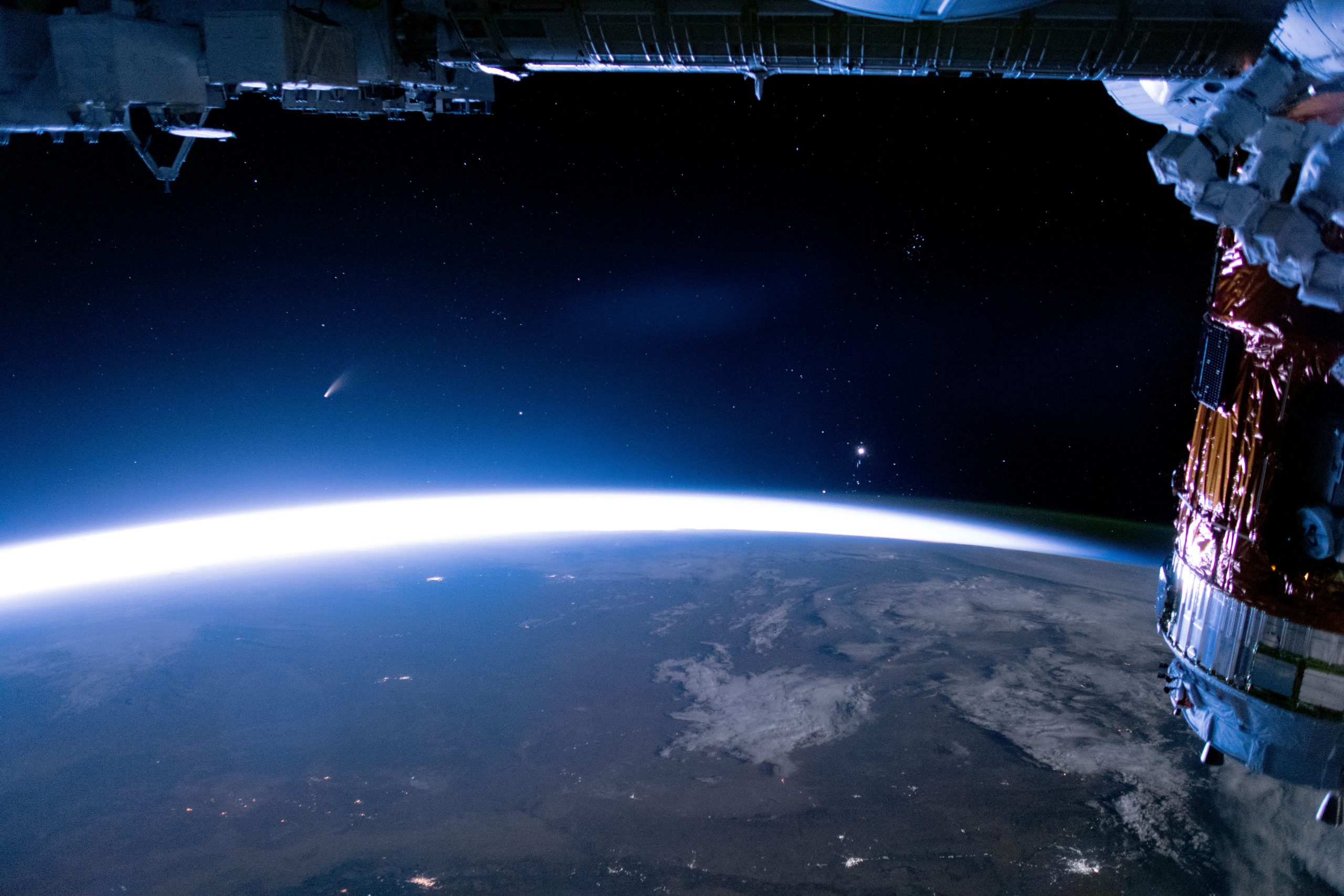
Comet NEOWISE as viewed from the International Space Station (ISS) on July 5, 2020. taken with ISS Digital Camera. Image courtesy of NASA.
Astronomers using NASA’s Wide-field Infrared Survey Explorer (WISE) satellite discovered comet NEOWISE, short for C/2020 F3 (NEOWISE), earlier this year. During this month there will be lots of opportunities for stargazers, particularly in Europe and North America, to see the comet. Whilst a telescope or binoculars will make it clearer, it is possible to see it simply by looking.
However, you will need to find somewhere that has dark skies. Unfortunately, the centre of the majority of urban areas will have too much light pollution. This is the term used to describe the ‘sky glow’ seen above towns and cities and is caused by street lights and light spilling out from buildings – think of the large office blocks that leave lights on throughout the night. This sky glow is also what makes urban centres and roads visible at night to satellites.
You might be lucky and live in an area without too much light pollution, but if not you can find suitable areas known as Dark Skies Areas/Reserves. Close to where Pixalytics is based in the South West of the UK, we have the Exmoor Dark Skies Reserve that covers an area of just over eighty square kilometres and offers many great viewing points for stargazing. There are many of these Dark Skies Areas around both the UK and the world, which you can see here.
To find the comet, the first step is to look towards the northwest and find the Plough, also known as the Big Dipper or the Ladle due to its shape, and the last two stars of the constellation point towards the bright Pole Star, also known as Polaris or Ursula Minor. If you look along the line of these two stars, but in the opposite direction, you will find the comet below and to the left. It will appear as a slightly blurry image and it will not be as sharp as the stars. The tail will be pointing straight up, but this will be difficult to pick out without a telescope of binoculars.
Comets, like NEOWISE, are often described as ‘dirty snowballs’ as they have a solid centre – in this case, the comet has a diameter of approximately three miles. However, behind the centre is the tail which can be thousands of kilometres long and is made up of dust and charged particles of gas coming off the comet.
NEOWISE is expected to make its closest approach to Earth around the 22nd or 23rd of July, although close is a relative term as it will still be over sixty million miles away! However, if you want to see this comet, don’t miss your chance. It’s on a long near-parabolic orbit and astronomers estimate that it won’t be back to Earth for almost seven thousand years! Given what is currently happening on our planet, it does make you wonder what NEOWISE will see when it returns!
