

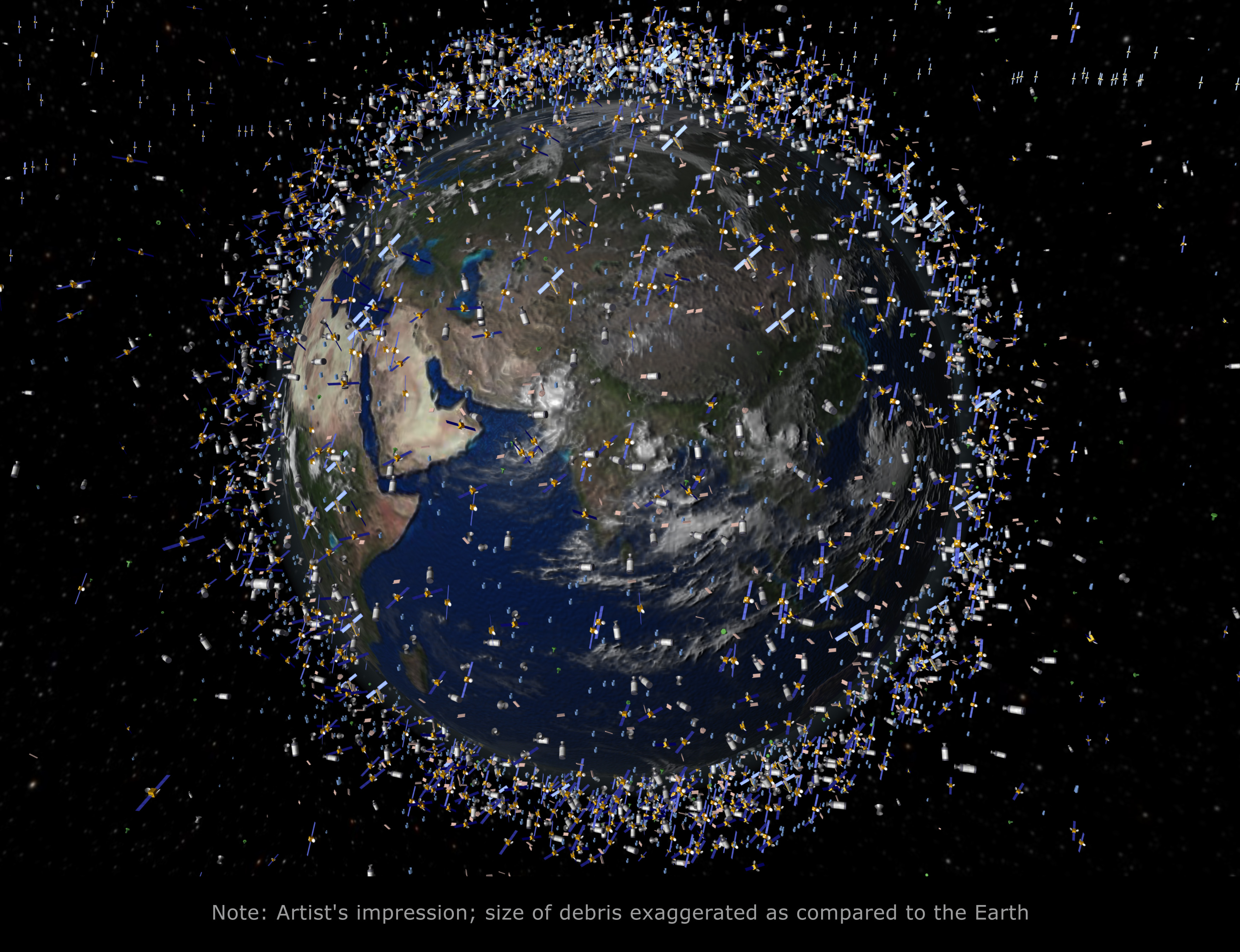
Image courtesy of ESA
Note: The debris field shown in the image is an artist’s impression based on actual data. However, the debris objects are shown at an exaggerated size to make them visible at the scale shown
Space based broadband, also known as satellite internet and as the names suggest, provides access to broadband without needing any ground-based infrastructure. For example, in the UK, most broadband services are provided to locations via telephone or fibre cables – and individual locations are limited to the speed their local infrastructure can handle.
As an alternative, space-based broadband is provided via a satellite dish that enables that location to connect to the internet, meaning that it is ideal for remote and rural areas where there is no local cable infrastructure.
To provide a worldwide space-based broadband service requires a significant number of satellites to ensure that there is one available for a user to connect and get access to the internet. Initially, this service was slow, but recent developments have improved speeds and reduced latency, making working-from-home, video calling, video streaming and gaming all viable. This improvement has corresponded with an explosion in the number of satellites launched by these service providers, and those hoping to become such service providers.
Starlink
The Starlink constellation, owned by SpaceX, is the most well-known space-based broadband provider and currently has a constellation of over 7,000 satellites in orbit. The precise number changes frequently, and already in May 2025, 85 new Starlink satellites have been launched – twenty-eight on 2nd May; twenty-nine on 4th May; and twenty-eight on 7th May – and further launches are anticipated this week on the 9th and 10th. The reason for the number of launches is that, according to astronomer Jonathan McDowell with a survey he conducted in January, four to five Starlink satellites deorbit and return to earth every day.
This level of loss needs to be constantly replenished, and then as the Starlink service develops, the number of satellites must be increased to provide that service. For example, last month, two of India’s largest telecommunication companies signed deals to bring the Starlink internet service to the country.
As we’ve previously written, SpaceX has a licence to launch 42,000 Starlink satellites, and so there is a long way to go before they are anywhere near their ambition.
Other Competitors
Like any successful business, SpaceX is facing competition and there are new providers emerging, even though the industry barriers to entry are significant. The main competitors are:
- OneWeb – They have a constellation of 654 satellites in orbit.
- Project Kuiper – This is Amazon’s satellite internet project, and they launched the first twenty-nine of their satellite constellation last month, with the ambition of having a 3,236 strong constellation.
- GuoWang – is China’s satellite broadband constellation, created by SatNet supported by the China Association for Science and Technology. It had its latest launch of satellites on Monday 5th May, giving it a forty-satellite constellation – however, it does have an ambition of creating a constellation of almost 13,000 satellites.
Why Does This Matter?
According the figures above, just these companies have ambitions to launch over 50,000 satellites. To give this context, there have only been approximately 21,000 objects launched into space ever! They are planning to launch more than double the number of objects that the whole world has launched in sixty years.
While it’s unlikely that these figures will be delivered soon, over time there will be impacts on the world. There is the economic and environmental cost of having to manufacture and launch this many satellites, add to this the increase in objects in the critical Low Earth Orbit. Any collisions, accidents or incidents, could have a major impact to the way in which the world currently works – think of everything from using maps on your phone, satellite navigation, weather forecasting, and many more being reduced, or even lost, if space-based services were not available.
Developing space services is fantastic, particularly for those communities that currently don’t have the facilities others do, but it is important that this done carefully, and we don’t do anything that could threaten the overall Low-Earth orbit.
