

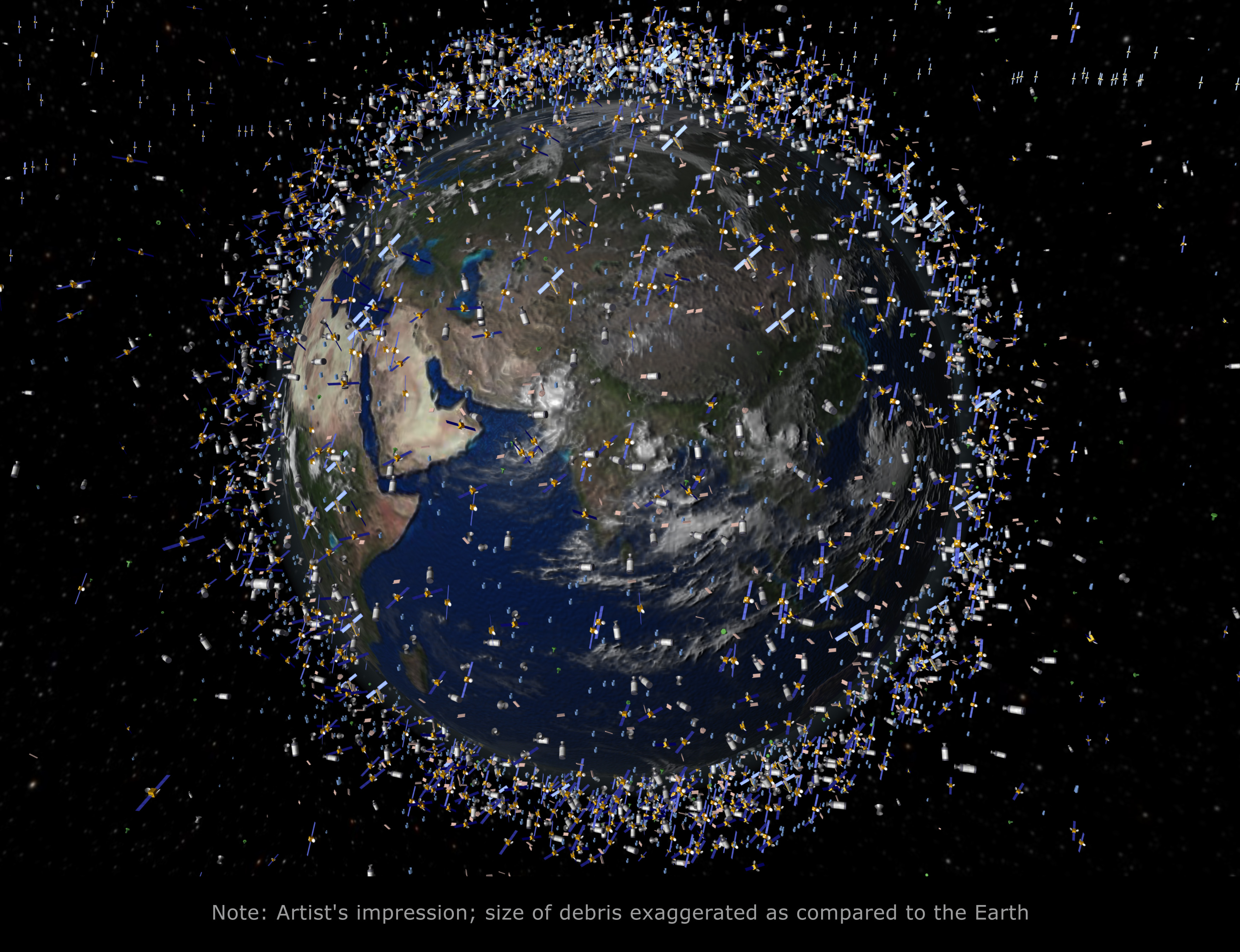
Image courtesy of ESA
Note: The debris field shown in the image is an artist’s impression based on actual data. However, the debris objects are shown at an exaggerated size to make them visible at the scale shown
The 1990s saw the Dot Com Bubble, the early 2000s saw the US Housing Bubble which led to the 2008 financial crash, and, according to some commentators, we are awaiting the burst of the current AI bubble. Is space next?
An economic bubble is a market phenomenon where asset prices surge to levels far exceeding the intrinsic, fundamental value of the asset. It is often driven by an intense passion, excitement, and belief in the sector rather than the underlying financial fundamentals and when the bubble bursts there are financial consequences. Bubbles are not new, the Tulip Mania bubble occurred in 1637 where speculators bought up tulip future contracts and then the tulip market burst leaving the speculators with worthless contracts, and the South Sea Bubble happened in 1720 when Great Britain gave the South Sea Company exclusive contracts for trade routes leading to new start-ups flooding the market, and as insiders began selling stock panic set in, leaving thousands of investors out of pocket and there was a political scandal as senior politicians were involved.
SpaceX
Last week Elon Musk fired the financial excitement starting gun for the space sector with the announcement that SpaceX planned to go public with an initial public offering (IPO) on the US Stock market, which would allow people to buy into the firm and trade its stocks. SpaceX currently values itself at US$1.25 trillion and is reportedly aiming at an IPO valuation between US1.75 and US$2 trillion. Yet, last year its revenue was US$18.6 billion with a net loss of US$2.5 billion; its balance sheet shows US$102 billion of assets, alongside US$60 billion of debt. So, can the valuation be justified?
SpaceX would point to the fact that it has multiple income streams such as commercial satellite launch facilities, Starlink, Government contracts such as the delivering astronauts and cargo the International Space Station, social media platform X, and the artificial intelligence company xAI, etc. The IPO document indicates that the company has a potential market of US$28.5 trillion, and the initial IPO document can be found here.
However, as we know from this blog over the years, working in space is challenging, things can wrong and when they do it is extremely difficult to rectify them. The IPO document itself also acknowledges the challenges of working in this sector, and some of its other ambitions in what it describes as future markets – such as orbital AI centres (data centres in space), space tourism or working on the moon. Interestingly orbital AI gets 77 mentions in the IPO, and indicates that the first data centres could be in space in 2028.
Wider Space Sector
The SpaceX IPO has also generated interest more widely, and there are lots of articles looking at some of the other commercial companies in the sector, such as:
- Rocket Lab – It went public in 2021 and has been a steadily rising stock over the last year. It’s 2025 figures show US$601.8 million revenue, a 38% increase on the previous year, but it also recorded a net loss of US$198.2 million. Although commentators do point to the US$2.2 billion order book it has.
- Planet Labs – Also went public in 2021. For its last financial year, it recorded revenue of US$308 million, 26% increase over previous year, but, again, a net loss of US$246.9 million.
- BlackSky Technology – Another to go public in 2021, and for 2025 it reported revenue of US$106.6 million and, you may have guessed, a net loss of US$70.3 million
Summary
Despite the underlying financials and the risks of some of its key working sectors, there is huge interest in the SpaceX IPO with a large chunk of the shares expected to be reserved for individual retail investors. However, as other companies demonstrate, it may be a long way from making a profit and investment decisions are likely to be driven by potential, excitement and passion.
It will be interesting to see what happens when the shares go live and whether space is becoming a new investment sector, or simply a the start of potential bubble getting ready to burst.
