

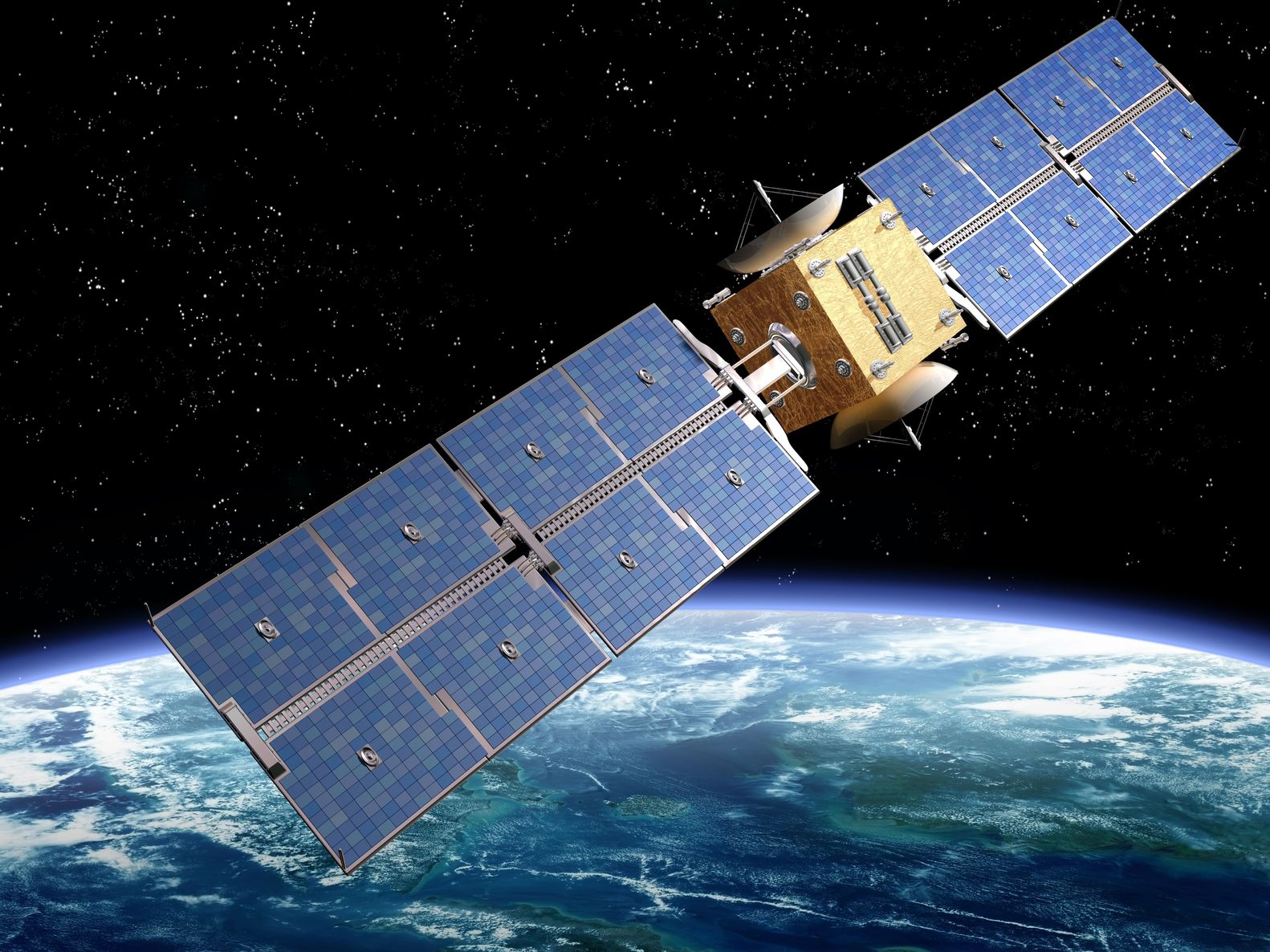
Artist’s rendition of a satellite – paulfleet/123RF Stock Photo
This week is all about Asia, as we’re highlighting the first light images of a Taiwanese satellite, plus the latest Chinese launches, and a test flight of a high-altitude platform balloon in India.
Taiwan
Taiwan has confirmed that its first Formosat-8 satellite will become fully operational in July, after validation work has determined that image quality has met or exceeded ambitions, and signal quality has also exceeded expectations. This coincided with the Taiwan Space Agency’s release of Formosat-8 images of the Tamsui River Bridge and the Port of Taipei.
Formosat-8A is a high-resolution optical imaging satellite, which was launched on the 25th November 2025 on a SpaceX rideshare mission by a Falcon-9 rocket into a sun-synchronous orbit at an altitude of 561 kilometres. It offers images with sub-metre spatial resolution, and with processing the resolution can be improved to approximately 70 centimetres. Apart from visible and panchromatic modes, it also offers a red-edge band mode.
Formosat-8A is also known as Chi Po-lin, as it is named after the Taiwanese documentary filmmaker, photographer and environmentalist, best known for his 2013 film Beyond Beauty: Taiwan from Above. As regular readers know, we love the concept of naming satellites after people rather than numbers or acronyms, like the Portuguese literary figures from our recent blog.
Formasat-8A is the first in what is hoped to be a six strong constellation, with further satellites being launched over the next five years. The plan is to increase the spatial resolution over time, with ambitions to have the last satellite offering a resolution of approximately 30 centimetres.
Formosat-8 was developed domestically, and this approach will continue to help the country build a stronger space industry.
China Satellite Launches
Last Friday the Lijian-1 Y13 carrier rocket took off from the Dongfeng commercial space innovation pilot zone in northwest China and successfully launched five satellites into space. They were:
- Taijing-3 05A and O5B are two high-resolution optical satellites developed by Minospace for the city of Chengdu in Sichuan province. They will provide images of the city and surrounding areas to improve planning for new developments, emergency preparation, and to support the local agricultural industry.
- Tianyi-50 is an X-band synthetic aperture radar satellite for the city of Hubei in Wuhan province. It’s designed to monitor hydroelectric power plants and will revisit the same sites every eleven days.
- Tianyan-27, also known as Youxi, was developed by the Shanghai Xuntian Qianhe Space Technology Co Ltd. It is a demonstration satellite that is reported to testing infrared remote sensing technologies, onboard AI processing of ‘ultra-high resolution’ data and will stream views of the planet.
- Jilin-1 Gaofen-03D55 is latest Jilin satellite from Changguang Satellite Technology Co Ltd and will join the existing constellation offering optical imaging with a spatial resolution of 1 metre with a swath width of 17 kilometres.
India
Finally, an interesting report from India where the Red Ballon Aerospace company successfully conducted a tethered trial of what it described as India’s first super-pressure balloon. The test of this high-altitude platform (HAP) was undertaken with the balloon anchored to the ground, while its system performance and operational readiness were evaluated. The company indicated that all payload tests on the trial were successful.
Following this trial, Red Ballon Aerospace indicated that a full launch was planned for later this year with the aim of getting the balloon to the edge of the stratosphere at approximately 25 kilometres.
Summary
It’s always exciting to see new launches and the first images of a new satellite. In addition, as we’re currently involved in a project with HAPS, we’re always interested in see new developments in this area. As usual, there is always something new happening in the space sector.
