

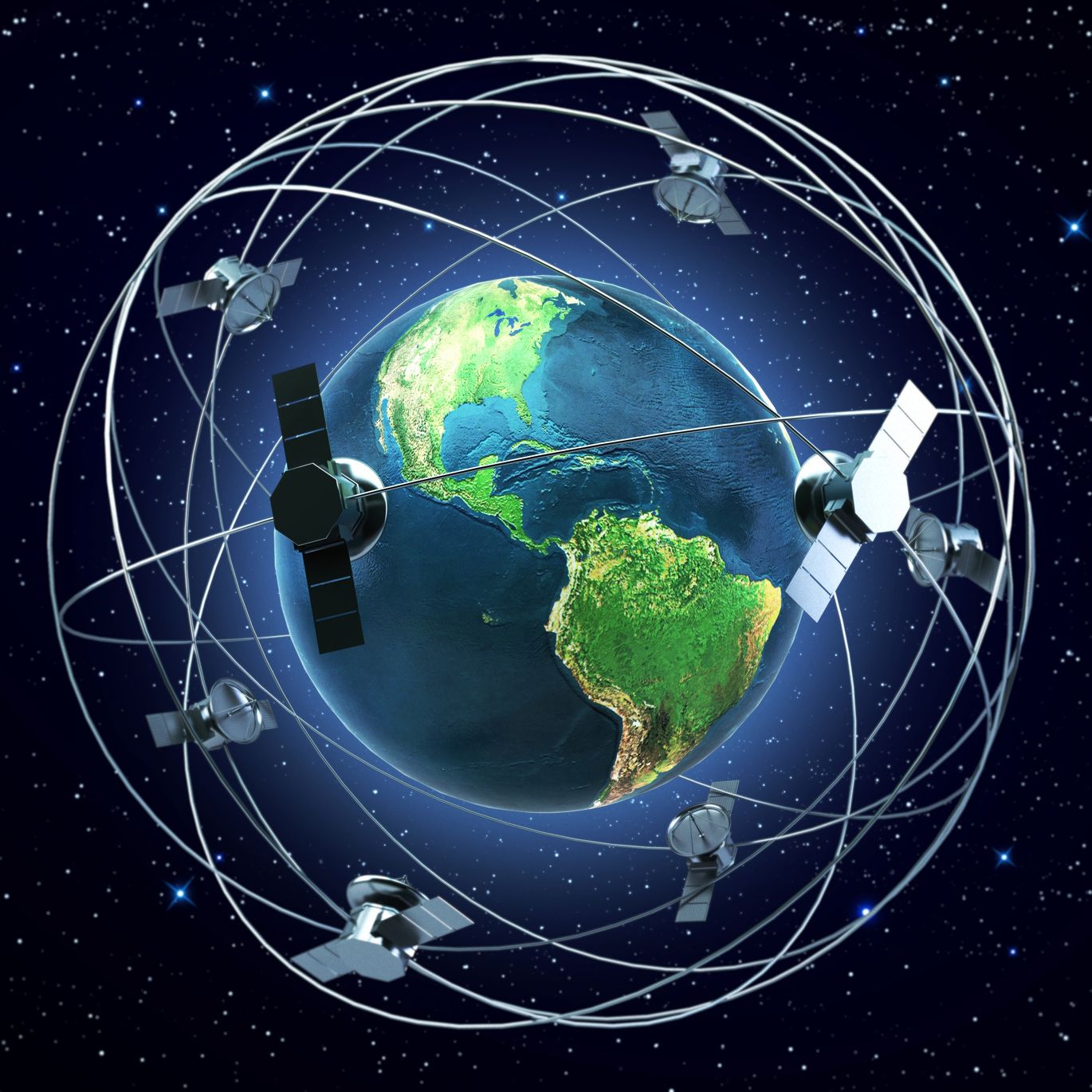
Artist’s rendition of satellites orbiting the Earth – rottenman/123RF Stock Photo
This week we’re highlighting some recent satellite launches, the first of which is the launch by China of a climate satellite monitoring greenhouse gases; and secondly recent Portuguese launches that have literary connections.
China Launch
On Friday 17th April, China delivered a successful launch of its Daqi 2 (DQ 2) Earth Observation (EO) satellite, which was taken into a sun-synchronous 700-kilometre orbit by a Long March 4C rocket from the Jiuquan Satellite Launch Center.
Daqi-2, also known as High-Precision Integrated Greenhouse Gas Observation Satellite, was developed by the Shanghai Academy of Spaceflight Technology and as the alternate name indicates it is designed to monitor greenhouse gases. The satellite has five instruments onboard:
- Atmospheric Detection Lidar
- Cloud and Aerosol Imager
- Wide-Swath Hyperspectral Greenhouse Gas Monitor
- Infrared Hyperspectral Atmospheric Composition Detector
- Ultraviolet Hyperspectral Atmospheric Composition Detector
These instruments give the first combined active and passive monitoring of greenhouse gases, allowing high-precision, wide-spectrum global observation.
The satellite has a mission life of seven years and follows Daqu 1 which was launched four years ago in April 2022. The two satellites will be part of the wider Gaofen constellation, and the two Daqu satellites will operate in tandem and provide data to support ecological and environmental management’ climate change research, energy conservation, emissions reduction, and pollution monitoring.
Given the United States are pulling back from climate research, this launch reinforces the fact that China and the European Union are becoming the undisputed leaders in this field.
Portugal’s Satellites
A couple of weeks ago we wrote about the EO satellites on the SpaceX rideshare mission, which was launched on the 30th March. There were some Portuguese satellites that we didn’t highlight in the previous blog but are interesting.
The first four satellites are not strictly EO satellites, they are communications satellites aimed at enhancing maritime navigation and communications across the Atlantic Ocean. Developed by the Portuguese company LusoSpace, they are part of the Lusíada Constellation, and the reason I am highlighting these satellites is that they are named after four of Portugal’s literary figures, namely:
- Luís de Camões who was a poet: This is the Lusíada 1 (Camões) satellite.
- Agustina Bessa-Luís was a female writer and theatre director: Lusíada 2 (Bessa) satellite.
- José Saramago was a writer and received the 1998 Nobel Prize for Literature: This is the Lusíada 3 (Saramago) satellite.
- Fernando Pessoa was a poet and writer, famous for his Book of Disquiet: This is the Lusíada 4 (Pessoa) satellite.
As someone who reads, and writes, poetry and fiction in my spare time, I am ashamed to say that I have not read anything by these writers, but I will now look out for their work to add to my ever growing ‘To Be Read’ pile. I loved the fact that the satellites are named after writers and it’s great to see the crossover between technology and culture.
In addition to the four literary satellites, there were two EO launches for Portugal on the same rideshare mission, and they will join three already in orbit as part of the Atlantic Constellation. These two were:
- CA-01 satellite that is a Synthetic Aperture Radar (SAR) satellite for the Portuguese Air Force designed to provide high-resolution radar data; and
- VHRLight NexGen EO satellite developed by CEiiA and N30, in collaboration with international partners. It is a multi-spectral optical satellite with a spatial resolution of 70 centimetres.
Conclusion
As EO satellites continue to be launched regularly, there is always something happening and always a little surprise if you look closely enough. Bravo Portugal for launching satellites bearing the name of literary figures, rather than numbers of acronyms. Perhaps the UK should consider the same approach – will we soon be launching the Dickens, Austin, Pratchett. or Adams! Or perhaps you have some other suggestions, let us know!
