

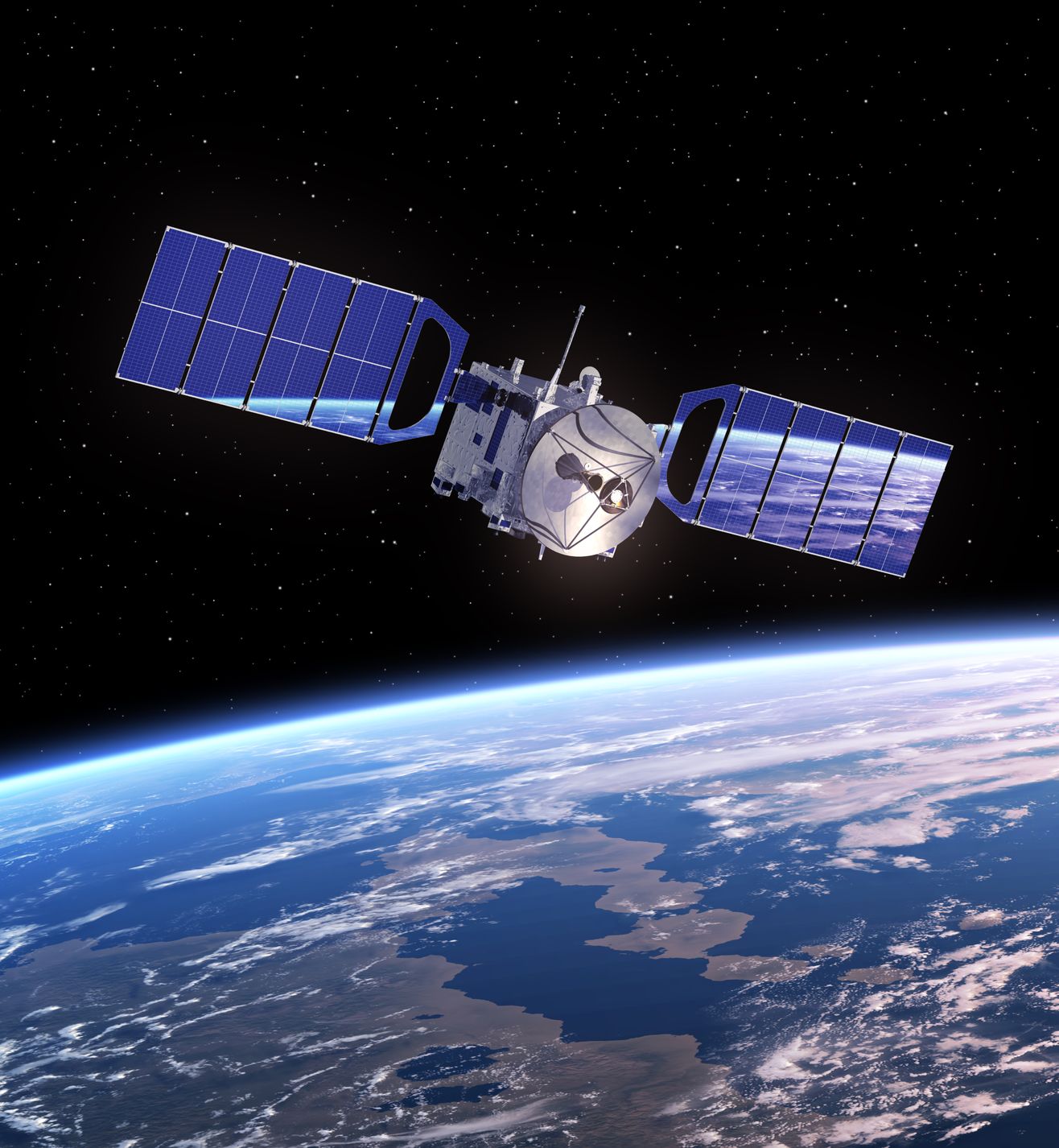
Artist’s rendition of a satellite – mechanik/123RF Stock Photo
The UK is getting closer to joining the club of satellite launching nations according to two announcements made last week, with progress being made for both horizontal and vertical launch facilities in Cornwall and Scotland respectively.
Horizontal Satellite Launch
It was announced the first satellite launch from the UK is currently planned to take place from Spaceport Cornwall, at Newquay , in late summer – end of August/start of September. This is exciting for Pixalytics as our office is only 50 miles away!
The planned launch will be of two Prometheus-2 cubesats on behalf of the UK Ministry of Defence and international partners, including the US National Reconnaissance Office (NRO). As well as the UK’s first satellite launch, it will be the US National Reconnaissance Office’s first use of horizontal launch facilities.
The cubesats are being built by In-Space Missions Ltd in conjunction with Airbus Defence & Space, and each will carry slightly different instruments:
- Cubesat 1 – includes a hyperspectral imager, a laser detector and a GPS receiver.
- Cubesat 2 – includes two optical imaging cameras, a laser range finder, and a GPS receiver.
Undertaken with Virgin Orbit’s Launcher One, this will be horizontal launch via rocket from a modified Boeing 747 jet. The intention will to be place the cubesats into low Earth orbits, at an altitude of 550 kilometres, and approximately 50 – 100 kilometres apart.
Together the cubesats will provide a pathfinder test platform for the Minerva constellation, a planned network of new satellites to support military operations for future space-based intelligence and surveillance for the mission partners.
Vertical Satellite Launch
A second announcement regarding UK satellite launches also came out last week, but this time for the first vertical launch. Orbix, a British microlauncher company, unveiled a full-scale prototype of its Prime orbital space rocket for the first time. Specifically designed to launch very small satellites, it is the first microlauncher developed in Europe to reach this point of technical readiness.
Prime is a 19-metre long, two-stage reusable rocket powered by seven engines. The first six support the first stage launch through the atmosphere, and the final engine completes the rockets journey to low Earth orbit to put the satellites into orbit. Using a renewable bio-fuel, bio-propane it significantly reduces carbon emissions, stated as 96% lower than comparable launch vehicles.
It intends to offer small satellite manufacturers a dedicated launch service, rather than the more common ‘ride-share’ approach companies such as SpaceX operate. It’s designed to launch payloads ranging from a single ‘PocketQube’ measuring 53 centimetres, up to 16U smallsats offering the same volume as 16 standard cubesats each measuring 103 centimetres.
The microlauncher is currently on a launch pad at a test facility in Kinloss, Scotland, to undergo a period of testing and practice launches. Prime’s first flight is planned to be a dedicated launch for Surrey Satellite Technology Ltd, taking off from Space Hub Sutherland in Scotland. It’s hoped this launch will be later this year or early in 2023.
Summary
These two new stories show that progress is being made towards the ambition of having satellites launched from UK soil, and there are other sites besides these two moving in this direction. Whether there is enough businesses to support a multitude of UK launch sites remains to be seen, but it is an exciting time to be in the UK satellite industry.
