

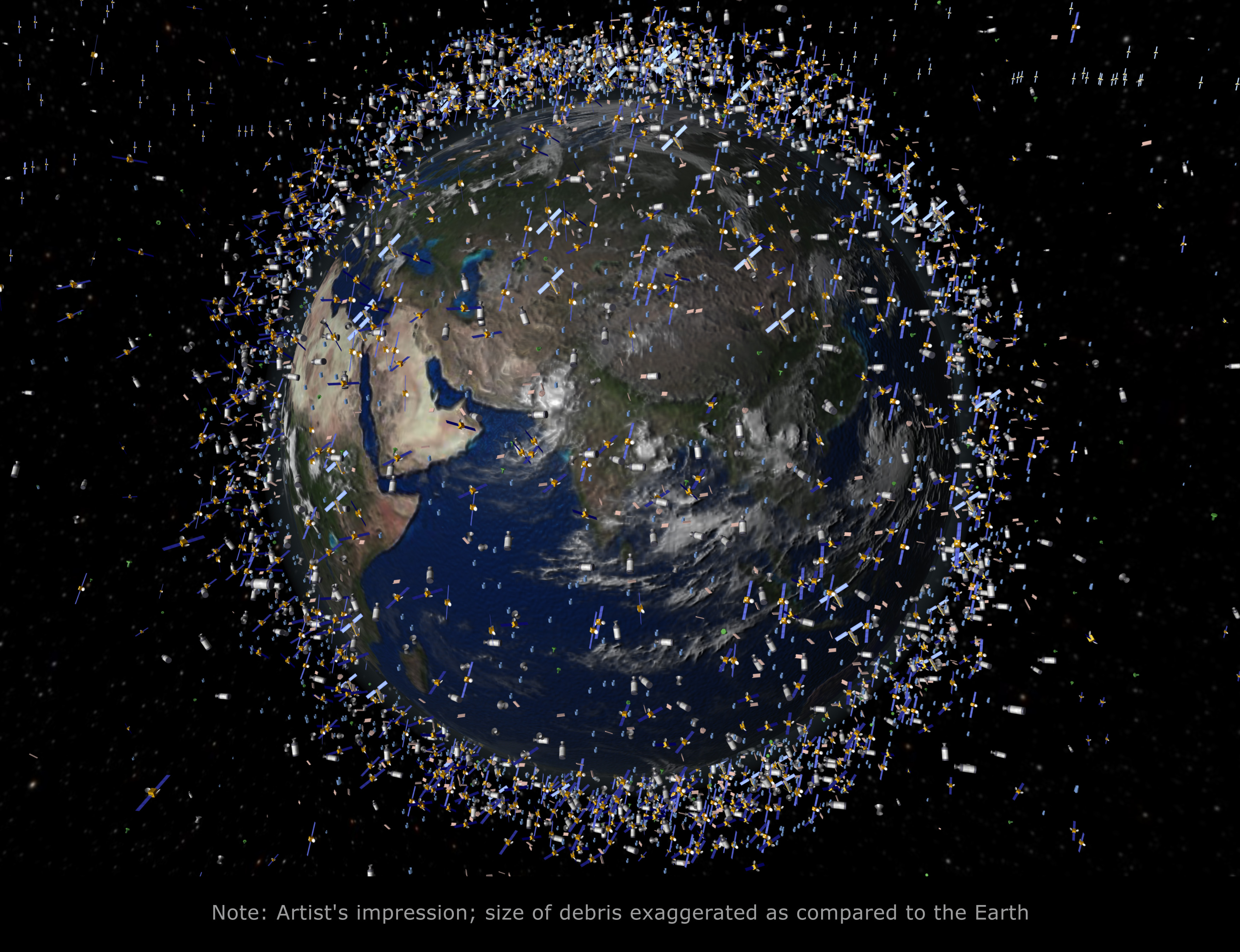
Image courtesy of ESA
Note: The debris field shown in the image is an artist’s impression based on actual data. However, the debris objects are shown at an exaggerated size to make them visible at the scale shown
We’re all about satellite launches this week. Looking at the latest launches from China, Starlink and Rocket Lab, and more excitingly the attempted mid-air catch by a helicopter of the booster from the Rocket lab launch vehicle!
Rocket Lab
On the 2nd May, Rocket Lab launched 34 satellites into orbit using its Electron launch vehicle. The more exciting part of this launch was actually when part of the Electron launch vehicle, a booster, returned to Earth and was caught in mid-air by a helicopter! Yes, you read that right! A helicopter deployed a hook on a long line and used that to capture the parachute line of the booster rocket. Now admittedly, 20 seconds after capture the helicopter had to let the booster go again as the weight was beyond what they were expecting. The booster continued to descend by parachute onto the Pacific Ocean where it was collected by a boat. Even so, capturing it by helicopter was still pretty stunning!
The mission itself was called ‘There and Back Again’ in honour of The Hobbit as Rocket Lab always give their missions quirky titles. There were some Earth Observation missions on the launch, and all 34 cubesats were:
- Unicorn 2A satellite for the Scottish company Alba Orbital. It is a technology demonstrator picosatellite that will perform optical night-time imaging to monitor light pollution.
- 3 satellites for the US company ACME AtronOmatic (MyRadar). The MyRadar 1, TRSI-2 and TRIS-3 will together test hardware for their Hyperspectral Orbital Remote Imaging Spectrometer (HORIS) constellation.
- 3 satellites for E-Space. These were three demonstration satellites to validate the technology for this Rwandan company’s sustainable satellite system, which is planned to have a stunning and worrying 100,000 satellites!
- BRO 6 (Breizh Reconnaissance Orbiter) for the French company, UnseenLabs. It is the seventh satellite in a constellation focused on maritime surveillance to support the geolocation of vessels at sea to track illegal fishing and environmental activity. It is expected to become a 20 strong constellation.
- Aurora Sat 1 is a technology demonstrator satellite for Finish company Aurora Propusion Technologies. It is focused on sustainable space use, and has two payloads: ARM-A, the small water thruster for satellite manoeuvring; and APB which is a plasma brake to enable deorbiting to occur effectively without using any fuel.
- 24 satellites for the US Company Swarm Technologies. There were 16 SpaceBEE satellites, and 8 SpaceBEENZ, joining their existing constellation.
- Copiafor a New Zealand company, Astrix Astronautics, which tested an inflatable solar array that was unfolded after the satellites have been deployed.
China’s Satellite Launches
China launched eight Earth Observation (EO) satellites on Wednesday 4th May from the Taiyuan Satellite Launch Centre aboard the Long March 2D rocket. These satellites were more commercial satellites for the Chang Guang Satellite Technology company and comprised of:
- Seven Jilin-1 Gaofen 03D satellites with the numbers 27 to 33. These are optical satellites with a spatial resolution of 3 metres in multispectral mode and 0.75 metres in panchromatic mode, with a swath width of 17 km, and
- A Jilin-1 Kuanfu 01C satellite, also known as the Jilin-1 Wideband 01. It is an ocean satellite using the Global Navigation Satellite System reflectometry (GNSS-R) technique with the L-Band signal. The satellite is believed to have a 2 metre spatial resolution in multispectral mode, and will have a swath width of 136 km. It will provide data such as mean sea surface height, wave height, sea ice formation, sea surface wind field and sea salinity.
The Chang Guang Satellite Technology company is one of the leading Chinese companies in the commercial space sector and it’s based in Changchun, which is the capital of Jilin province, after which its constellation is named. Currently, it has over 50 satellites in orbit and claims it can revisit the same point on the planet at least seventeen times every day. Its ambition is create a 138 strong constellation with a revisit resolution of only 10 minutes by 2030.
SpaceX Starlink Launches
The latest SpaceX launch of Starlink satellites took place on Friday 6th May, with 53 satellites put into orbit from the Kennedy Space Centre in Florida by the Falcon 9 rocket. This followed another 53 that were launched a week earlier on Friday 29th April, and another 53 which were launched just over a week before that on the 21st April.
So far this year, 98 Starlink satellites were launched in January, 145 in February, 148 in March, 106 in April and now 53 in May so far, making a total of 550 satellites launched in 2022. Although these are cubesats, to give a little context, there are only four years in human history that more than 550 satellites have been launched in a single year. Those are the last four years (including 2022), meaning a single company has launched more satellites in the first four and half months of this year than the whole world managed in 61 one of the 65 years of space flight since 1957!
The Starlink constellation is in excess of 2,200 satellites already and there are plenty more launches planned for the rest of this year.
These latest launches all show that the space industry is going forward at a pace, driven by the small satellite constellation operators. The question is can the planet support constellations of tens or even hundreds of thousands of satellites, however small they may be.
