

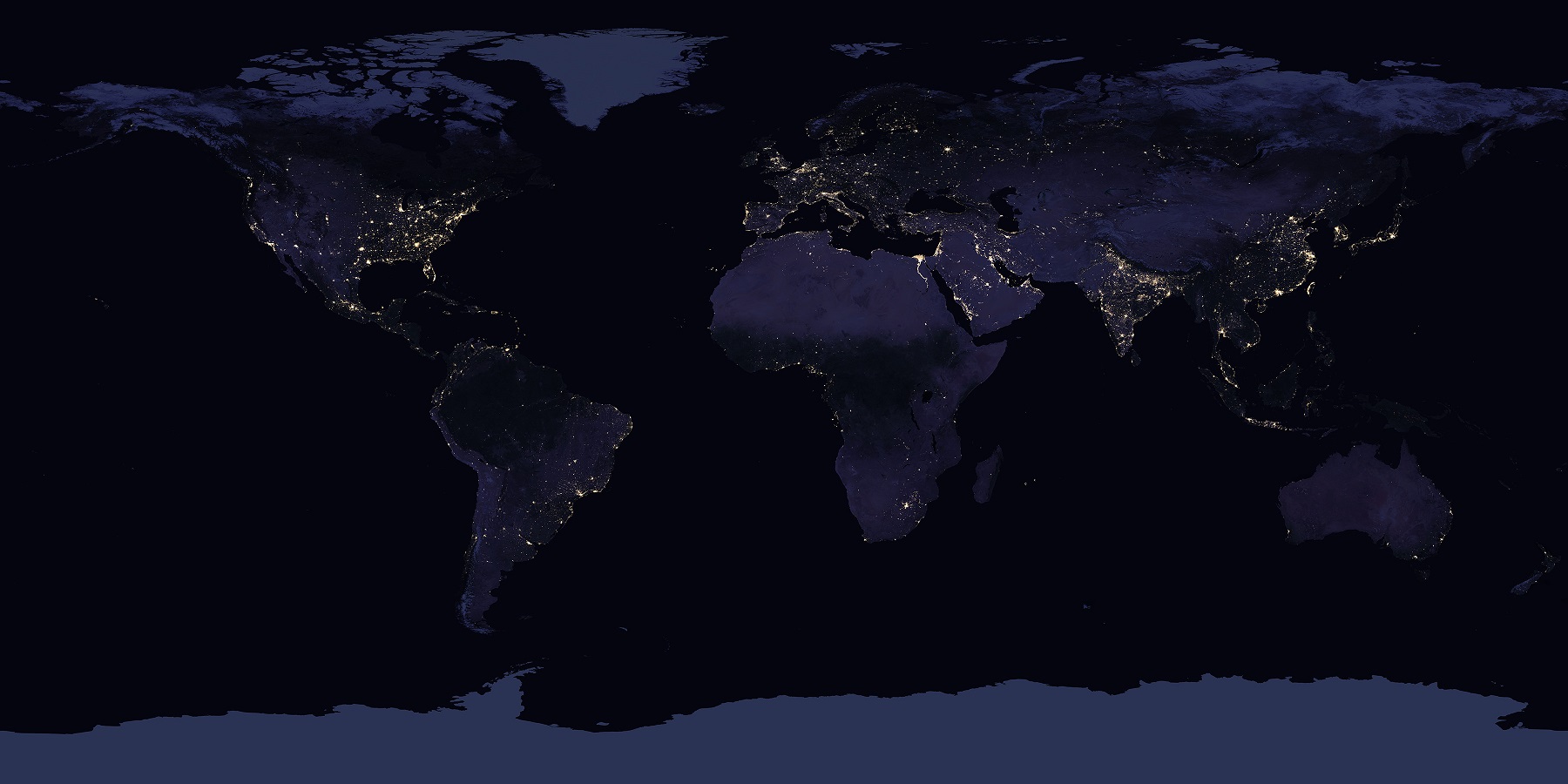
Flat composite global map created from data acquired by VIIRS in 2016. Image courtesy of NASA/NASA’s Earth Observatory.
Last month, the United States’ Federal Communications Commission (FCC) approved the launch of a new satellite. However, this approval has provoked discussion and controversy within the space sector.
The approval is for the Earendil 1 satellite, for the American company Reflect Orbital, which will be put into orbit at an altitude of 510 kilometres, plus or minus 20 kilometres. However, this will not be a traditional satellite; instead, it will be an 18-metre-wide space mirror that is designed to reflect sunlight to Earth’s darker side. The sunlight will be reflected to specified points on the Earth’s surface with a 5-kilometre-wide resolution, aimed at making better use of renewable solar power without needing to install thousands of new solar farms.
While the FCC approval offers a two-year window for testing and demonstration of the satellite, ultimately the company has ambitions to launch a 50 000 satellite constellation of these mirrors.
Reflect Orbital have highlighted that the world has an energy problem, and this is simply one opportunity to increase the capacity of renewable energy without needing to install thousands of new solar farms. The concept will aim to extend the operating hours of solar farms and other solar-based commercial applications, and while they acknowledge it is not a silver bullet for energy, it can be part of the overall solution. The energy requirements of data centres and artificial intelligence are well known, and we recently wrote of the ambitions of SpaceX to have data centres in space to utilise solar power. However, the Reflect Orbital decision to beam the sunlight back to Earth is, unsurprisingly, not without its critics.
A series of potential concerns and issues have been raised. These include:
- Detrimental impact to astronomers and astronomical research as the reflecting light would increase the sky’s brightness and reduce what can be seen. Some reports suggest it will affect observations of faint celestial objects and could even make stars invisible for those in urban illuminated areas.
- The reflected light will disrupt the natural darkness of the night sky, which could disrupt circadian rhythms of plants, animals and humans.
- Sensitive detectors in research telescopes, as well as star-tracking cameras on lower-altitude satellites, could become overloaded.
- The light would be reflected beyond the intended illumination area, creating a halo around the reflected beam.
- Depending on the sites chosen to receive the reflected light, it could impact human activity and lives by effectively introducing artificial daylight into the area.
- Flashes during mirror repointing could disrupt pilots and drivers.
- Warnings on telescopes for amateur astronomers may have to be extended to not looking directly at the Sun, nor the Reflect Orbital satellites, as both could cause eye damage.
In response, Reflect Orbital have noted that this test satellite is about proving that the reflected sunlight can be controlled precisely, used only where appropriate, limited in brightness and duration, and coordinated with affected communities and scientific institutions.
Summary
Although this is a single licence for a single satellite, it is certainly opening up a new use of space. The question of who controls space is once again up for debate, as once this satellite is in orbit, it could impact significant areas across the globe. It begs the question as to whether the current system of individual country-based satellite approvals is fit for purpose for these new types of satellites. This will certainly be one to keep an eye on.
