

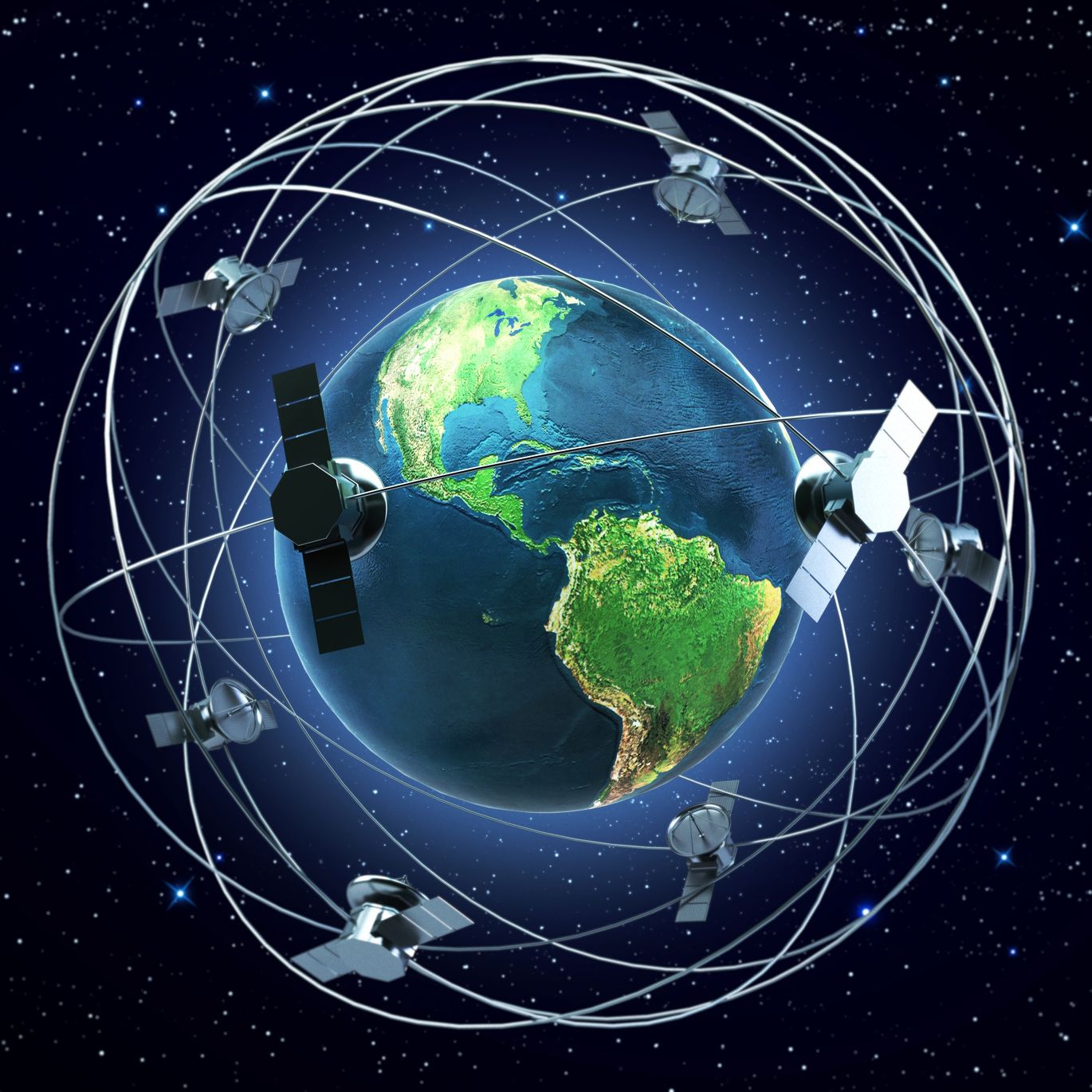
Artist’s rendition of satellites orbiting the Earth – rottenman/123RF Stock Photo
We regularly blog about the number of satellites in orbit around the Earth, and how much this has increased over the years. Our 2025 version described that around 15,000 satellites were in orbit from the almost 21,000 objects that had ever being launched into space, and that over half of these had been launched in the previous five years.
We’ve also previous written about the potential number of authorised satellites in internet broadband constellations, for example:
- SpaceX has a licence to launch 42,000 Starlink satellites
- Project Kuiper, Amazon’s broadband satellite internet project, has licence for over 3,000 satellites.
- GuoWang, China’s satellite broadband constellation, has an ambition of a 13,000 satellites constellation.
However, these numbers could be hugely eclipsed by future constellations to support artificial intelligence data centres according to two recent filings to the US Federal Communications Commission.
Space Exploration Holdings
Space Exploration Holdings, a wholly owned subsidiary of SpaceX, last week applied for a licence to launch 100,000 Starlink Gen3 satellites to deliver multi-gigabit satellite broadband with low latency for the whole globe. The application describes the public interest benefits of this constellation which are to ensure that everyone can benefit from Artificial Intelligence (AI) enabled services highlighting particularly polar research stations, communities deep in rainforests, and isolated islands. The application also notes that Gen3 will enable the United States to maintain leadership in space, spectrum, robotics, and AI.
It describes that 100,000 satellites will be deployed in two thin orbit bands with nominal altitudes between 323 and 327.5 kilometres and 473 and 477.5 kilometres. This constellation is linked to SpaceX’s Starmind project which aims to launch up to 1 million satellites to act as data centres for AI.
Orbital Compute Inc
Last month Orbital Compute requested a licence to launch a 100,000 strong satellite constellation to create the Orbital Datacenter System, where each satellite would operate as a node in a distributed computer network to provide orbiting AI computing power.
Orbital’s plans to have each satellite functioning as a single high-density rack, equivalent, it says, to about eight servers, with each satellite having its own solar arrays. The satellites would be deployed into sun-synchronous circular orbits at altitudes between 500 kilometres and 850 kilometres.
The company estimates that this will provide 10 gigawatts of computing power using the power of the sun. Orbital has an ambition to launch a prototype payload of a single Nvidia GPU next year via SpaceX. The first data centre, currently known as Orbital-1, is hoped to be in orbit during 2028.
Conclusion
Could these two applications be part of the next generation of space usage? It should be noted that they will not be alone as Jeff Bezos’ Blue Origin company is also developing plans to build an orbital data centres constellation.
As Euywn Poon, founder and CEO of Orbital Compute, notes that the demand for AI is outrunning what can be supplied on Earth. The issues with developing data centres on Earth have been highlighted recently in Devon where we are based, where plans for an 850-acre site for a data centre and solar farm generating a lot of local opposition in terms of water usage for cooling, electricity generation, heat, noise, etc. Similar concerns are facing data centres around the world, and so could space provide an alternative?
Euwyn Poon has highlighted that space can solve the three key issues for data centres, with sunlight providing the power, space providing the cooling, and no local communities to object. While all of this could well be true, what about the impact of having thousands of satellites in space? Everything from light pollution, space debris, to the potential Kessler Syndrome making parts of space impassable could be issues.
According to the apocryphal phase about living in interesting times and the coming years for the space sector look certain to be interesting!
