

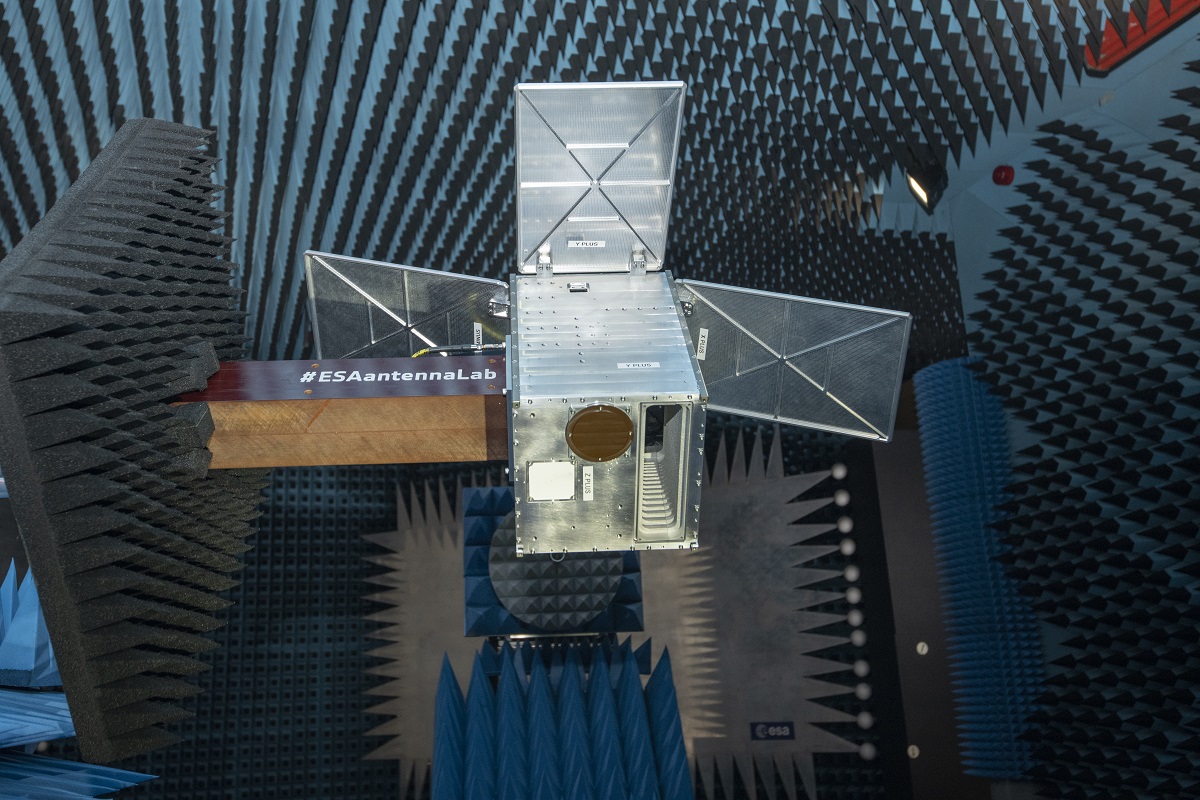
Satellite mockup of ESA’s Proba-V Companion CubeSat. Image courtesy of ESA-P. de Maagt
Focusing on two interesting satellite launches this week, the first is the start of another satellite internet broadband constellation, but this time for Amazon. The second is a rideshare mission, which has a number of interesting Earth Observation (EO) missions.
Satellite Internet Broadband
The first interesting launch is due to take place on Friday, 6th October, when a United Launch Alliance Atlas V 501 rocket will lift off from Cape Canaveral Space Force Station in Florida. The payload, will be the first two prototype satellites for Amazon’s satellite broadband constellation, Project Kuiper.
There have been several delays to this project, but this week should see KuiperSat 1 and 2 go into a 590 kilometre orbit. The satellites feature a Ka-band prototype broadband payload and will test the technology for the future constellation.
Project Kuiper is due to provide more competition in the internet broadband market, with SpaceX’s Starlink constellation currently the dominant player. If these prototypes are successful, this launch will start another large number of satellite launches as Project Kuiper has plans for a constellation of 3,236 satellites.
Satellite Rideshare Mission
The second notable launch, due this week, will take off from Centre Spatial Guyanais (CSG) at Kourou in French Guiana, when Europe’s VEGA rocket is hoping to take a rideshare mission into orbit on the 7th October. The launch has a number of Earth Observation satellites and cubesats onboard:
- PROBA-V-CC (Project for On-Board Autonomy – Vegetation – Companion CubeSat) is a mission that will fly a scaled-down single telescope version of the Vegetation Imager instrument aboard the Earth-observing PROBA-V, which was launched in May 2013. The aim will be for PROBA-V-CC to achieve a spatial resolution of 80 metres, with a swath width of 80 – 100 kilometres. It was planned for PROBA-V and PROBA-V-CC to joint measurements to evaluate how the instrument performs on a smaller and less expensive platform, unfortunately launch delays prevent this; instead, cross-calibration experiments will be undertaken with Sentinel-2 and Sentinel-3. This is of particular interest for us at Pixalytics, as we have done a lot of work over the years with the PROBA-1 satellite and we are excited to see how the cubesat performs.
- THEOS-2 is Thailand’s second EO satellite, and will be operated by the state owned Geo-Informatics and Space Technology Development Agency. THEOS-2 is a high-resolution optical satellite with a spatial resolution down to 50 centimetres and it is due to go into a 621 kilometre sun-synchronous orbit. It will have a swath width of 10.3 kilometres, and it is expected to acquire images covering around 74,000 kilometres every day, returning to the same location on the Earth every 26 days. The data from this satellite will be used for applications such as agriculture for classifying crop types, monitoring plant health, and predicting yields; water quality monitoring and resource management; disaster planning, response and recovery; urban planning including managing national infrastructure; and natural resources management including monitoring forests and tracking carbon emissions management.
- FORMOSAT-7R, also known as TRITON, is a cubesat for the Taiwan Space Agency (TASA) will that join the existing joint Taiwanese-US FORMOSAT 7 / COSMIC-2constellation collecting atmospheric data. It carries a Global Navigation Satellite System (GNSS)-Reflectometry instrument, collecting data that can be used to calculate the wind speed over sea surface, and helping improve the prediction of typhoons.
- PRETTY (Passive REflecTomeTry and dosimetrY) is also a cubesat using a GNSS Reflectometry instrument. It is for Graz University of Technology of Austria, and will measure the ice and sea ice surface elevation and roughness in the Polar Regions.
- ANSER LEADER/FOLLOWER 1/2 (Advanced Nanosatellite Systems for Earth observation Research) is a cluster of 3 cubesats with panchromatic and hyperspectral cameras for Spain’s INTA for monitoring the quality of inland (reservoirs) water over the Iberian Peninsula.
In addition to these EO satellites, also on the rideshare mission are:
- MACSAT cubesat is a IoT communication over 5G demonstrator mission for the Luxembourg company, OQ Technology.
- CSC-1 and 2 contains 7 different experimental payloads from various institutions being flown for the Dutch company ISISPACE.
- N3SS (Nanosat 3U pour la Surveillance du Spectre) is a demonstrator for detecting and localize radio-frequency jammers on civil spectrum for the French space agency Centre national d’études spatiales.
- ESTCUBE-2 is a technology demonstrator mission with multiple scientific payloads for University of Tartu of Estonia.
Summary
New satellite launches continue, and while from an EO viewpoint it is great to get more novel missions and new data, it is the Amazon launches which could have the greatest impact on numbers over the coming years. It will be interesting to see if they can really become a competitor to SpaceX.
