

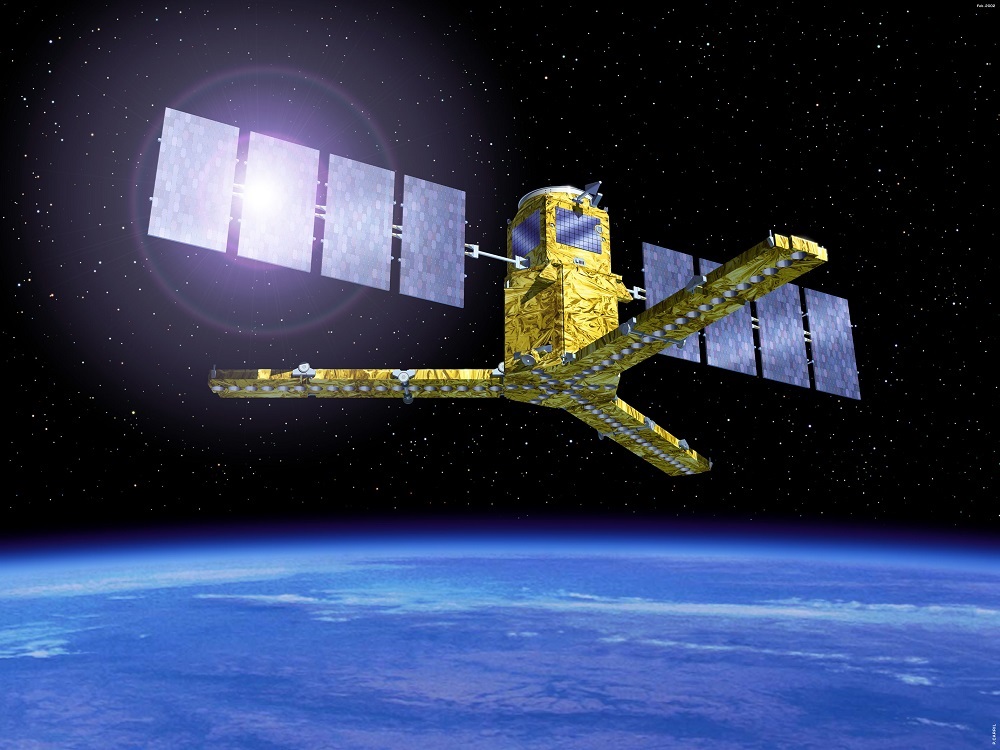
Artists impression of the Soil Moisture and Ocean Salinity (SMOS) satellite. Image courtesy of ESA – P. Carril.
An interesting new research paper, published in Nature Geoscience, has used satellite data to determine that young trees are actually more effective at capturing and storing carbon dioxide than older ones.
Researchers used data from European Space Agency’s Earth Explorer Soil Moisture and Ocean Salinity (SMOS) satellite to generate global maps of annual live vegetation biomass to measure how terrestrial carbon stocks have changed at regional & global scales. The paper by Yang & Ciais et al is titled ‘Global increase in biomass carbon stock dominated by growth of northern young forests over past decade’ and was led by researchers at the French Laboratoire des Sciences du Climat et de l’Environnement (LSCE). It found terrestrial carbon stocks increased by an average of 510 million tonnes of carbon per year during 2010–2019.
SMOS was launched on the 2nd November 2009, and placed into a sun-synchronous polar orbit at around 750 km above the Earth. It carries the Microwave Imaging Radiometer using Aperture Synthesis (MIRAS) instrument, which is a 2D interferometric L-band radiometer with 69 antenna receivers distributed on a Y-shaped deployable antenna array. The team were able measure vegetation biomass using L-band microwave vegetation optical depth.
While the research closely mirrored the observations of the global atmospheric carbon dioxide growth rate, however, it was their findings about forests that were interesting.
Forests have long been recognised as a key tool in the fight against climate change. However, this research found that the tropical deforested and degraded old-growth forests, over 140 years old, are nearly carbon neutral. While temperate and boreal young forests, under 50 years old, and middle-aged forests, between 50 and 140 years old, are the largest sinks – meaning they absorb more carbon from the atmosphere than they release. This is surprising as the general thinking, used in most global vegetation models, is that all old-growth forests are large sinks.
These findings give weight to the thought that we should be planting more trees and forests. Saplings that are planted now can make a significant contribution towards achieving the Paris Agreement net zero goals by 2050.
It also potentially brings into question the way forests are currently managed form a climate perspective, as often it is the younger trees that are harvested and the older trees preserved. Of course, this shouldn’t mean we should chop down all the ancient trees and forests as will they may not have the carbon sink role previously thought they are still amazing ecosystems. However, it does mean that younger forests need to be given more time on the planet before they are cut down, and timber companies need to have a look at their business model and processes from a climate perspective.
This work demonstrates how satellite data can provide new insights into the way our planet works, often turning conventional thinking on its head.
