

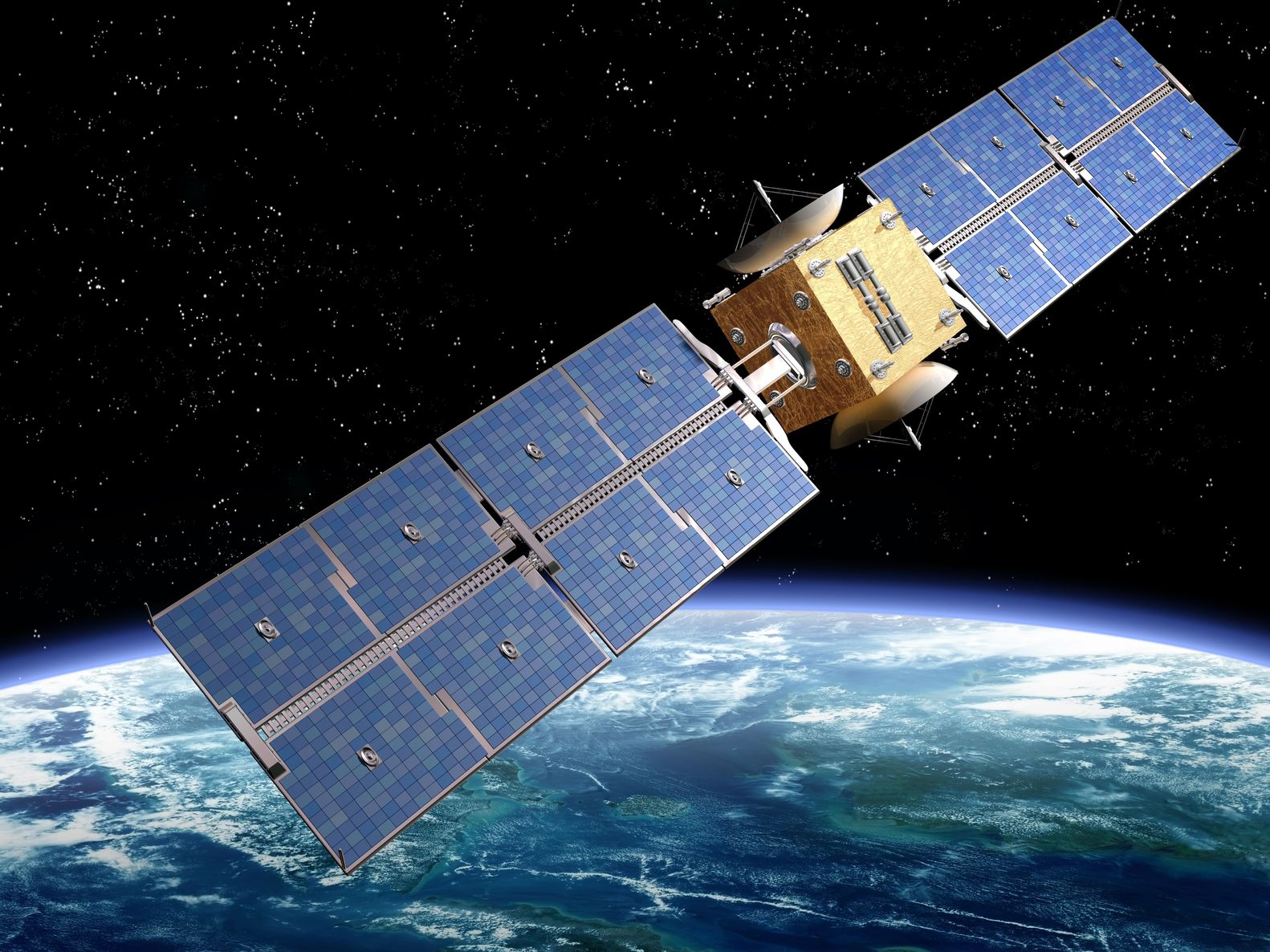
Artist’s rendition of a satellite – paulfleet/123RF Stock Photo
Last week the European Union (EU) and European Space Agency (ESA) signed a new Financial Framework Partnership Agreement (FFPA) that marks the start of a new EU space programme covering the period to 2027. The programme includes investment in space activities in Europe satellite-navigation, Earth observation, space situational awareness and secure communications. The FFPA indicates that the EU will transfer approximately €9bn directly to ESA between now and 2027 – which equates to around 25% of all ESA activities.
It also establishes a new organisation, the European Union Agency for the Space programme (Euspa) whose mission is to be the user-oriented operational agency of the EU Space Programme, contributing to sustainable growth, security and safety of the EU. It will be interesting to see how this new organisation works with the EU and ESA, and how it impacts the relationship. Of course, as the UK is no longer part of the EU, we are not part of Euspa. However, the agreement includes options for the UK and other non-EU members, such as Norway and Switzerland, to participate in some of the programmes. The UK only agreed to this after two specific points were confirmed:
- UK nationals cannot be prevented from working on EU-funded projects at the agency, except where the work relates to the most sensitive security aspects of those projects – essentially echoing the principles of how Galileo operates for the UK.
- If the EU wants control over intellectual property (IP) developed through Research & Development (R&D) work, it must state its intention at the outset of an ESA project, as the UK didn’t want to fund innovations it was prevented from exploiting. This will be interesting to see this practically in contracts as, in our experience, in ESA R&D contracts ESA want the rights to use any IP developed, but it also allows the company developing the IP to own and use it.
A further interesting point to note were comments made by the EUs Internal Market Commissioner Thierry Breton at the launch event, where he indicated that they were looking at a new constellation to address the issue of high speed broadband dead zones – both in Europe and in Africa. Although, no funding agreed, the Commissioner has already commissioned a feasibility study to assess options for space-based broadband to rival those such as the UK’s OneWeb or SpaceX’s Starlink constellation, and was looking to have more work done on the potential options later this year.
Turning to SpaceX, this week it’s hoping to launch its Falcon-2 rocket on its Transporter 2 mission carrying 88 satellites into space; this follows its record breaking Transporter 1 mission in January where it launched 143 small satellites. The launch was due to take place on Tuesday 29th June, but was stopped with thirty seconds to go due to an aircraft within the site’s restricted airspace. There are hoping to launch later this week.
Of the satellites due to be launched on this mission, 85 are part of Space-X’s Small Sat Rideshare scheme and the remaining 3 are Starlink satellites. Within the rideshare scheme there are some interesting Earth Observation satellites being launched, including:
- Four Argentinian ÑuSat optical satellites with both visible and infrared spectral bands, operating with a spatial resolution of 1 m. The satellites are developed and operated by Satellogic, and will form part of the Aleph-1
- Synthetic Aperture Radar (SAR) satellites feature regularly in the launch with:
- Four more ICEYE X-band SAR satellites.
- UmbraSAR is also carrying an X-band instrument with a spatial resolution of 25 cm and swath width of 16 sq km.
- Capella 5 is the fifth SAR satellite in its constellation, planned to number 30 in total. Another X-band SAR, offering a spatial resolution of less than half a metre.
- TUBIN is a nanosatellite project of the Technical University of Berlin to observe the Earth in the infrared.
- Two Spire LEMUR-2 satellites which are used meteorology and ship traffic tracking
Finally, unlike Falcon-2, the Russian Progress cargo ship did launch on Tuesday from the Baikonur Cosmodrome in Kazakhstan heading to the International Space Station with cargo and supplies for the astronauts.
