

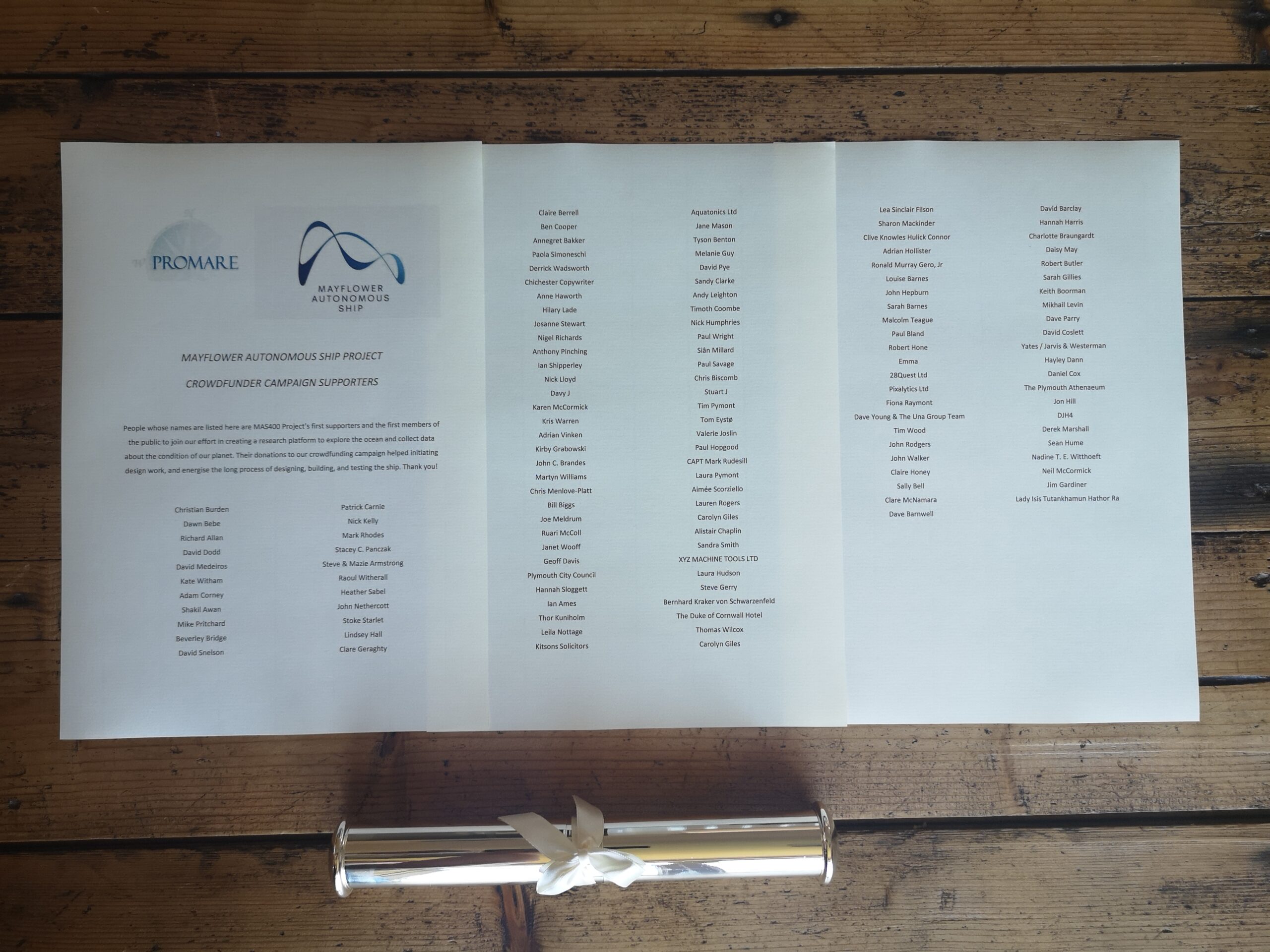
MAS Roll of Supporters. Image Courtesy of Mayflower Autonomous Ship Project.
Pixalytics is based in Plymouth and 2020 was expected to be a big year for the city as it was four hundred years since the Pilgrim Father’s left Plymouth in the Mayflower to sail across the Atlantic to America. There were lots of events and celebrations planned … but, the global pandemic had other ideas and a lot of these events were cancelled and postponed.
Some events are taking place this year including the Marine Tech Expo, which we’re speaking at – but more on that in coming weeks – and another is the maiden voyage of the Mayflower Autonomous Ship (MAS). This is an unmanned ship which is planning to leave Plymouth and sail across the Atlantic to Plymouth, Massachusetts, a journey of around 3500 miles, navigating by Artificial Intelligence (AI) and powered by the sun.
The idea for the MAS came from ProMare’s co-Founder Brett Phaneuf who put forward the idea of recreating the original Mayflower crossing with modern technology and collect data on the journey. An initial crowd funding took place, and we were in the first group to provide support for this ambitious project.
People who’ve followed our journey over the years will know that we love an usual marketing opportunity; we’ve sponsored two Formula One cars in F1’s Abu Dhabi Grand Prix in 2014, and went to the edge of space (at least we think we did) in 2017. So the opportunity to go across the ocean in an autonomous vessel was something we jumped on! You can see our details midway down on the fifth column of supporters above.
MAS is a trimaran and took four years to build through a project led by ProMare working with computing giant IBM, and Plymouth firms M Subs and Marine AI, and cost £1 million. At 15 m in length, it’s the largest unmanned vessel built to date. It weighs five tons and has a maximum speed of 10 knots. Alongside its solar-driven hybrid electric motor, it is powered by various IBM hardware and software. It has six AI cameras on board and more than fifty sensors. The scientific instruments on board are:
- A fluorometer for fluorescence monitoring supporting the detection of phytoplankton.
- A robotic, multi-bottle water sampling array that will be used to take water samples for later analysis of micro-plastics, plankton, etc.
- RS Aqua PORPOISE underwater noise recorder and digital hydrophone.
- Oceanographic sensors to measure water salinity, temperature and oxygen levels.
- High precision Global Navigation Satellite System (GNSS) and accelerometer measurements will be used to measure the sea level and wave energy in the open ocean.
- HD video of the waves will be combined with accelerometers to calculate the energy of waves in real time.
- HyperTaste technology is an electronic, AI-assisted ‘tongue’ developed by IBM Research which enables rapid, AI-assisted chemical characterization of ocean’s water.
As part of our reward for the crowdfunding Pixalytics’ name is on a list of campaign supporters that will be carried inside the vessel during the crossing!
The first attempt at the voyage took place on the 15th June, but unfortunately a few hours in a mechanical issue on the boat meant it returned to Plymouth. The team felt it was prudent to return to shore and sort this issue out before trying again!
The IBM Image Gallery has some fantastic shots of the MAS, and you can keep track of the voyage through a dashboard on their website, which includes live webcams, location data and various sailing indicators.
It is hoped that this voyage will lead to more autonomous vessels, and we’re delighted that we were a tiny part it and can’t wait for the team to try again later this summer.
