

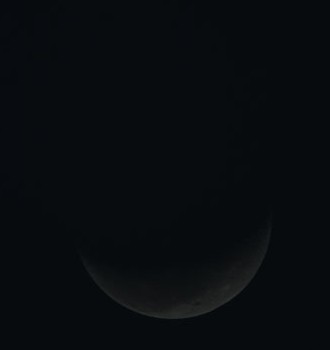
Faint last quarter crescent moon taken by astronauts on the International Space Station on 03/09/2010. Image credit: Earth Science and Remote Sensing Unit, NASA Johnson Space Center
Reports on work regarding the calibration and validation of Earth Observation (EO) sensors caught our attention this week – in terms of using moonlight and collaboration. In addition, we look at the latest EO satellite launch – or at least what is believed to be an EO satellite!
Calibration by Moonlight
NASA has recently completed a three-week high-altitude campaign using its Airborne Lunar Spectral Irradiance instrument, also known as air-LUSI, measuring the Moon’s brightness to help improve the calibration and validation of satellite sensors. The air-LUSI was flown on the ER-2 aircraft at approximately 70,000 feet over the West Coast of the United States, collecting measurements of lunar light.
The campaign is part of efforts to improve the accuracy of Earth Observation satellites by using the Moon as a stable natural calibration source. As the Moon’s surface reflects light consistently, and is unaffected by Earth’s changing environment and season variations, moonlight is a good reference point for calibration.
As sensor performance degrades over time once satellites are in space, they are often recalibrated to ensure that the long-term datasets remain accurate and comparable. Using lunar spectral irradiance or the amount of light reflected by the Moon across different wavelengths, it is possible to determine whether sensors are drifting from their original calibration and where needed make corrections.
The air-LUSI is a collaboration between NASA, the National Institute of Standards and Technology, the U.S. Geological Survey, the University of Maryland, Baltimore County, and McMaster University in Ontario, and the team have been running campaigns to measure moonlight since 2022.
ISRO & ESA Calibration and Validation Collaboration
Continuing the calibration theme, the Indian Space Research Organisation (ISRO) and the European Space Agency (ESA) signed a joint agreement on the 4th March for the ‘ESA-ISRO Arrangement concerning Joint Calibration and Validation Activities and Scientific Studies for Earth Observation Missions’.
This continues long-standing co-operation between the two space agencies, which began in 1978 and highlights the importance of collaboration in terms of EO missions.
Rocket Labs Latest EO Satellite Launch – we think!
Rocket Lab launched a satellite from its Electron rocket on March 5th from their Launch Complex 1 in New Zealand. The mission called ‘Insight At Speed Is A Friend Indeed’ was only confirmed five hours prior to launch, and had a payload of a single satellite for an unnamed customer.
The satellite was successfully placed into a 470-kilometre orbit, and reports suggest the satellite was likely to be for BlackSky, although this is unconfirmed. Part of the thinking for this is that last November a similar mission took off, after being confirmed a few hours before launch, and five days later BlackSky confirmed it was their Gen-3 satellite.
Summary
The EO sector encompasses a range of industries and skills and individuals, companies and space agencies often need to work together and collaborate. The stories this week show how different forms collaboration can take, but all are critical to success.
