


Artist’s impression of the EarthCARE satellite in orbit. Image: ©ESA/ATG medialab
The Earth Cloud Aerosol and Radiation Explorer (EarthCARE) satellite is scheduled to be launched next week. This is joint European/Japanese mission involving European Space Agency (ESA), Japan Aerospace Exploration Agency (JAXA), & Japan’s National Institute of Information and Communications Technology (NICT). It is one of the largest and complex missions within ESA’s Earth Explorer programme, and there are 23 UK contributors to various aspects of the mission.
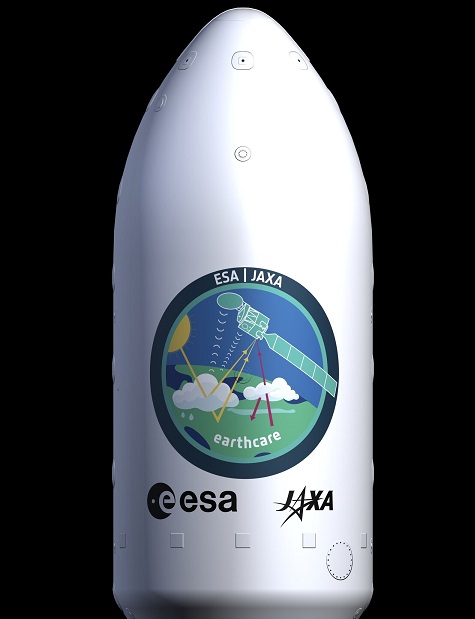
Artist’s view of the EarthCARE sticker on SpaceX Falcon 9 rocket. Image: ©ESA – P. Carril
The satellite is scheduled to be launched on SpaceX’s Falcon 9 from the Vandenberg Space Force Base in Santa Barbara County, California, with the launch is currently scheduled for Tuesday 28 May 2024 at 23:20 British Summer Time. The satellite is expected to go into a sun-synchronous orbit at 393 kilometres altitude.
The main goal of the mission is observing and characterizing the clouds and aerosols in the atmosphere, together with measuring the reflected solar radiation and the infrared radiation emitted from Earth’s surface and atmosphere. Although clouds are a key component of the earth’s climate, how they are formed, their behaviour, and their interaction with the radiation aren’t fully understood. The data from the mission is expected to help scientists improve their climate and numerical models, to better understand climate change and rising temperatures.
EarthCARE Instruments
The satellite is equipped with four instruments:
- ATmospheric LIDar (ATLID) – an advanced atmosphere lidar, it will provide profiles of aerosols, thin clouds and the top of thick clouds. It’s the second European spaceborne ultraviolet lidar after Aeolus. This information is crucial for improving climate models and understanding the role of aerosols and clouds in Earth’s energy balance.
- Cloud profiling radar (CPR) is an instrument measuring the inside of clouds, including their vertical structure and velocity, particle size distribution, and water content. It gives detailed information about weather systems’ structure. JAXA and NICT developed this radar. This radar is useful for studying cloud processes and contributes data for improving weather and climate models.
- Multispectral imager (MSI) – Developed by a UK company, Surrey Satellite Technology Limited (SSTL), this instrument captures relatively high-resolution images at 500 metre ground resolution with a 150 kilometre swath. It has seven channels: visible, near-infrared, two shortwave infrared and three thermal-infrared. It will provide details on the optical properties of clouds and aerosols. This will improve our understanding of the radiative impact of clouds and aerosols on Earth’s climate system.
- Broadband radiometer (BBR) – Developed by a UK consortium led by Thales Alenia Space, this instrument will measure the radiative fluxes at the top of Earth’s atmosphere, allowing the accurate quantification of the amount of reflected solar radiation and the outgoing thermal radiation emitted by Earth, known as the planet’s energy balance. This data will help improve understanding of the aerosol-cloud-radiation interaction.
Summary
This is an exciting Earth observation mission, and we’ll be watching the SpaceX launch feed next week. We’re looking forward to seeing and using the data that EarthCARE collects.
