

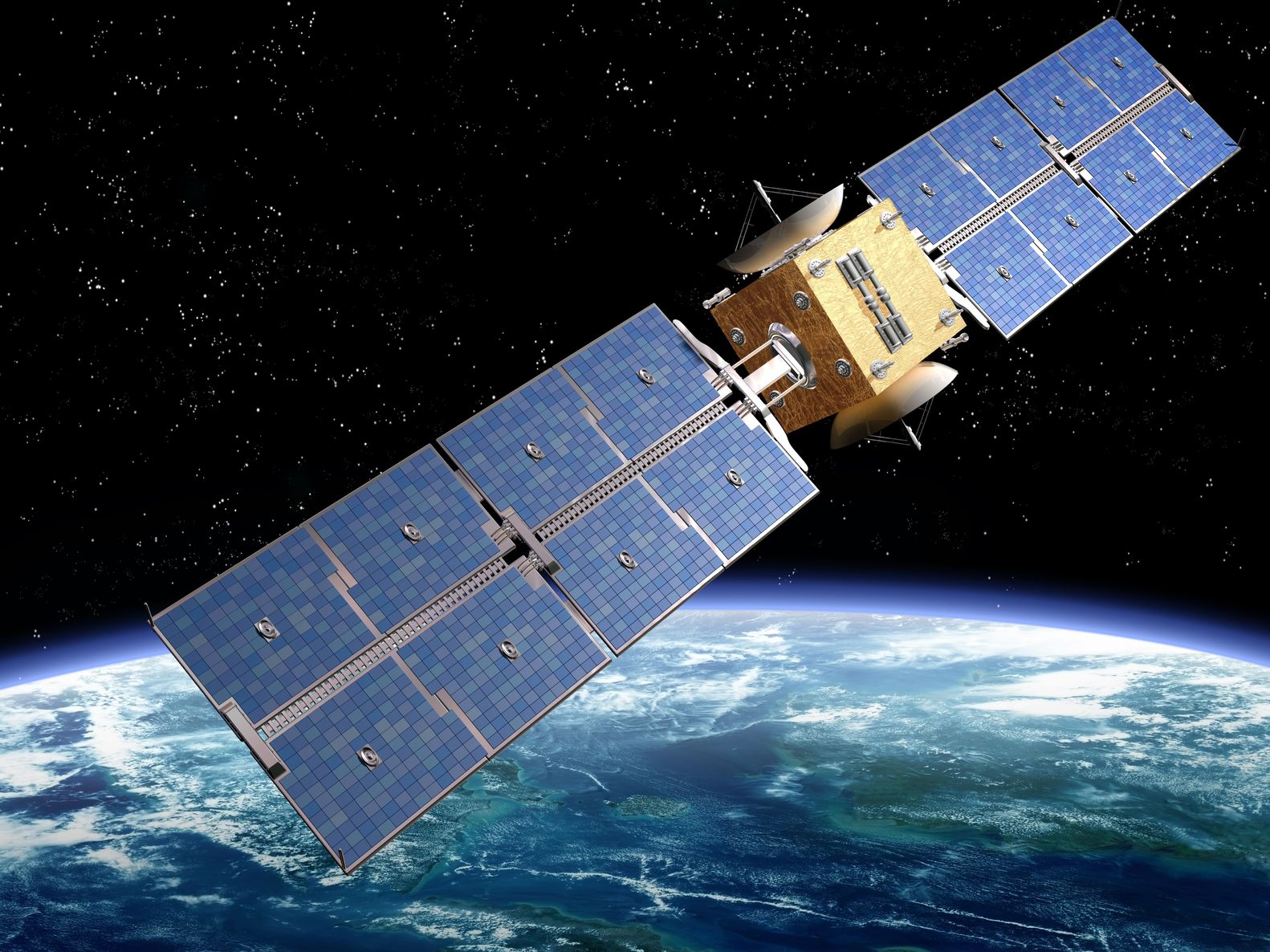
Artist’s rendition of a satellite – paulfleet/123RF Stock Photo
This week we’re catching up on some of the interesting satellite launches over the last month, as usual China has been very active, and, equally predictably, so have Starlink.
China Earth Observation Satellite Launches
The latest launch, on the 20th August, was a group of three Yaogan-35 EO satellites were launched by the Long March-2D rocket from the Xichang Satellite Launch Center. Two of the three, Yaogan 35-01A and Yaogan 35-01B were believed to be identical satellites, and the third, Yaogan 35-01B, is believed to be a different design. It’s reported the first two could be optical satellites, and the third a radar satellites. However, no official details on the instruments or specifications have been released. This was the fourth batch of these satellites, with another three launched in July, and pairs of the satellites launched in November 2021 and June 2022 respectively; the whole constellation is believed to have military purposes. Officially, they are described as collecting data for land resource surveys, agricultural product yield estimation, and disaster prevention and reduction.
On the 10th August a batch of 16 Jilin-1 EO satellites were put into 535 km sun-synchronous orbits by the Chang Zheng 6 rocket from the Taiyuan Satellite Launch Center. These will join existing the Jilin-1 constellation, which are commercial satellites designed and owned by Chang Guang Satellite Technology Co. The first 10 satellites were Jilin-1 Gaofen high-resolution optical imaging satellites. The remaining six were Hongwai satellites, also referred to as Jilin-1 IR satellites as they provide infrared imagery.
The day before on the 9th August saw a launch by the Chinese commercial launch provider, fantastically named Galactic Energy, saw three small satellites put into 500km sun-synchronous orbits by its Ceres-1 rocket. The payload was two commercial remote satellites from Minospace called Taijing-1 01 and Taijing-1 02, together with the Donghai-1 multi-mode remote sensing satellite developed by the Chinese company ASES Space. The purposes of these satellites was not released, however, the Ping An Insurance (Group) Company of China, Ltd, confirmed in a press release that Taijing-1 01, also known as PingAn-3, was its third satellite to go into orbit. It is a high-resolution optical imagine satellite and its data will be used to support the supply chain of financial services by Ping An Bank and the development of inclusive finance. The anticipated applications include monitoring the growth of crops in agriculture, monitoring solar panels for the energy sector and monitoring progress of construction projects.
The first week of the month, on the 4th August, had the launch of the Terrestrial Ecosystem Carbon Inventory Satellite (TECIS) on board the Long March-4B rocket into an approximate 500 km sun-synchronous orbit. The satellite carries 4 instruments: Multi-Beam LIDAR, Directional Multi-Spectral Camera, Directional Polarization Camera, and Chlorophyll Fluorescence Hyper-Spectral Monitor (SIFIS). It is intended to evaluate forest biomass, measure atmospheric aerosol content, and detect photosynthetic fluorescence. These measurements will contribute to efforts to combat global warming. Also onboard the launch was the commercial HEAD 2G satellite that tracks ships via Automated Identification System (AIS) data for HEAD Aerospace. Also, the Minhang Juvenile Star, also known as the Zero-Carbon Pioneer, which is an education satellite developed by school children in the Minhang District of Shanghai and will promote middle and primary school students’ participation in space-related science and engineering activities.
Iranian Earth Observation Satellite Launch
On the 9th August the Russian Soyuz 2.1b rocket put the Iranian Kayyam-1 satellite into a 500 km orbit. It is large EO satellite with a mass of 600 kg, and believed to be an optical satellite with a spatial resolution down to around 1m. The satellite is named after the Persian polymath, Omar Khayyam, who lived between 1048 and 1131 and made contributions to mathematics, astronomy, philosophy, and poetry. It is believed to be a satellite for the Iranian military, although the official details are that the data will be used for both government and civilian purposes.
Starlink Satellites
During August Starlink has launched:
- 52 satellites on the 10th August
- 46 satellites on the 12th August
- 53 satellites on the 19th August
- 53 satellites are planned for launch on the 28th August.
Assuming the final launch is successful this will be total of 204 satellites launched this month, following the 205 satellites launched in July. So far, Starlink has launched almost 1,200 satellites in this year alone!
Conclusion
For many people in the northern hemisphere, August is the month of sun and holidays to rest and recuperate for the coming autumn and winter. However, this isn’t the case for the global EO industry as this blog shows August has seen a lot more EO satellite launched!
