

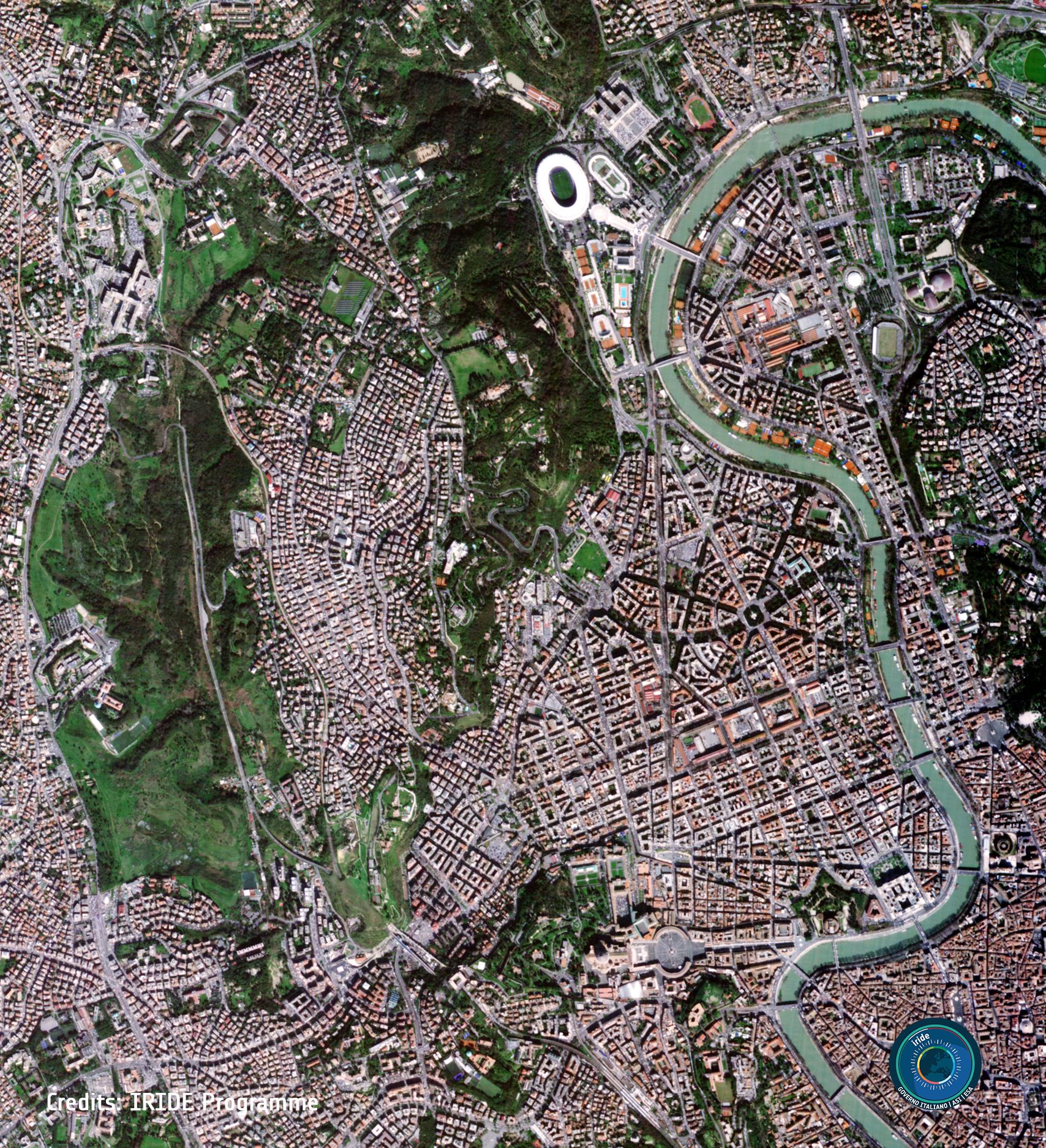
Centre of Rome, Italy. Image acquired on the 5th March 2025, by the first IRIDE satellite, the Pathfinder Hawk. Image courtesy and copyright, IRIDE and ESA.
Three news items caught our attention this week: a first light image from the Italian Earth Observation (EO) IRIDE satellite constellation, the birth of a new wildfire detection constellation, and a reduction in the number of weather balloon launches.
First Light Image
The first light image from a new Italian EO IRIDE satellite mission was issued last week, it is a high-resolution image of a strip of the Italian peninsular showing the city of Rome and is at the top of the blog. The image was acquired on the 5th March by a multispectral optical instrument on the first IRIDE microsatellite, Pathfinder Hawk, and has a spatial resolution of 2.66 metres.
The microsatellite was launched on 14 January 2025. The IRIDE constellation, coordinated by ESA with support from the Italian Space Agency, aims to complete the deployment of six satellite constellations, which could be up to 60 satellites. Further launches are planned for June and November this year, with the full constellation expected to be operational by June 2026.
The constellations are expected to provide data for monitoring air quality, land cover, mapping land motion, climate and water resources, together with emergency and security services for Italy.
Wildfire Satellites
Last week, the New Zealand based Rocket Lab successfully launched a constellation of eight microsatellites into 550 km sun-synchronous low Earth orbits with its Electron rocket. The mission named ‘Finding Hot Wildfires Near You’ was on behalf of the Germany-based company, OroraTech.
The satellites, known as OTC Phase 1 (OTC-P1) and then numbered 1 to 8, are based on a prototype satellite FOREST 3 that was launched on the 14th January this year. Each microsatellite carries a thermal imaging camera described as being able to help detect wildfires and hot spots as small as 10×10 metres. The company’s aim is to have a constellation in excess of 100 microsatellites, which could offer a 30 minute site revisit time providing real-time wildfire detection. Although, the thermal collection will be impacted by cloud cover.
Reduction in Weather Balloons
The United States National Weather Service, which is part of the National Oceanic and Atmospheric Administration, has announced it is reducing the number of weather balloons it launches. The service used to launch weather ballons twice a day, at 8 a.m. and 8 p.m., from 100 locations, to collect data on air temperature, wind, humidity, and pressure from the ground to approximately 100,000 feet. At this height, the balloons burst pop and the instrumentation comes back to Earth with a parachute.
This data was used as an input, alongside various other sources, into weather models to provide weather forecasts across a variety of television, radio, and commercial apps. However, the launch of weather balloons has been stopped, reduced, or temporarily postponed at 11 locations, with staff shortages because of the cuts instigated by the Trump Administration’s Department of Government Efficiency (DOGE), headed by Elon Musk.
These reductions mean there will be less data for the forecasting models, and while this won’t immediately mean that weather forecasts will become poor, it does mean over time, particularly locally to those areas, potentially greater uncertainty in future forecasts.
Summary
The EO sector is being impacted by changes implemented in the United States, not only issues such as the one highlighted here for weather balloons, but also the broader changes in funding and the wider impact of tariffs expected to be announced today. For example, the closure of the SERVIR program due to the withdrawal of USAID funding, which was a joint NASA global initiative to provide EO and geospatial data on managing climate-risk and land use.
It’s not clear what the overall impact will be on the global industry, other to say things are changing and companies need to be alert and nimble, as potentially costs may increase, customer/suppliers may withdraw from markets, or the impact may not be as big as predicted. The only thing for certainty is uncertainty!
