

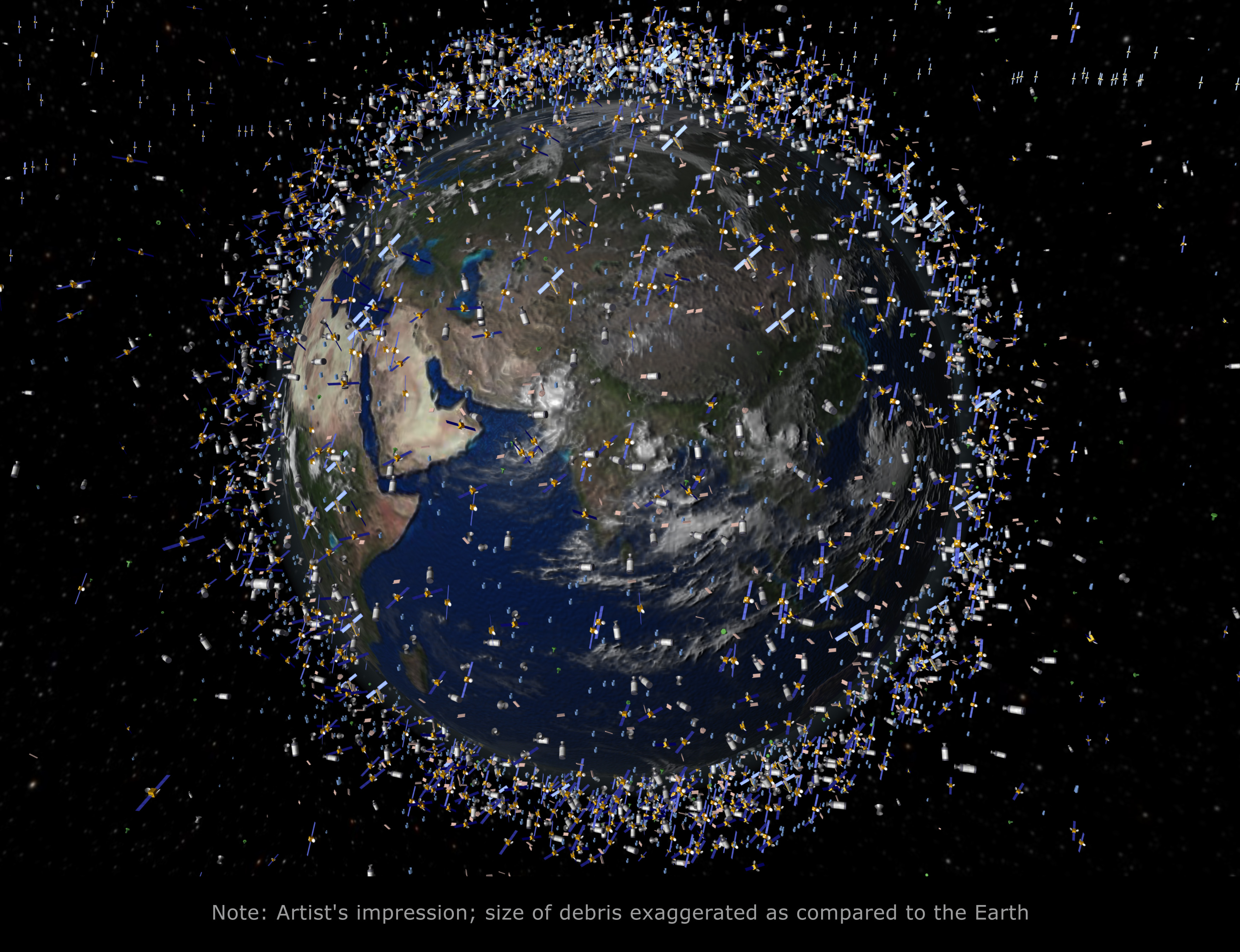
Image courtesy of ESA
Note: The debris field shown in the image is an artist’s impression based on actual data. However, the debris objects are shown at an exaggerated size to make them visible at the scale shown
Space debris has exploded into the news this week. The positive side of the story occurred on Friday November 12th with the launch of the Net Zero Space initiative at the fourth Paris Peace Forum. Ten space industry companies and organisations committed to taking concrete actions by 2030 to reduce the amount of in-orbit space debris and promote the sustainable use of outer space. Specifically, the recommendation was to take urgent action from now to rapidly contain and reduce the ongoing pollution of Earth’s orbital environment:
- by avoiding further generation of hazardous space debris, and
- by remediating existing hazardous space debris
The ten organisations are Arianespace, Astroscale, CGSTL/Chang Guang Satellite, French Space Agency (CNES), European Union Space Surveillance and Tracking (EUSST), Eutelsat, International Institute of Air & Space Law, Isispace, Planet, Share my Space, and Spaceable. Although the initiative was launched there are currently no firm commitments, with more details expected next year. However, the importance of this initiative was highlighted by Eutelsat’s own announcement, which highlighted that without action the potential for collisions in space would increase.
This initiative is great news, but the challenge it faces became stark as just three days later it was announced that Russia had conducted an anti-satellite missile test blowing up their inactive Tselina-D #38 satellite. This created approximately 1,500 pieces of new trackable space debris, and many more thousand smaller pieces. Giving that the second of the Net Zero Space actions was to avoid further generation of hazardous space debris, this has not helped that ambition!
The Tselina-D #38 satellite, also known as Kosmos 1408, was originally launched on the 16th November 1982, and was part of a constellation that provided surveillance and detailed observation and classification of radio emitters.
Russia isn’t the first country to undertake such a missile test. The US destroyed the Solwind scientific satellite in 1985. In 2007, China destroyed one of its weather satellites creating over 3,000 larger pieces of debris and over 100,000 smaller pieces. Recently in 2019, India also used a weapon to destroy its Microsat-R satellite.
Ignoring all the international rhetoric, these tests pose a serious threat to our use of low Earth space. In 1978 Donald Kessler outlined his Kessler Syndrome hypothesis, which proposed a scenario where the density of objects in low earth orbit is so such that the debris from a single collision between two objects would set off a cascade so great, that it would prevent any further spacecraft from passing through the low Earth orbit area. It’s estimated that there may be 300 million pieces of debris in space, which is travelling at speeds of up to 33,500 miles per hour, or if prefer 558 miles per minute or 9.3 miles per second. Any collision, even from a fleck of paint, can be serious.
In 1996, a French satellite was damaged by debris from a French rocket that had exploded a decade earlier. On the 23rd August 2016, the Copernicus Sentinel-1A satellite was struck by a millimetre-size object damaging its solar array. This week there was concern debris created by the Russian test would hit the International Space Station, and so the astronauts were put into their escape pods onboard. Nothing happened on this occasion, but the danger is obvious.
In addition, the orbits of active satellites regularly have to be adjusted to avoid collisions with tracked debris and other satellites. Sometimes, these encounters come too close to comfort as we discussed in a previous blog!
For the last fortnight the world has been talking about COP26 and the steps we need to take to prevent catastrophic damage to the planet. We need to take similar steps around 500 km up into the atmosphere and ensure that we start treating space with the respect it deserves.
