

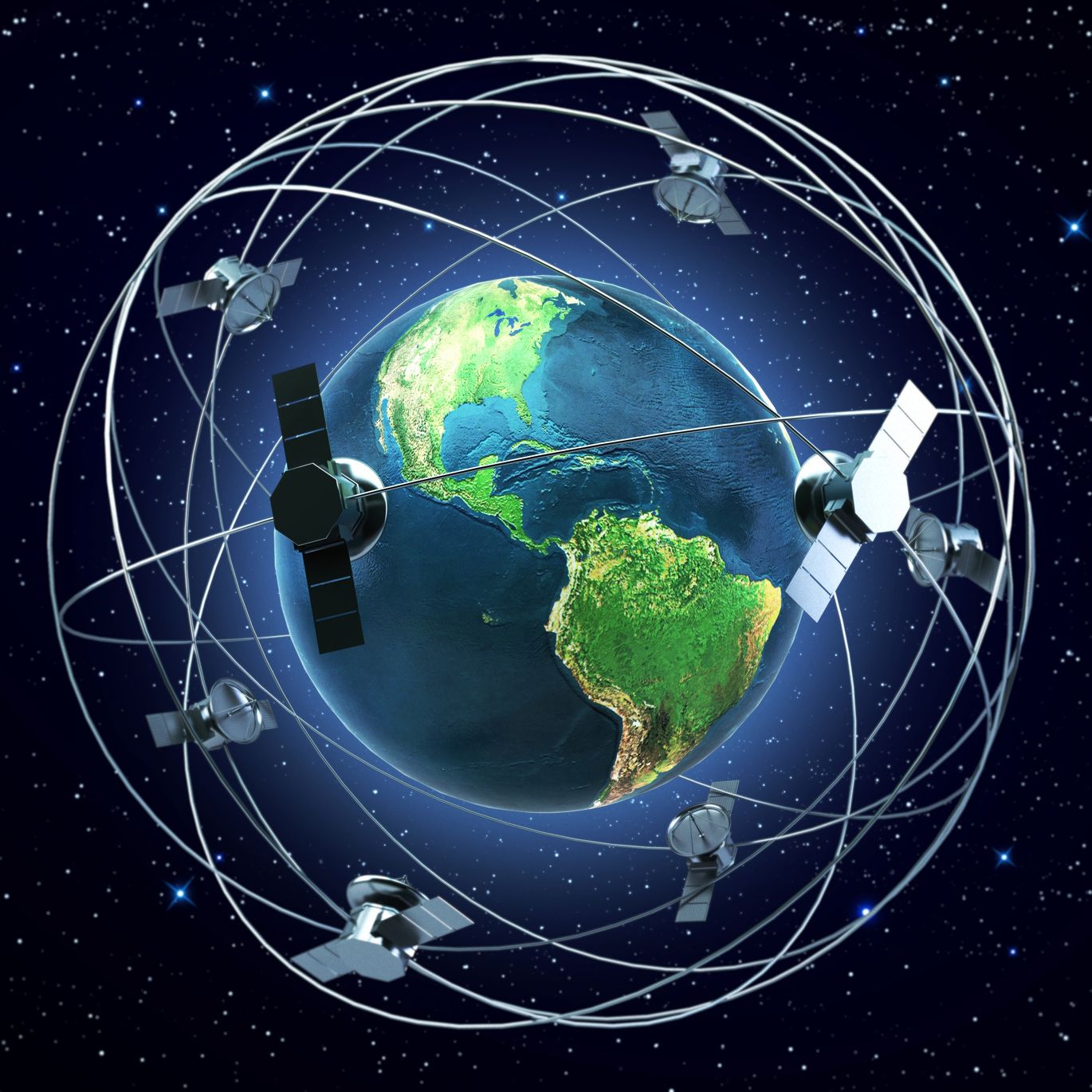
Artist’s rendition of satellites orbiting the Earth – rottenman/123RF Stock Photo
Summarising the latest Earth Observation (EO) news, this week we’re looking at the latest Copernicus Contributing Mission, the latest solar observation satellite from China, a HAPS world altitude record and an announcement from Monaco!
We’ll start with the Copernicus Contributing Mission, as it was announced last week that Finland’s ICEYE has become the latest mission to sign a contract with the European Space Agency so that their constellation of synthetic aperture radar small satellites will become a Copernicus Contributing Mission. Whilst the Sentinel missions are the cornerstone of the Copernicus Programme, the European Union has, via ESA, brought in a number of Contributing Missions to support Copernicus ensuring the whole range of EO data is available.
ICEYE currently have 14 SAR satellites in space offering a spatial resolution of 3 metres and plan to expand the constellation by up to 18 satellites over the next year, which it hopes will deliver a three hour revisit time anywhere on the planet. Current Contributing Missions offer sensors including very high and medium resolution optical imagery, Synthetic Aperture Radar (SAR) sensors, altimetry sensors, radiometers and spectrometers. Some examples of the satellites that are part of the Contributing Missions include Kompsat-2 and 3, Worldview 1,2 & 3, Cosmo-SkyMed, TerrSAR-X, RadarSAT-2, Spot and Pleiades satellites.
Swapping from EO to solar observation, last Thursday China launched its first solar observation satellite from the Taiyuan Satellite Launch Center. The satellite is the Chinese H-Alpha Solar Explorer (CHASE), it’s also known by the Chinese name, Xihe, the name of the sun goddess in ancient Chinese mythology. The satellite will orbit the Earth keeping a fixed position relative to the sun and will collect data to help scientists better understand solar flares, which often threaten satellite communication and navigation systems in space and on Earth. It’s the first satellite to observe the H-Alpha spectrum of the sun and there is a hint, and hope, that the data will be shared with scientists around the world.
Moving from satellites to high altitude platform systems (HAPS), the Airbus Zephyr S HAPS set a new altitude record for a stratospheric HAPS achieving an altitude of 76,100 feet, to go with its previous longest flight of 26 days. The latest record was achieved during two stratospheric flights over the summer of 2021 lasting a combined 36 days. The unmanned solar-powered Zephyr has a wingspan of 25 metres and weighs only 75 kg. Having flown for over 2,000 hours in total to date, the Zephyr is rapidly becoming close to offering an alternative to satellite or airborne remote sensing. Airbus plans to use the Zephyr for defence capabilities, but are also expected to offer it for both disaster response and commercial applications.
Finally, Monaco has recently established an Office of Space Affairs to support the Monegasque space community, including activities such as the small EO satellites, communication satellites and planetary rovers.
Approved by Prince Albert II, the Office was established on the 2nd August 2021, although only announced last week, and it is hoped that this will promote growth in the space sector generating economic, education and reputational benefits for the country, as well as attracting highly qualified people to the country. At an international level, the Office of Space Affairs will represent the country in the relevant international organisations, and is looking to work with other countries on knowledge sharing and develop economic cooperation. So, if anyone in the space sector is looking to set up a Monaco office, they are ready for you!
As usual, lots happening in EO and space applications across the globe!
