

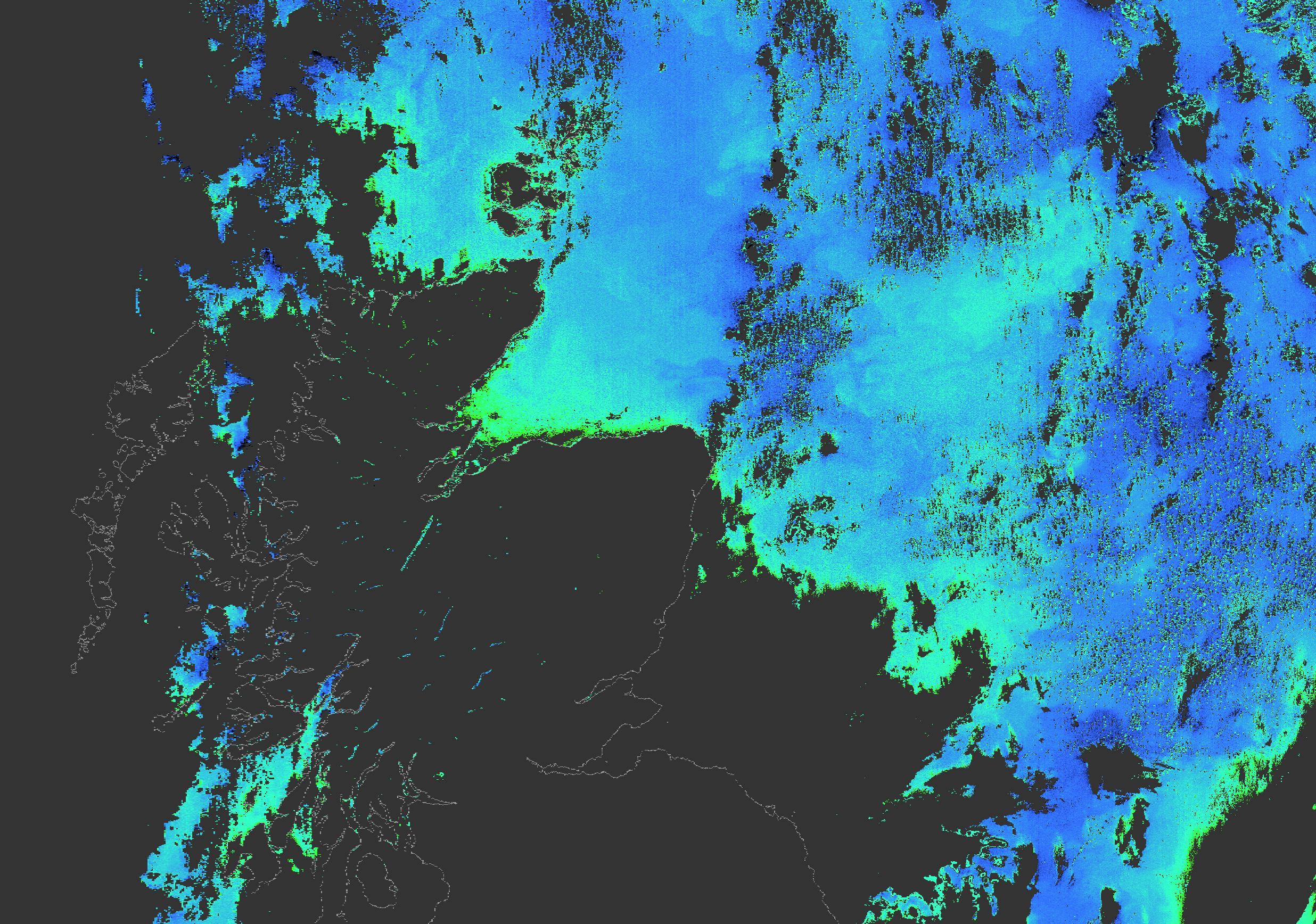
Chlorophyll Image around the coast of Scotland acquired by Sentinel-3 on 28/09/2021. Image Courtesy of ESA/Copernicus.
Phytoplankton are microscopic organisations that live in both fresh and seawater and form one of the lowest levels of the aquatic food chain, with many marine creatures eating them. Phytoplankton contain chlorophyll, like plants, and therefore require sunlight to survive and grow which means they live in the upper parts of the ocean. They capture sunlight and use photosynthesis to turn it into chemical energy.
There are two major seasons for phytoplankton blooms during the year. The first usually occurs between the months of March and May, and the second between August and October. These blooms occur within waters that have sufficient sunlight and nutrients, with the latter being a particular driver for the species. The spring season tends to result in large blooms as the spring sun warms the top level of the water, creating a warm layer above the colder deeper water drawing the phytoplankton to the surface. Whereas the autumn bloom is generally triggered by a mixing of the deeper waters that are rich in nutrients, with the surface waters that have become nutrient depleted. A bloom can appear over a few days or a longer period, and the bloom itself can last up to several weeks.
Despite these blooms being a natural and necessary part of the marine ecosystems, it is possible for them to be dangerous as well. If waters become too rich in nutrients, the phytoplankton can grow out of control and the blooms can become harmful producing toxic compounds that can damage the creatures that eat them throughout the aquatic food chain.
There have been two articles in the news these week concerning toxic algae blooms. Firstly, in the UK there have been, as reported in the Press and Journal, thousands of seabirds found dead or dying on the north-east coast of the UK. The birds, mostly guillemots, have been washing up onto beaches from Northumberland to Orkney, although the precise reason why is not known.
Dr Peter Miller from Plymouth Marine Laboratory has been investigating the presence of a large dense algae bloom and whether this might have turned toxic, which if enough were eaten by small fish could make them toxic to the seabirds. Dr Miller has used the European Space Agency’s Sentinel-3A satellite to map the algal blooms present during September. Whilst the bloom has now gone, the UK Centre for Ecology and Hydrology (UKCEH) research institute is assessing, alongside other possibilities, whether a toxic algal bloom could be causing the deaths, although no conclusion has been reached yet.
The image at the top of the blog shows the chlorophyll concentrations around the coast of north east Scotland on the 28th September 2021, around the time of the bloom. The greener the colour, the greater the concentration of photoplankton. The image shows strong levels along the coastlines.
A second article on toxic algae blooms was released by Woods Hole Oceanographic Institution as a team of their researchers together with colleagues from National Oceanic and Atmospheric Administration (NOAA) and other researchers in the USA, Japan, and China have identified that the warming of the northern Alaskan Arctic Ocean has created the right conditions for toxic algae blooms to occur in the area. Blooms have been previously rare, but could now become more frequent with the warming ocean.
A paper on the work by Anderson & Fachon et al titled ‘Evidence for massive and recurrent toxic blooms of Alexandrium catenella in the Alaskan Arctic’ was published this week in the journal Proceedings of the National Academy of Sciences of United States of America.
The study used samples from seafloor sediments and surface waters collected during 2018 and 2019 in the region extending from the Northern Bering Sea to the Chukchi and Beaufort Seas north of Alaska. These allowed the researchers to map the neurotoxin-producing Alexandrium catenella dinoflagellate phytoplankton. They found that seeds of this phytoplankton were widely distributed in high concentrations in both bottom sediments and surface waters of the Alaskan Arctic, which could produce potentially toxic blooms.
The warming temperatures in the Arctic mean that future blooms are likely to be larger and occur more frequently, and similarly studies have also indicated that climate change will increase the frequency of such toxic blooms in the North Sea of the UK. Therefore, there is a concern that similar events like seabird die off in the North Sea could be repeated both here and in the Arctic Ocean, which has the potential to degrade both marine ecosystems and impact the lives of the people who are dependent on them.
The potential dangers of climate change should not be underestimated, and it is hoped that world leaders at COP26 in Glasgow next month will act, otherwise these reports will become more common.
