

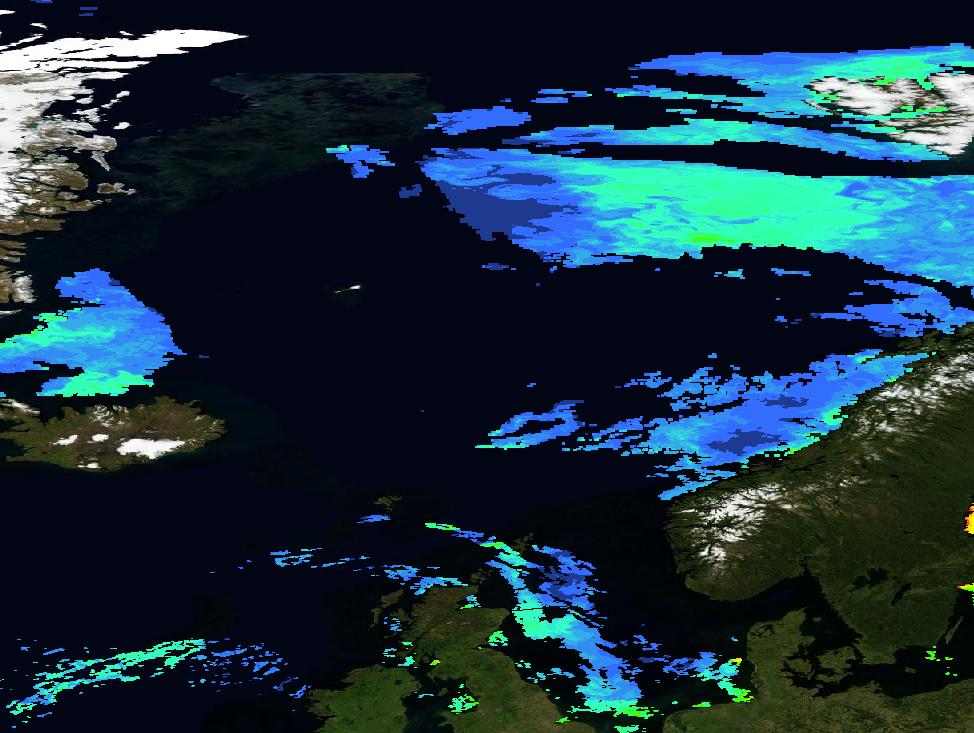
MODIS daily global Chlorophyll composite at 4km resolution, zoomed-in to show the large bloom (light green pixels) south of Iceland. Data courtesy of NASA
Phytoplankton are microscopic organisations that live in both fresh and seawater and form one of the lowest levels of the aquatic food chain, with many marine creatures eating them. Phytoplankton contain chlorophyll, like plants, and therefore require sunlight to survive and grow which means they live in the upper parts of the ocean. They capture sunlight and use photosynthesis to turn it into chemical energy.
There are two major seasons for phytoplankton blooms during the year. The first usually occurs between the months of March and May, and the second between August and October. These blooms occur within waters that have sufficient sunlight and nutrients, with the latter being a particular driver for the species. The spring season tends to result in large blooms as the spring sun warms the top level of the water, creating a warm layer above the colder deeper water drawing the phytoplankton to the surface. Whereas the autumn bloom is generally triggered by a mixing of the deeper waters, that are rich in nutrients, with the surface waters that have become nutrient depleted. A bloom can appear over a few days or a longer period, and the bloom itself can last up to several weeks.
A paper published in Science last month indicated that phytoplankton biomass is increasing in the Arctic. The paper ‘Changes in phytoplankton concentration now drive increased Arctic Ocean primary production’ by Lewis et al, found that the phytoplankton biomass had increased in the Arctic by fifty-seven per cent in the twenty years between 1998 and 2018. A lot of this increase is found within the Chukchi and Barents Seas both of which are marginal seas of the Arctic Ocean.
The image at the top of the blog was acquired on 26th July with the Moderate Resolution Imaging Spectroradiometer (MODIS) on NASA’s Terra and Aqua satellites and shows a bloom of phytoplankton in the Arctic Ocean. Despite being microscopic-organisms, they are visible from space as they change the colour of the ocean, termed ocean colour. MODIS uses an Ocean Colour 3 (OC3M) algorithm to measure phytoplankton pigment concentrations using a blue/green band ratio. At high pigment concentrations, the signal at 440 nm becomes too small to be retrieved accurately and thus the pigment algorithm switches from a blue/green to a green/red ratio that’s less sensitive to variations in the pigment concentration.

Phytoplankton bloom off the coast of South West UK. Image captured by Sentinel-2 on the 23rd June. Image courtesy of Copernicus/ESA.
The Arctic isn’t the only area to see a bloom in recent weeks. Last month there was a large coccolithophore bloom in the English Channel, just off the coast from Plymouth, seen in the image on the right from the 23rd June acquired by Sentinel-2. In addition, last this weekend Sentinel-3 captured an algal bloom in the Baltic Sea.
