

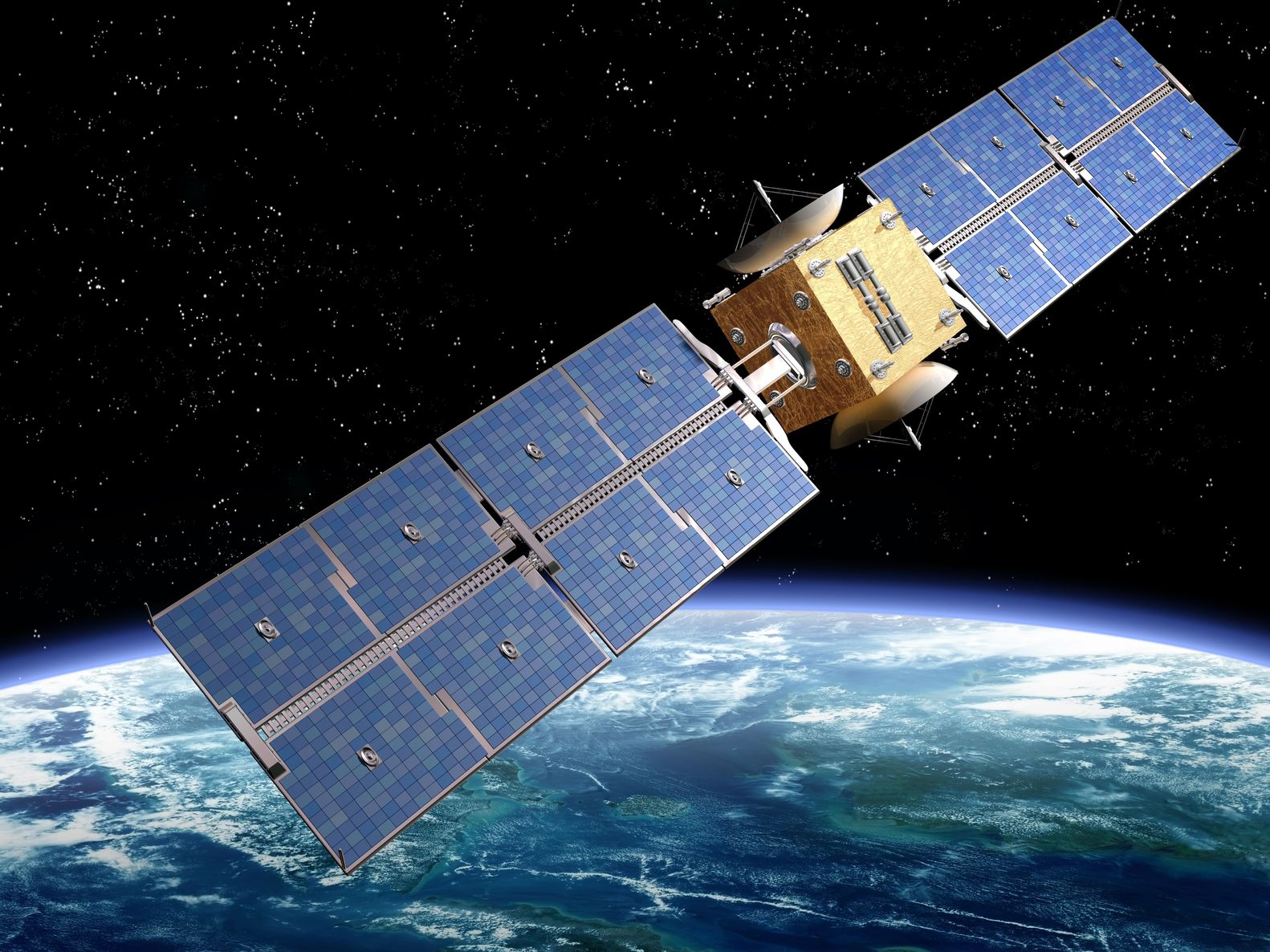
Artist’s rendition of a satellite – paulfleet/123RF Stock Photo
We’re in the middle of a busy period for Earth Observation (EO), with new launches and satellites going into service.
We begin the new launches in China with news that on Sunday they launched the Gaofen 9-05 satellite from the Jiuquan Satellite Launch Centre on board the Long March 2D rocket. If this sounds familiar, it’s because it is! Three weeks ago, we wrote about the launch of Gaofen 9-04 from the same place on the same rocket! Although, no official specifications are released the Gaofen 9 series are believed all to be very similar, each with optical imaging camera with a sub-metre resolution. Like its predecessors, Gaofen 9-05 was put into a low Earth orbit at around 500 km and will be used for applications such as land surveys, urban planning, transportation, crop yields and disaster support.
Two small satellites also piggybacked on this latest launch:
- Tiantuo 5 aims to collect data on maritime and aviation traffic. It was developed by the National University of Defense Technology, a military academy founded by the Chinese People’s Liberation Army.
- The Academy of Military Science, a research institute of the Chinese People’s Liberation Army, launched a small satellite to test communication, navigation and remote sensing technology, but no further details were given.
The second recent launch, and again a refrain you may have heard before, is that on the 18th August SpaceX launched another 58 Starlink satellites, taking the total constellation in orbit to 653. The Falcon 9 rocket, which left Cape Canaveral Air Force Station in Florida, also launched three of Planet’s smaller SkySat EO satellites.
Moving from launches that have occurred, to those coming up. Next Tuesday, 1st September. is the rescheduled first launch of ESA’s Small Spacecraft Mission Service (SSMS) aboard the Vega rocket flight VV16. It was originally due to go up in June, but it was postponed due to poor weather conditions. This new planned launch, from Europe’s Spaceport in French Guiana, will take 53 small satellites – 7 microsatellites and 46 nanosatellites – into Sun-synchronous orbits at around 500 km altitude.
This proof-of-concept mission will demonstrate a launch facility for small satellites between 1 kg and 500 kg. ESA itself has four missions onboard:
- ESAIL – Which will be tracking ships automatic identification system (AIS) data.
- Simba – A Belgium nanosatellite, which aims to calculate our planet’s overall energy budget.
- PICASSO – Another Belgian led mission, which will use the filtering of sunlight by Earth’s atmosphere to check the health of our protective ozone layer.
- ɸ-sat-1 – It will be monitoring changes in vegetation and water quality, detecting urban heat islands and examining the role of evapotranspiration in climate change. The data from this mission will be available through the Copernicus Land and Marine Environment Service
The remaining satellites on the launch are reported to include, amongst others:
- 8 x Lemur-2 CubeSats built by Spire Global Inc for meteorology and ship traffic tracking.
- 14 Flock 4v SuperDove EO satellites for Planet.
- 12 satellites for Swarm Technology working on global connectivity
- Trisat – an EO imaging mission led by the University of Maribor, Slovenia with a miniaturized multispectral optical instrument in up to 20 non-overlapping bands in NIR-SWIR (Near to Short Wave Infrared) spectrum.
- NewSat-6 is a low Earth orbit commercial remote sensing microsatellite designed and manufactured by Satellogic S.A. in Argentina.
- AMICalSat, an educational mission, developed by the University of Grenoble Alpes in France and Lomonosov Moscow State University-Skobeltsyn Institute of Nuclear Physics in Russia to take pictures of the Northern Lights – the outcome of which will be potentially exciting for any Philip Pullman fans out there!
- GHGSat-C1 a Canadian mission to monitor industrial greenhouse gas and air quality gas emissions,.
- NEMO-HD is a high precision interactive remote sensing mission for acquiring multispectral images and real-time HD video developed by Slovenian Centre of Excellence for Space Sciences and Technologies.
- RTAFSAT-1 (Royal Thai Air Force Satellite-1) mission, also referred to as NAPA-1, is the first remote sensing CubeSat mission for Thailand.
- DIDO-3, a commercial mission of SpacePharma is to gather data on the effects of a microgravity environment on biological materials
- TTU100 will test earth observation cameras and high-speed X-band communications in the visible and IR electromagnetic spectrum and was developed by the Tallin University of Technology in Estonia.
Finally, moving onto satellites becoming operational, China has announced its Gaofen-7 EO satellite has been put into service. We reported its launch in a blog last November. The satellite has two cameras and a laser altimeter and will collect high-resolution optical 3D observation data and high-precision laser altimetry for use in survey and mapping, and reportedly has a sub-metre spatial resolution. It’s expected to enhance China’s ability to survey and map large scale construction projects.
All of which shows the EO satellite launch teams have not had much time on the beach this summer!
