

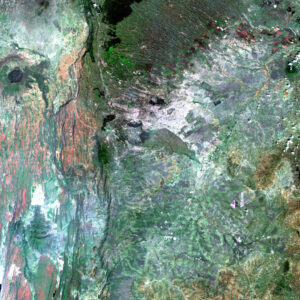
Image captured by Sentinel-2 over Kenya on the 20 December 2019, including Nairobi (the white area just above the centre). Image courtesy of Copernicus/ESA.
Today, on World Humanitarian Day, the UK Space Agency has announced new funding for Pixalytics to help Kenya tackle the social and environmental impacts of unsustainable sand mining.
Pixalytics will be leading the international project, called Earth Observation for Sustainable Aggregate Supply (EO4SAS) that aims to provide Kenya with Earth observation data and ideas on how the country might improve the management of its sand resources. The project is being undertaken in conjunction with partners Satellite Applications Catapult, Chatham House and the University of Plymouth in the UK, and NIRAS Africa and Nairobi Design Institute in Kenya. The project is also being supported by the British Geological Survey with their knowledge of the country and the topic.
The scheme is one of 10 new cutting-edge projects involving UK companies helping tackle global development problems – from the spread of malaria to human trafficking. The UK Space Agency’s International Partnership Programme (IPP) which is designed to use UK space expertise in satellite technology and data services to deliver ground-breaking solutions to real-world problems across the globe. Projects aim to help developing countries while building effective partnerships that can lead to growth opportunities for the UK space sector and IPP has provided £3.4 million funding in total, including just under £360,000 for the EO4SAS project.
Dr Samantha Lavender, Managing Director Pixalytics Ltd, said “Sand is a finite resource, especially with increasing global demand, and unsustainable extraction to meet this need has both environmental and social impacts. We are excited to be working with our partners to deliver the EO4SAS service that will use satellite data and stakeholder discussions to support the Geological Survey, within the Government of Kenya, and local communities to develop a sustainable system.”
In Kenya, unmanaged extraction of sand and aggregate has potentially serious long-term and wide-ranging impacts. This project will deliver insights into aggregate resources, location, scale and practices of extraction sites, extraction rates, flows to markets and environmental changes on the land associated with extraction activities. The final service will improve the monitoring and regulation of aggregate mining and support sustainability in the aggregate supply chain.
IPP, a £30 million a year programme which is part of the Department for Business, Energy and Industrial Strategy’s (BEIS) Global Challenges Research Fund (GCRF), has already grant-funded 33 projects in 44 countries across Africa, Asia-Pacific and Latin America and built partnerships between 120 space-enabled data organisations and 147 international partners in developing countries. These projects are designed to meet UN Sustainable Development Goals (UN SDGs) such as support for precision agriculture, early warning systems for disaster prediction, maritime safety, and disease forecasting.
The Programme has so far generated £279 million in Gross Value Added for the UK economy and supports 3,300 jobs globally. The UK economy gains more than £2.50 for every £1 invested in IPP projects.
Liz Cox, IPP’s Head of International Relations at the UK Space Agency, said: “The compelling results of the previous projects cement the case for investment in space for sustainable development. IPP is not only demonstrating the value of satellite solutions and improving the lives of people on the ground in developing countries but also facilitating effective alliances between the United Kingdom and international organisations. It’s a ‘win-win’ and an exciting moment in the Programme”.
The UK space sector is an economic success story, growing by over 60% since 2010. The sector already supports £300 billion of UK economic activity through the use of satellite services, and the government has established a new National Space Council to consider how space policy can enhance the country’s prosperity and place in the world, as well as our security interests.
All IPP projects are match-funded by consortium members and international partners to ensure maximum value for money. The Programme is fully compliant with Official Development Assistance (ODA), with the Independent Commission for Aid Impact reporting that the UK Space Agency had developed robust procedures for ensuring ODA eligibility and was thorough in its ODA compliance screening.
