

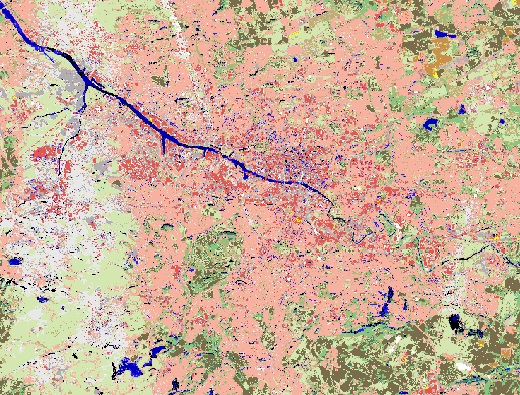
Land Classification over Scotland with Landsat 8
Last Friday afternoon, 26th June, I spent an interesting session at the British Association Remote Sensing Companies (BARSC) Cuddle Number Seven. These networking Cuddles bring together BARSC Members, speakers and other industry organisations to discuss key issues that matter to the Earth Observation (EO) community. Originally face-to-face events, this and the previous Cuddle have been held virtually due to the Government restrictions.
The title of this event was “What role does Artificial Intelligence (AI) have in your EO business strategy?” and it explored the impact of artificial intelligence on both the science, and business, of EO. The speakers were Chetan Pradhan from Earth-i, David Petit from Deimos Space and myself.
Chetan started with an overview of the downstream analytics capabilities that Earth-i has been developing, which includes a range of applications using Machine Learning (ML). The applications include monitoring copper production through smelting activity and the production of coffee in Africa, which was funded through the UK Space Agency. They are also starting a new project, funded by ESA, to detect leaks for wear companies. The aim is for 95% accuracy for when detecting or extraction features, and where there is uncertainty, customers prefer for the system to detect a potential artefact of interest, rather than to ignore it. The differentiator from the past is the increased reliance on training data.
David discussed the change in EO applications development from a long process involving specialists to a much quicker approach requiring data scientists rather than EO specialists. He discussed that the intellectual property (IP), and therefore value, now lies with the ground-truthing & training data rather than the approach itself as there are lots of freely available open-source code to run different ML techniques. Also, testing has become test data-driven rather than unit test-driven with the advantage of a greater focus on the accuracy of the output compared to the implementation approach. In turn, this has also resulted in a change within the industry with EO exploitation platforms being developed by upstream satellite operators rather than just a specialist downstream platform developer. In future, this also means that AI/ML approaches can be run on the satellite. As discussed in last week’s blog, ESA is about to launch Phi-Sat to test an AI onboard approach.
When it came to my turn, I discussed how the use of tools for multiple non-linear regression had changed over time. Research papers I was involved with 10+ years ago were using Generalized Additive Models (GAMs) and Neural Networks for classification, whereas now we’re using Random Forests. For us, the next step is automating the processing and having an iterative system where the ML approach is improving over time/experience. Looking forward, I see a shared role for computers and humans, with humans at the start and end of the process – providing the curated training data and insight into the output.
Earlier this year Pixalytics received 3-months funding from the UK Space Agency to develop a database for ML Land Cover Classification. Once implemented, the approach supported a90% reduction in time to train and generate a land cover classification with an average time saving of 11 hours per dataset.
I want to end this blog by asking all our readers a question that arose during the event, which was of the people working on EO application development – would you consider yourself an EO expert, a data scientist using EO data, or something else?
To gain an insight, we’re running a Twitter poll on this question starting today for the next few days or feel free to reply to this blog post. We’ll collate the results and update the outcome next week.
Update – Poll Outcome
The outcome of the poll was that:
- 1% of respondents considered themselves EO Experts working with AI
- 3% of respondents considered themselves data experts using EO data
- 3% of respondents considered themselves to have good skills in both
- 3% of respondents considered that they categorised themselves in other ways.
This shows that EO skills are still the largest factor, however, this should be read alongside:
- survey sample was relatively small, and
- given our blog/twitter followers are predominantly EO specialists
Perhaps, the more interesting point is that over 40% of respondents did not see themselves as EO experts first – something the industry needs to take seriously for the future.
