

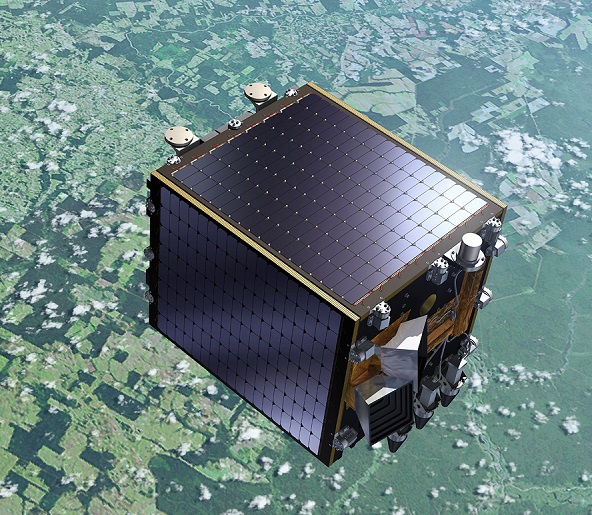
Artist’s impression of Proba-V. Image courtesy of ESA–P. Carril, 2012.
It’s a mixed week for satellites from the European Space Agency’s (ESA) PROBA missions.
The positive side is that last week ESA celebrated twenty years of the PROBA-1 mini-satellite being in orbit. PROBA-1 was launched from Satish Dhawan Space Centre in India on the 22nd October 2001 and put into a sun-synchronous 615 km low earth orbit.
PROBA-1, which was built by QinetiQ Space Belgium, was seen as an experimental small satellites, with its name derived from the Latin word ‘probare’ which means ‘to test’ or ‘to try’, and PROBA stands for Project for On-Board Autonomy. After twenty years the satellite is still fully operational, making it ESA’s longest serving mission.
Onboard the satellite is the Compact High Resolution Imaging Spectrometer instrument (CHRIS), prompting some scientists to refer to the mission as CHRIS PROBA. The mission also carries a monochromatic 5 m spatial resolution High Resolution Camera, alongside the Debris In-Orbit Evaluator (DEBIE-1) for measuring space debris and the Standard Radiation Environment Monitor (SREM) for monitoring radiation belts. PROBA-1 provides hyperspectral data, with the CHRIS instrument which was built by Surrey Satellite Technology Ltd (SSTL), having up to 62 spectral over wavelengths ranging from 400 to 1050 nm at a spatial resolution of 17 m, although the number of bands needs to be decreased when full spatial resolution data is acquired, and so the satellite has a number of modes.
The data from the satellite is used to derive a number of physical, chemical and biological properties of the Earth, including:
- the albedo of the land surface which measures the whiteness of the surface
- plant biomass
- chlorophyll content
- organic matter content in inland and coastal water bodies
PROBA-1 was followed by the Sun-observing PROBA-2 in 2009 and vegetation-tracking PROBA-V in 2013, and it is to PROBA-V that we turn from the sad PROBA news. Following a eight-year mission to collect data to monitor the daily growth of vegetation on Earth the final measurements will be taken this coming weekend with the mission ending on the 31st October 2021.

Image of the United Kingdom acquired by Proba-V on the 19th July 2015. Image courtesy of ESA/Belspo – produced by VITO, Creative Commons CC BY-SA 3.0 IGO
Launched on the 7th May 2013 from Guiana Space Centre in Kourou, in a 820 km polar sun-synchronous orbit, the cubic-metre-sized PROBA-V mini-satellite was the last of the ESA satellites to be launched without any propulsion. The instrument onboard is Vegetation – PROBA (VGT-P), a multispectral pushbroom spectrometer with 4 spectral bands – 3 very near infra-red bands (VNIR) and one short ware infra-red band (SWIR). The spatial resolution is 100m for the VNIR and 200 m for the SWIR, with all bands have a large swath width of 2285 km which allowed the mission to image all Earth’s vegetation in just over one day.
Like its predecessor, PROBA-V is also an experimental mission, it had a newly improved and smaller version of the vegetation instrument from the France Space Agency’s SPOT-4 and SPOT-5 missions. It was hoped that this joint mission would continue the dataset once the SPOT missions ended, which it did as SPOT-4 mission ended on the 29 June 2013 and SPOT-5 ended on the 31 March 2015.
Overall, the mission has acquired more than a petabyte of environmental data during its time in orbit. PROBA-V’s observational mission formally ended on the 30th June 2020, but the vegetation instrument remained operational in experimental mode and has continued to collect data over the European and African continents. However, this ends on the 31st October 2021.
Whilst the mission ends, the dataset does not! The Copernicus Sentinel-3 satellite will now provide the data to continue this important dataset, and to carry on one of satellites greatest attributes – data continuity.
It’s sad to see PROBA-V go, but we know Sentinel-3 will do a great job! Now, all we have to worry about is PROBA-1, as no follow on mission has been confirmed for this amazing little satellite. We’re hoping ESA will keep the satellite going as long as possible and confirm the way for the continuation of this dataset.
