

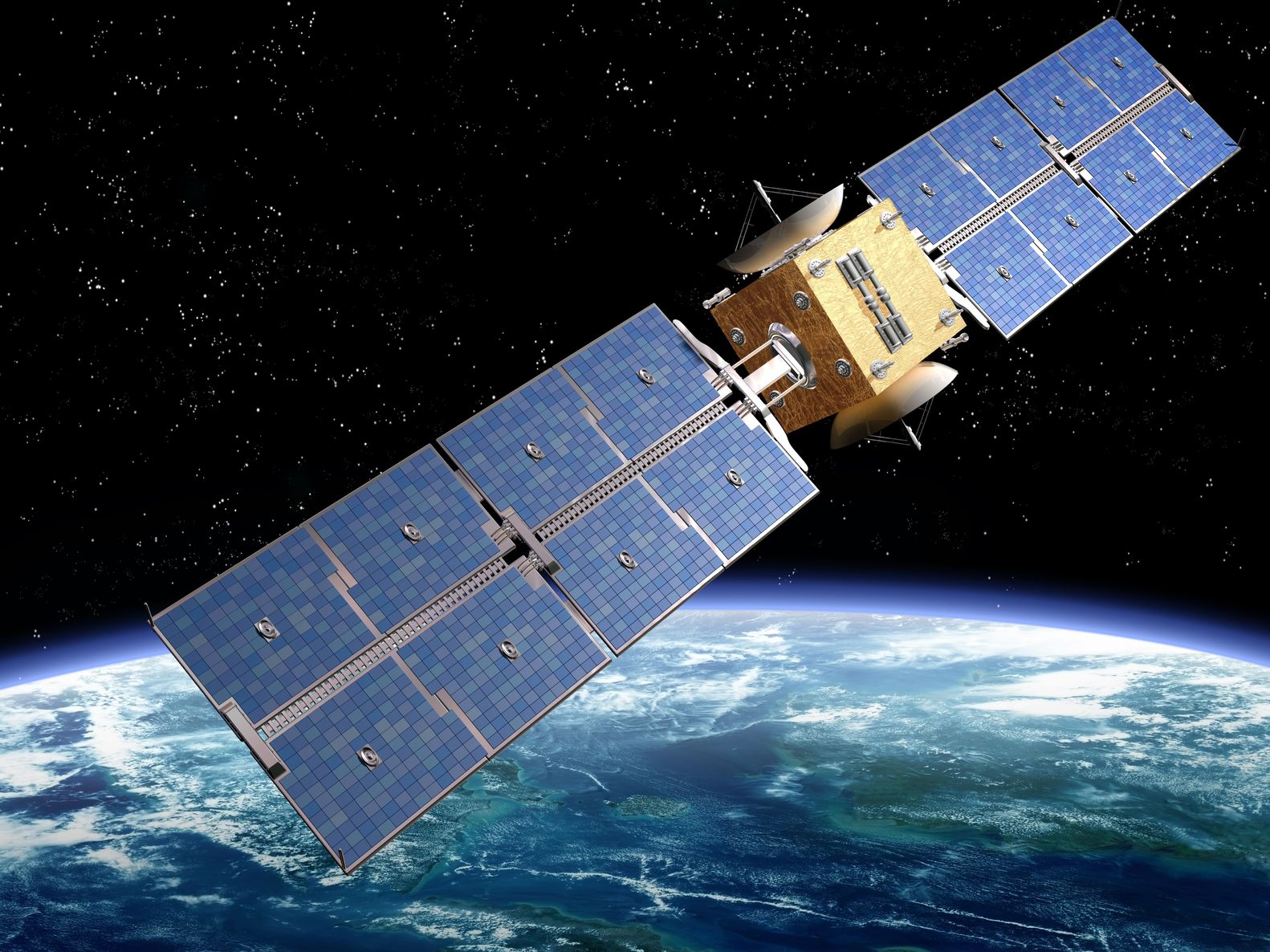
Artist’s rendition of a satellite – paulfleet/123RF Stock Photo
There is feeling of déjà vu in reporting the latest Earth Observation (EO) satellite launches as, once again, they are from the US company BlackSky and China!
On the 9th December the Rocket Lab Electron launch vehicle put more two BlackSky EO satellites into a 430 km orbit from a launch site on New Zealand’s Mahia Peninsula. BlackSky 14 and 15 are high-resolution optical EO satellites with four bands and panchromatic mode, and have a ground resolution of 0.9 – 1.1 metres. These are the fifth and sixth BlackSky satellites to be launched in the last three weeks, following two on the 18th November and another two on the 2nd December.
The Chinese launches were undertaken by Galactic Energy, a private Chinese launch company. It’s Ceres-1 rocket took off from the Jiuquan Satellite Launch Center on the 6th December and had five satellites onboard, which were placed into sun-synchronous orbits at approximately 500 km. These were:
- Golden Bauhinia-5 is an optical remote sensing satellite developed by Starwiz for the Hong Kong Aerospace Technology Group Limited (HKATG).
- Golden Bauhinia-1 (03) is also an optical remote sensing satellite, this time developed by developed by Lab for HKATG.
- Tianjin University-1 is an infrared remote sensing satellite developed by Changguang Satellite Technology.
- Lize-1 is a scientific experimental satellite built by Spacety in collaboration with Chinese companies, Zhongguancun Ruichen Satellite Innovation Application Research Institute and Beijing Yingshi Ruida Technology Co., Ltd. It has a novel satellite platform to carry out in-orbit tests for future constellations.
- BAOYUN is a technology validation mission for the upcoming ‘Tiansuan’ constellation, and has an on-board intelligent computing platform to carry out in-orbit high-performance computing experiments such as edge computing and intelligent internet-of-things processing
Moving away from actual launches, to potential future launches. We’re excited and interested to see a report published examining the viability of having a spaceport in Kenya. We’ve worked in Kenya over the last eighteen months, including talking with the Kenya Space Agency, and last year wrote about their 5-year strategic plan for developing their space sector.
Commissioned by Viwanda Africa Group in collaboration with Longshot Space Technology, students from Kenyatta and Nairobi universities assessed the 47 counties of Kenya to determine which one would be best suited to hosting a spaceport. After initially narrowing the list down to seven counties, they have worked out that Marsabit County is the most suitable county in Kenya to set up a spaceport. Marsabit County is the largest country in Kenya and is in the central north of the country, being just over twenty-five thousand square miles in size. It’s favourability for a spaceport includes factors such as semi-arid climate, large amount of unoccupied land, mostly flat terrain, sparse population density, & low traffic airspace.
There is interest in having a spaceport in Kenya as it has a geographically advantageous position due to being located on the equator, which would mean that launches from Kenya would be given a speed-boost of aver 1,500 km an hour due to the Earth’s rotation. This would provide opportunities to save energy and potentially carry heavier payloads into space.
The report estimates that construction will cost 5 billion Kenyan Schilling and annual operating costs would be 7 billion Kenyan Schilling, whilst there will also be additional supporting infrastructure costs such as roads, etc. However, the report estimates that income would be 1 billion Kenyan schilling per launch, with 5 launches in the first year rising to 60 by year ten, meaning that the it could have a positive impact on the growth of the country.
It is exciting to see the development of space around the globe, and not just be dominated by the US and Europe as happened so much in the past.
