


South West UK using Sentinel-2 data acquired 11th August 2026. Data courtesy of Copernicus.
Everyone in Europe will know that this year has been a hot one. Last week the UK experienced its fifth heatwave of the 2026, and a sixth is forecast for next month. For this country a heatwave is declared when a specific threshold temperature is met for a period of at least three consecutive days; the threshold temperature varies from 25 degrees Celcius (degC) for rural areas, up to 28 degC for urban London.
According to the UK Metrological Office, 2026 is on course to be the hottest summer on record and the country has had 37 consecutive heatwave days so far, while the top temperature of the year has been 38.1 degC recorded at Kew Gardens in London last week; although, this is below the maximum temperature ever recorded in the UK, which was 40.3 degC at Coningsby in Lincolnshire recorded on the 19th July 2022.
The high and persistent heat, and lack of rainfall, can be seen from satellite imagery; for example, at the top of the blog is a Sentinel-2 image of the South West, acquired on the 11th August 2026.
The European Drought Observatory (EDO),, which is part of the Copernicus Emergency Management Service (CEMS), reports that 65% of the territory of England was in Warning conditions and 25% in Alert at the end of July 2026, where:
- Warning: Soil has dried up significantly due to a severe shortage of precipitation, meaning the ground lacks adequate water storage to sustain normal conditions.
- Alert: vegetation and crops show visible signs of stress and damage, on top of the soil moisture deficit, meaning plant productivity is reduced, threatening harvests and the ecosystem.
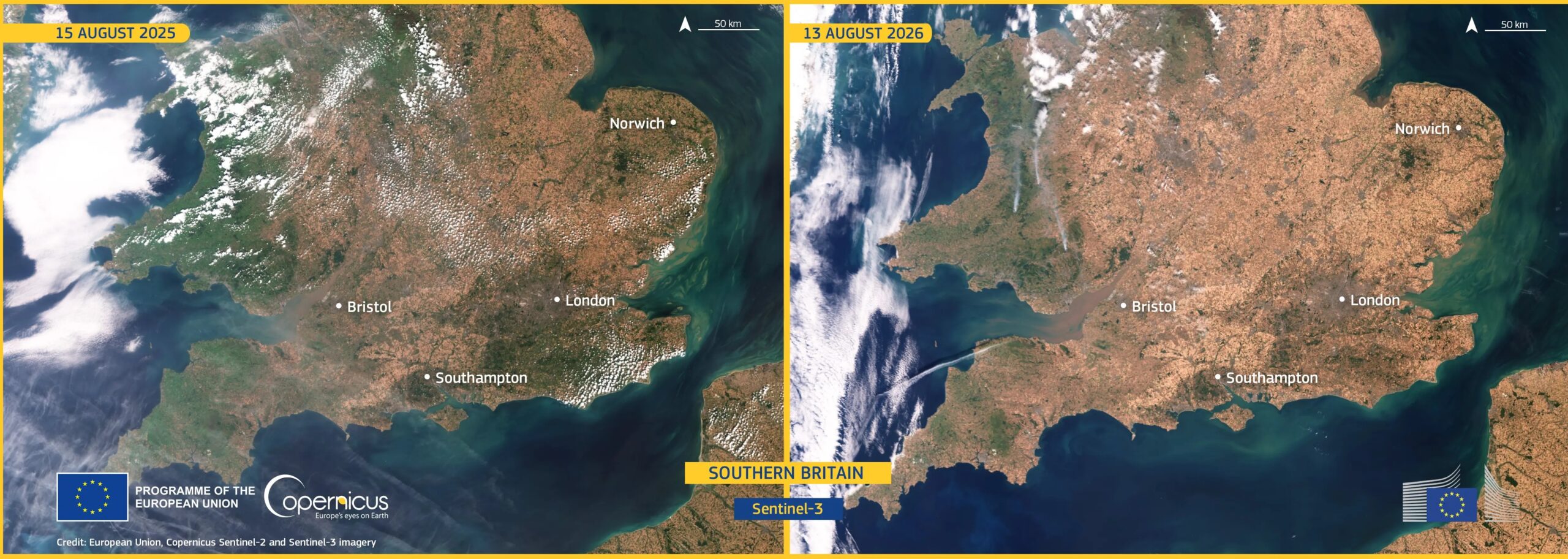
Images of the United Kingdom from Sentinel-3 showing August 2025 and August 2026. Credit: European Union, Copernicus Sentinel-3 imagery
The images on the left show Copernicus Sentinel-3 imagery acquired over southern Britain in August 2025 and 2026, showing widespread brown areas. These brown areas are very dry, and the risk of wildfires in the UK has increased significantly.
Previously, wildfires have occurred on moorland or heathland, but this year they have spread into urban areas and destroyed homes. While we often see this on the news in other parts of Europe, previously wildfires have rarely impacted urban centres in the UK. The risk of fire prompted the UK Government to issue a nationwide alert, via mobile phones, to warn that people ‘should not engage in any activity that could start a fire, including disposable barbeques, firepits, garden incinerators or fireworks’. Equally, significant parts of the country are facing hosepipe bans as water usage has increased and reservoir levels are low.
The UK climate is changing, for example:
- July was the sunniest month on record for the UK.
- July was the driest month on record for England and Wales.
- There has been a record number of days in the year where the temperature has exceeded 30 degC.
- A temperature of 35 degC has also been recorded somewhere in the UK in the four consecutive months of May, June, July, & August for the first time ever.
Although no significant rain is forecast, the coming week is likely to be unsettled with showers. The country is going to need a wet autumn and winter to restore the environment and reservoirs, which of course, might be possible if we have a significant El Niño impact.
Conclusion
All this means the UK needs to start adapting homes, lives, and industry to take account of changing conditions, as we are likely to see hotter springs and summers, and wetter autumns and winters. We also need to keep reducing our climate impact and support nature to survive these shifts.
