

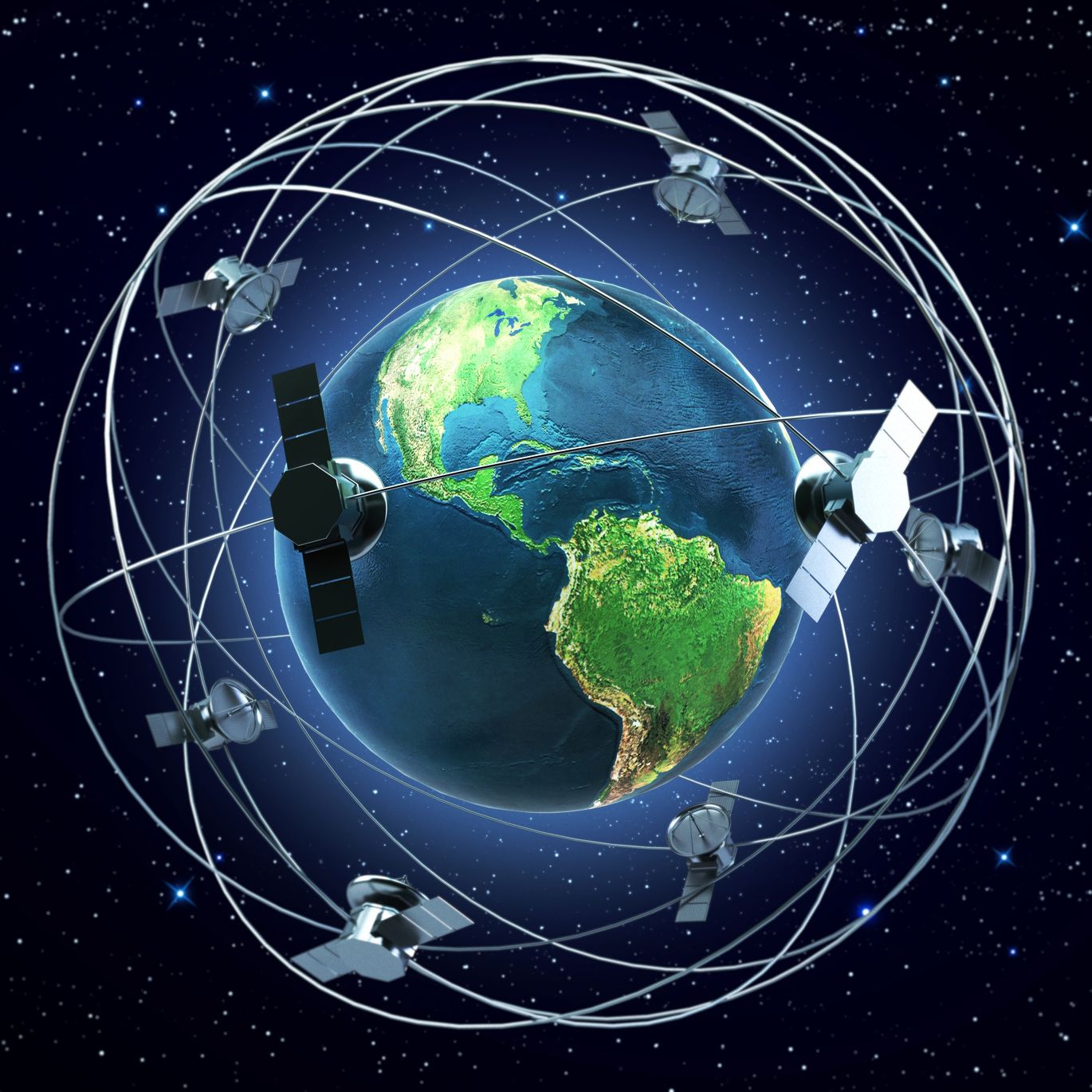
Artist’s rendition of satellites orbiting the Earth – rottenman/123RF Stock Photo
Last week I had the opportunity to attend the UK Earth Observation 2021 week. The National Centre for Earth Observation (NCEO), Centre for Earth Observation Instrumentation (CEOI) and the Remote Sensing and Photogrammetry Society (RSPSoc) created a fully packed virtual event that brought together experts to discuss all things Earth Observation (EO)!
EO week 2021 kicked off with a keynote by Professor Iain Woodhouse who took us through the development of remote sensing over the course of his career so far. Professor Woodhouse provided the optimistic case that 2021 is the ‘golden age of remote sensing’ due to the ever-growing collaborations between scientists and commercial companies. As a PhD student who is relatively new to the field of EO, it always amazes me how quickly the technologies and capabilities have advanced in only a few decades!
The UK’s contribution to global Earth observation efforts was highlighted across all the sessions I attended and as my interests lie in satellite oceanography, the SEASTAR session grabbed my attention. SEASTAR is a new satellite mission concept from UK scientists which has been selected as one of four to enter pre-feasibility to become the 11th European Space Agency Earth Explorer. The mission would provide ocean surface current and surface wind vectors at 1 km resolution for all the coastal ocean, shelf seas and marginal ice zones, helping scientists better understand ocean dynamics and small-scale ocean process. A detailed look into how a successful mission concept was created from an idea was given by Professor Christine Gommenginger. It was inspiring to see the innovation in being able to translate a need for a certain dataset into a satellite with the capabilities to produce it! I also found it interesting that testing is done using an aircraft, combining many methods of remote sensing.
As well as discussions on the actual satellites and sensors recording the data, there were plenty of talks about using the EO data. I particularly enjoyed the talks by Philip Kershaw on the JASMIN data analysis platform and Dr. Katie Awty-Carroll on the NERC Earth Observation Data Acquisition and Analysis Service (NEODASS). As a PhD student, sometimes it can be daunting when first working with EO data, but it is great to feel supported by the teams running these services and by how they continuously work to improve their systems and its accessibility.
My biggest takeaway from the EO Week 2021 was just how passionate everyone is in this field is about their work, you can’t help but be inspired! It was great to immerse myself in all things satellites last week and hopefully I’ll get to meet everyone in-person at the next event.
Blog written by:
Sophie Durston
PhD Student
Satellite Data in Environmental Science – Centre for Doctoral Training (SENSE CDT)
Pixalytics Ltd is a Collaborative Awards in Science and Engineering (CASE) partners for SENSE students
