

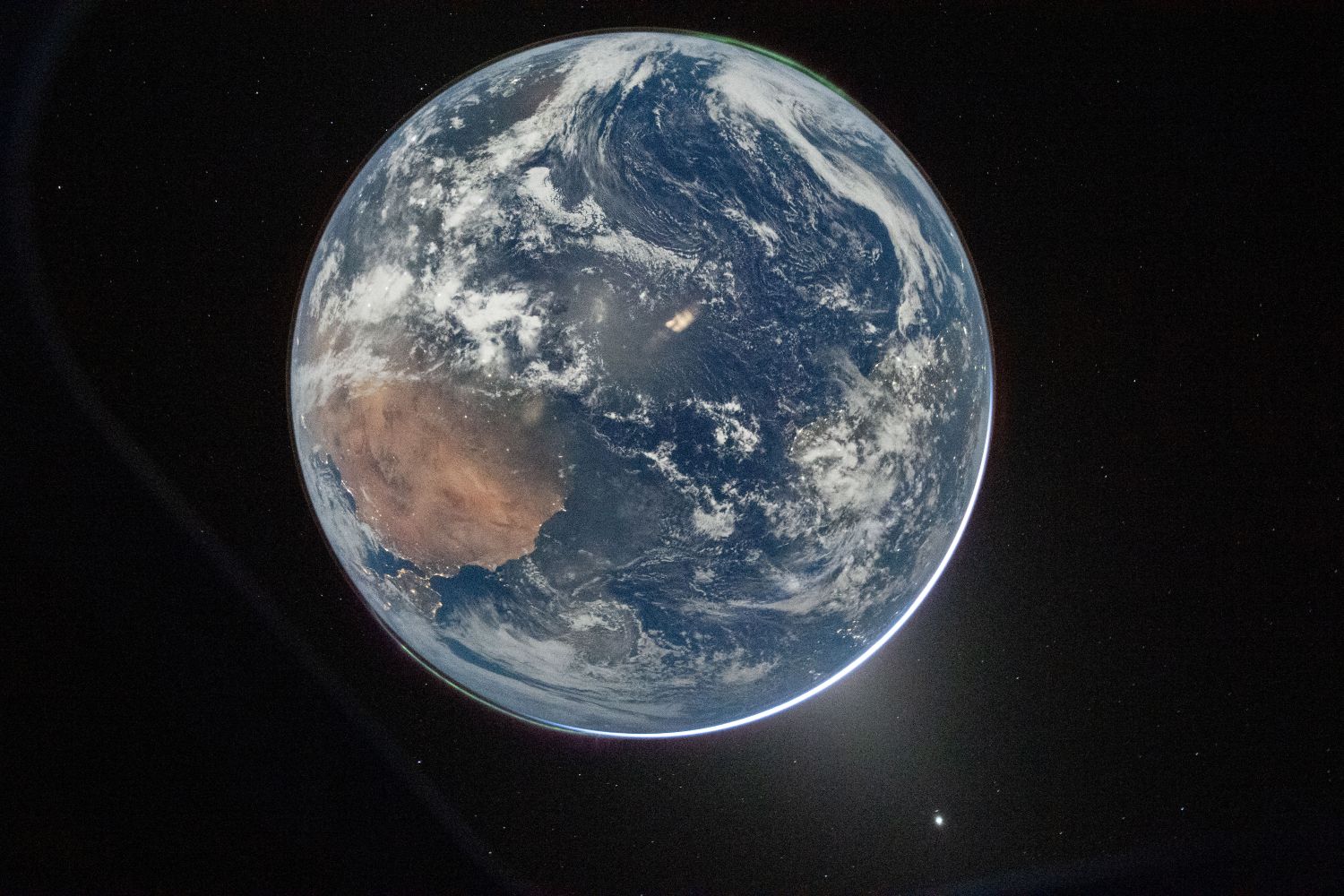
NASA astronaut and Artemis II Commander Reid Wiseman took this picture of Earth from the Orion spacecraft’s window on April 2, 2026. Image Credit: NASA/Reid Wiseman
Two bodies of the United Nations (UN) are this week calling on governments, regulators, and meteorologists to safeguard access to radio frequency spectrum essential for Earth Observation (EO).
The International Telecommunication Union (ITU) and the World Meteorological Organization (WMO) made the call at the start of the Global ITU-WMO Seminar on Spectrum Use for Meteorology: Challenges, Opportunities, and Evolving Requirements taking place this week in Geneva, Switzerland.
The WMO is a specialist agency of the UN whose mandate covers weather, climate and water resources, and it’s the scientific voice on the state and behaviour of the Earth’s atmosphere, its interaction with the land and oceans, the weather, climate, and the resulting distribution of water resources. While the ITU is the United Nations agency dealing with information and communication technologies (ICTs), where one part of its role is to allocates global radio spectrum frequencies and satellite orbit resources to prevent interference.
The UN has long acknowledged the importance of EO data, as 30 of 232 of the UN’s Sustainable Development Goals can only be monitored using satellite EO data. The UN describes both EO and meteorological systems as having a specific role in providing both direct and indirect contributions to achieving the SDGs.
The appeal this week also coincides with the release a new joint publication providing guidance on safeguard frequencies supporting weather forecasts, early warnings and climate monitoring, the handbook is the Use of Radio Spectrum for Meteorology: Weather, Climate, Water and Related Environmental Applications.
The handbook highlights that the effective management of radio frequency bands is critical to maintaining the quality and accuracy of weather and climate data. As some satellite sensors measure very weak naturally occurring signals at specific frequencies, any interference, for example if the radio frequencies were allowed to be used for other purposes as well, could degrade the data acquired, or even potentially prevent collection.
The WMO Secretary-General, Celeste Saulo, noted that meteorological data relies on specific bands — determined not by choice, but by the physical properties of the atmosphere itself and these enable observations no other frequencies can provide. The Secretary-General said “These bands must be protected …. Protect the spectrum that lets us observe the atmosphere, and we protect forecasts and early warnings on which every country depends.”
Conclusion
The radio spectrum is finite and as demand for wireless communications, data centres in orbit and other satellite services increases, the importance of protecting the radio-frequency spectrum used for Earth Observation is critical. As, if it is lost, then the accuracy of weather forecasts will be reduced, as will our understanding of how the climate is evolving, and the potential for the loss of long-standing datasets increases. This will have impacts on governments, countries, localities, and people, as they adapt to the changing weather and climate in both the short and long term.
