

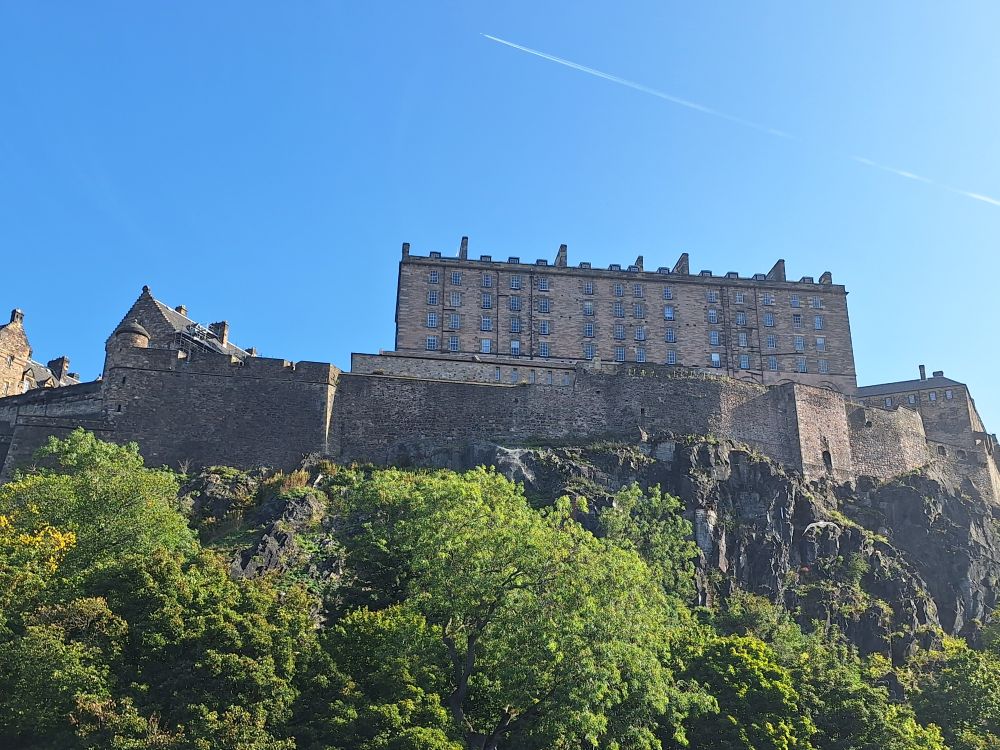
Edinburgh castle
I was in Edinburgh last week for the SPIE Sensors + Imaging 2026 conference. This took place over three days and is organised by SPIE, the international society for optics and photonics, and it combines programmes on Environmental Remote Sensing with Security + Defence.
I hadn’t been to Edinburgh for quite some time, so I arrived the weekend before and took the opportunity to walk around the city on the Sunday on a lovely sunny day. I walked around the castle, which you can see in the image at the top and then up and down the Royal Mile, where I noticed an increase in Harry Potter themed shops. I went into the East Princes Street Gardens for lunch, with a visit to the National Galleries of Scotland afterwards.
The conference began on Monday, and I focused on the Environmental Remote Sensing stream. The first day morning and afternoon sessions were for the ‘Remote Sensing of the Ocean, Sea Ice, Coastal and Inland Waters 2026’ track. Charles Bostater from Florida Institute of Technology in USA, and Susanne Kratzer from Stockholm University in Sweden were the two Conference chairs for this track, with Mariano Bresciani and myself as the conference co-chairs.
Mariano, who is from the Istituto per il Rilevamento Elettromagnetico dell’Ambiente in Italy, gave the first keynote ‘A synergy use of in situ and multi/hyperspectral optical images to study the ecological status of Lake Garda.’ He discussed his involvement in monitoring Lake Garda and the use of both Earth Observation (EO) and in-situ measurements to track seasonal and long-term changes.
This was followed by a presentation on ‘Long-term water quality trends and machine-learning anomaly detection in the inland waters: in-situ baselines for suspended sediment, CDOM, and turbidity retrieval validation’ highlighting the importance of in-situ sampling for capturing the characteristics of a water body – with occasional sampling, it is easy to miss key events or not capture the full seasonal cycle due to the weather’s impact on sampling. Next was ‘Detecting ephemeral inland water in hyper-arid coastal environments’ which focused on Bahrain, where these water bodies can become stagnant and a breeding ground for mosquitoes.
The final session before lunch was by Suse, who talked about in situ chlorophyll-a interlaboratory variability and showed how differences could exceed 20% due to different methodologies/sample handling in the presentation ‘Chlorophyll-a interlaboratory variability: implications for calibration, validation, and satellite ocean colour applications’.
I was the first talk after lunch with my presentation ‘AEROSTATS, monitoring the dynamic Greenland ocean-ice margins’ where I talked about the Aerial Experimental Remote sensing of Ocean Salinity, heaT, Advection and Thermohaline Shifts (AEROSTATS) project we are involved with. The project is led by National Oceanography Centre (NOC) in the UK and is funded by the UK Advanced Research & Invention Agency (ARIA), and it’s looking at the rapid melting of Arctic sea ice and Greenland Ice Sheet and the potential impact of additional significant freshwater input to the North Atlantic.
The Monday afternoon session was titled ‘Sea Ice and Northern Oceans Analyses’, and the talks that followed showcased the use of the passive microwave SMOS mission for sea ice thickness retrieval, glacier snow cover reconstruction from the optical Sentinel-2 MSI, and MODIS sensors and a framework for safer navigation around Canada.
The presentations and discussions on Tuesday initially focused on mapping coastal and shallow environments. Starting with a talk on using UAV multispectral mapping to detect invasive coastal vegetation around Ireland, and this was followed by a talk by Suse and myself on our work on mapping eelgrass around Sweden, and finally Charles showcased the use of commercial Worldview-3 to map shallow waters in the USA. After the break, the first talk continued the theme by using EO data to map Posidonia seagrass meadows.
Wednesday evening was the poster sessions and included two posters by Sean O’Kane from Stockholm University, who showcased his research using Sentinel-3 OLCI to monitor water quality in optically complex coastal waters in both Dublin Bay and the Baltic. The poster session also included several fascinating posters on deep learning and object detection.
Summary
Overall, it was great to catch up with Suse, Marian, and Sean and discuss our overlapping research and interests. The 2027 Conference has already been announced and will be taking place from the 12th to 16th September in Stockholm, Sweden, and so if this sounds interesting to you, I look forward to seeing you there next year!
