

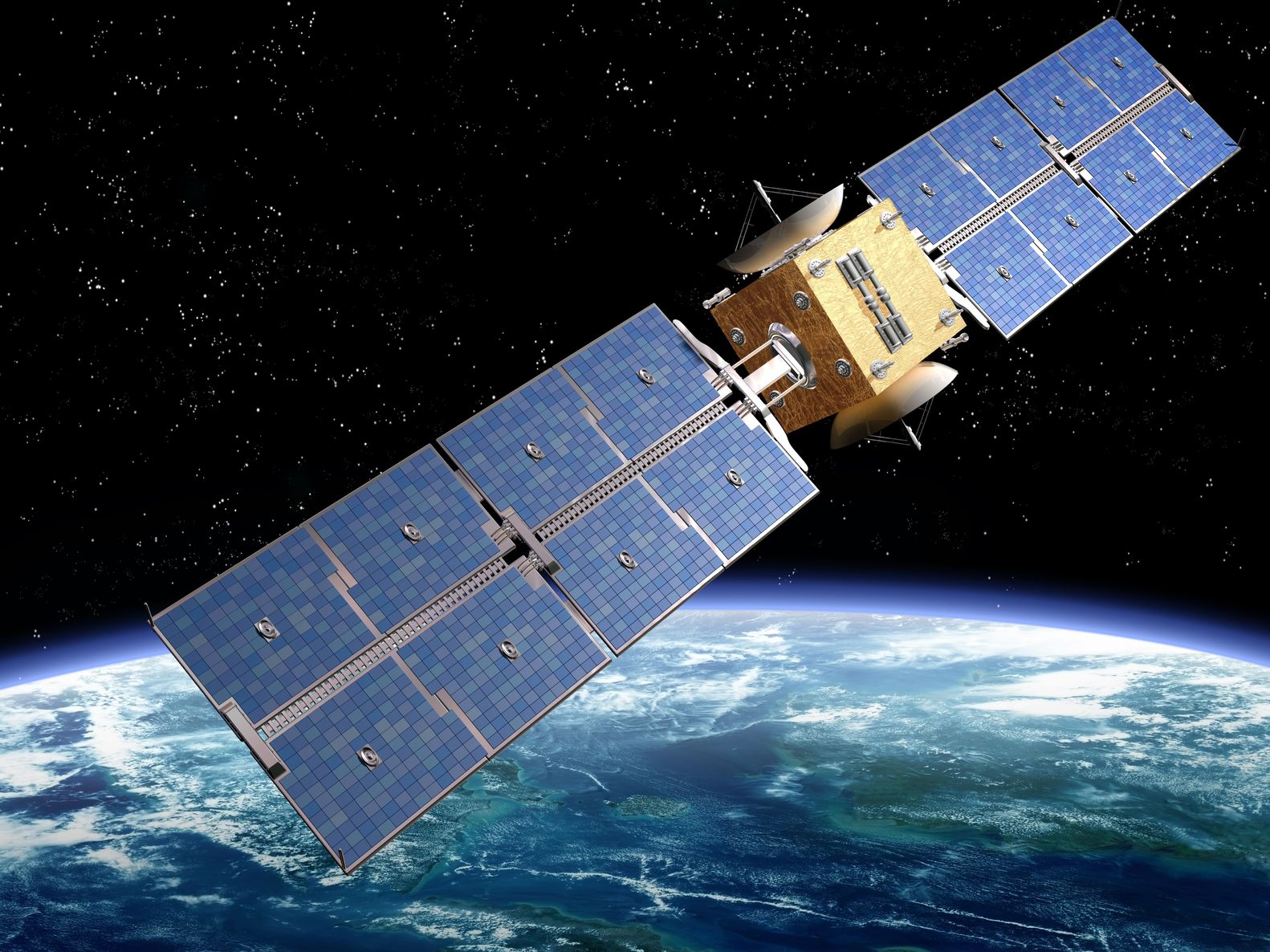
Artist’s rendition of a satellite – paulfleet/123RF Stock Photo
The focus of this week’s blog is India with the anticipated launch of an Earth Observation satellite, plus a new educational course opportunity focused on artificial intelligence and machine learning.
Satellite Launch
The Indian Space Research Organisation (ISRO) has a launch of its Small Satellite Launch Vehicle (SSLV) scheduled for tomorrow, 15th August 2024, from the Satish Dhawan Space Centre in Sriharikota, India.
The main payload will be the Earth Observation Satellite-08 (EOS-08), which will carry three instruments:
- Electro-Optical Infrared Payload (EOIR) – a high resolution optical imager working across both the Mid-Wave Infrared (MIR) and Long-Wave Infrared (LWIR) bands. It will collect data both during the day and at night, with the data expected to be used for applications such as surveillance, disaster monitoring, environmental observation, fire detection, and volcanic activity tracking.
- Global Navigation Satellite System-Reflectometry payload (GNSS-R) – a dual polarisation, dual frequency L1/L5 bands GNSS Receiver, demonstrating how this can be used to collect data for applications including ocean surface wind, soil moisture, cryosphere research over the Himalayan region, flood detection, and monitoring of inland water bodies.
- SiC UV Dosimeter – monitors ultraviolet irradiance and operates as a high-dose alarm sensor for gamma radiation.
This satellite is expected to be the last of EOS satellites to be launched, which began with the launch of EOS-01 on the 7th November 2020. The main mission focus for EOS-08 is operational meteorology, and it is also expected to make significant contributions to climate monitoring and space weather. It is due to be put into a low-earth orbit at around 475 kilometres altitude, with a mission life of one year.
Alongside EOS-08, two nano-satellites are being launched on this flight:
- IITMSAT (IIT Madras Satellite) – Nano-satellite built by students of the Indian Institute Of Technology – Madras. It will collect data about electrons and protons in the Earth’s upper-ionosphere, and its main aim is to study the energy spectrum of charged particles in the upper ionosphere and understand the effects of solar storms, lightning storms and seismic activity.
- Space Rickshaw-0 (SR-0) is a demonstration mission focused on amateur radio operators which can send, and receive, messages. It also has an educational element for school and college students to teach them about amateur radio and nano-satellites.
India Space Research Organisation Course on Machine Learning & Artificial Intelligence
Last week ISRO also announced a free five-day online course about artificial intelligence and machine learning with a focus on geospatial data processing. It will cover the main concepts, supervised and unsupervised learning, deep learning techniques, machine learning through Google Earth Engine, and Python programming for machine and deep learning models.
The course is part of the Indian Institute of Remote Sensing (IIRS) outreach program, and is aimed at undergraduate & postgraduate students, researchers & technical and scientific staff in government departments. By widening the knowledge base about these technologies, the IIRS hopes to increase interest and involvement in the sector, which will ultimately drive innovation.
Conclusion
While many companies, and countries, continue to launch satellites, it is fantastic to see that ISRO is also concerned about ensuring that it has people with the downstream skills required to manage, analyse, and visualise the data produced by these satellites as this is the way that discoveries are made, not by simply launching the satellite. We hope that some of the students on the course move into the exciting and interesting space sector, and who knows, we may see some of them at future conferences!
