

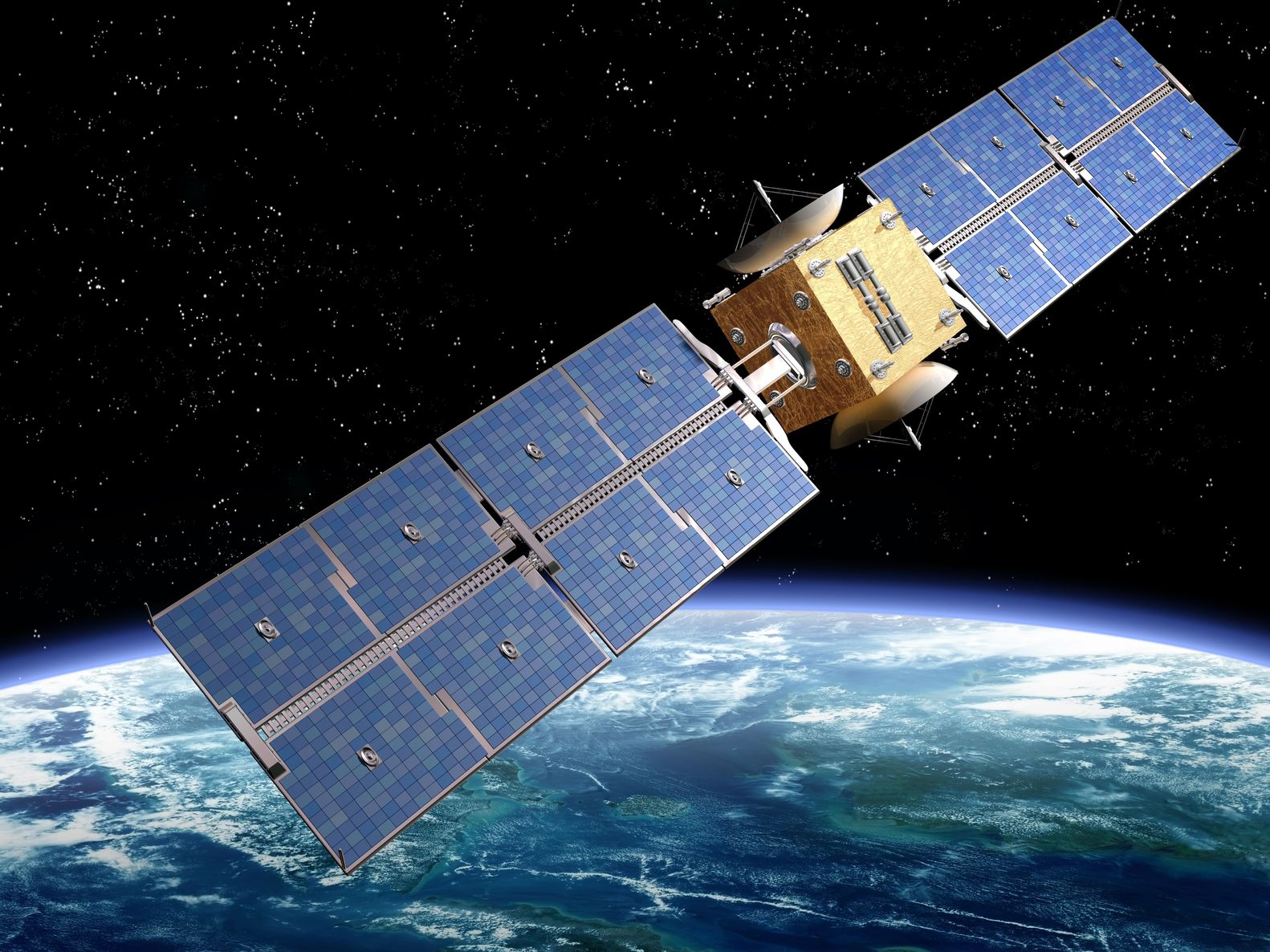
Artist’s rendition of a satellite – paulfleet/123RF Stock Photo
Despite it being Easter last weekend, there has still been a raft of Earth Observation (EO) satellite activity happening around the world.
We’re picking out some of the ones that caught our eye this week, including new launches, new contracts and newly operational satellites.
Satellite Launches
NASA’s Tropospheric Emissions: Monitoring of Pollution (TEMPO) instrument was launched into a geostationary orbit last Friday from a SpaceX Falcon-9 rocket taking off from Cape Canaveral Space Force Station. The instrument is a payload hosted on the Intelsat 40e satellite, a communications satellite operated by Intelsat.
TEMPO carries a grating spectrometer sensitive to visible and ultraviolet wavelengths that detects pollutants by measuring sunlight reflected and scattered from the Earth’s surface and atmosphere. It will provide hourly data for North America on pollutants including ozone, nitrogen oxide, sulphur dioxide and formaldehyde. The instrument has a spatial resolution of 2 km per pixel in the north-south direction and 4.5 km per pixel in the east-west direction, giving a significant improvement over current similar EO datasets. The data will enhance air-quality forecasts in the region, and should enable more effective early warnings of pollution incidents.
TEMPO will join the existing Korean Aerospace Research Institute GEO-KOMPSAT-2B satellite to form a multinational constellation measuring pollutants in the Northern hemisphere. They will be joined by European Space Agency’s Sentinel-4 satellite, due to be launched next year.
The second launch is the next SpaceX rideshare mission we discussed in our previous blog, it was due to take off yesterday. However, the launch was delayed and is now hoped to go into orbit today at the earliest. An additional interesting EO payload has been confirmed which is the DEWA-SAT2, a cubesat for the Dubai Electricity and Water Authority (DEWA). The satellite carries a multispectral imager with seven spectral bands and offers a spatial resolution to 4.7 metres. It also carries an infrared instrument to measure greenhouse gases.
DEAW-SAT data will be used to improve forecasting of weather patterns, seawater temperature and salinity to improve the efficiency of solar power plants run by DEWA and improving accuracy of solar generation forecasts. The satellite will also monitor electricity transmission lines and will support the identification of water leaks impacting operations.
Data Contract
On Friday, NASA announced it had awarded a Blanket Purchase Agreement to Capella Space for the provision of high-resolution Synthetic Aperture Radar (SAR) EO data using its constellation of SAR cubesats offering a spatial resolution of 0.5 to 1.2 metres. The contract, which for allows the repetitive ordering of SAR data, will last for five years.
Operational Satellite
Last week, China’s Ministry of Ecology and Environment announced that the Gaofen-5 02 hyperspectral EO satellite had completed its calibration testing phase and was ready to become operational.
The satellite was launched on the 7th September 2021 and the payload is believed to include:
- Advanced Hyperspectral Imager (AHSI) including visible and short wave infrared bands.
- Visual and Infrared Multispectral Sensor (VIMS)
- Greenhouse-gases Monitoring Instrument (GMI)
- Atmospheric Infrared Ultraspectral (AIUS)
- Environment Monitoring Instrument (EMI)
- Directional Polarization Camera (DPC)
The data from the satellite will is to be used for applications such as environmental monitoring, mineral surveys, agriculture and climate change.
Summary
All this shows that the global satellite industry never sleeps, and there is always something exciting happening somewhere in the world.
