

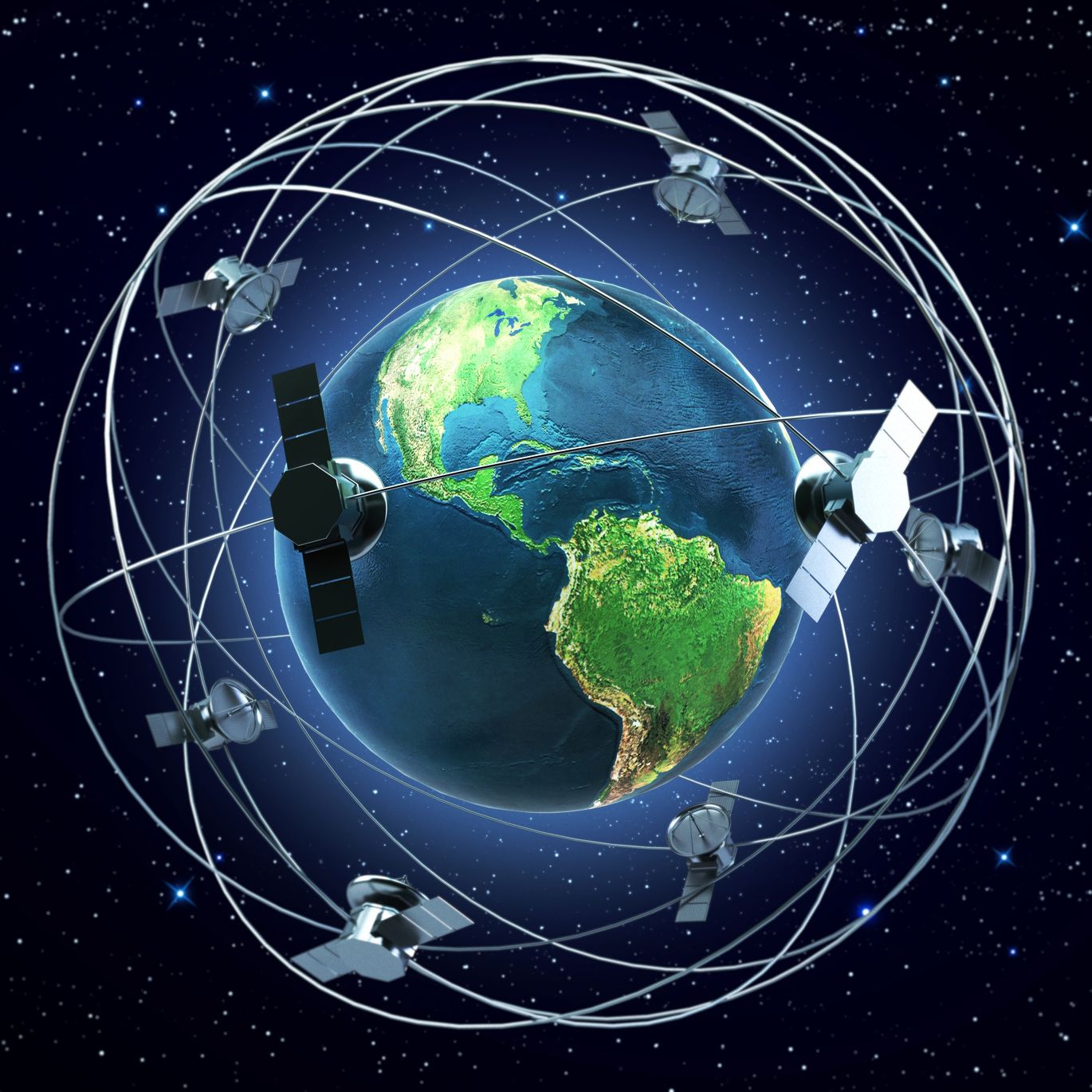
Artist’s rendition of satellites orbiting the Earth – rottenman/123RF Stock Photo
Latest news in the world of Earth Observation (EO) includes the launch of two new satellites, and the latest updates on the European Space Agency’s (ESA) Sentinel-1 constellation.
Gaofen-3 03
Last Thursday, China successfully launched the Gaofen-3 03 EO satellite last from the Jiuquan Satellite Launch Centre on a Long March-4C rocket. This is the third Gaofen-3 satellite to be launched, and joins the first two, creating a three satellite constellation in orbit. The first of the three was launched on 9th August 2016 and the second on the 22nd November 2021.
The Gaofen-3 satellites have multi-polarized C-band Synthetic Aperture Radar (SAR) instruments on board with a reported one metre spatial resolution and the constellation offers a temporal revisit resolution of five hours, allowing the collection of data over the same area five times each day. The data will support marine environment monitoring, marine disaster support, water conservation, together with meteorology and agriculture applications.
EnMAP
The second satellite launched recently was the German EnMAP (Environmental Mapping and Analysis Programme) hyperspectral EO satellite, which took off from Cape Canaveral in Florida aboard a SpaceX Falcon-9 record on the 1st April. It successfully reached its intended altitude of 642 km a few days later on the 9th April.
The satellite has 200 spectral bands, ranging from 420 nm to 1000 nm in the Very Near Infrared (VNIR) and from 900 nm to 2450 nm in Short Wave Infrared (SWIR). It has a spatial resolution of thirty square metres, a swath width of 30 km and a four day revisit time. EnMAP is managed by the German Space Agency DLR, and its aim is to study environmental changes, investigate ecosystem responses to human activities, and monitor the management of natural resources.
Sentinel-1
We wrote last month about ESA’s ambition to move up the launch schedule for Sentinel-1C due to the ongoing problem with Sentinel-1B. ESA announced last week that they had signed a contact with Arianespace for the launch of Sentinel-1C. The satellite will be put into orbit by the new Vega-C rocket from the European spaceport in French Guiana, with the anticipated launch date being in the first half of 2023.
If problems with Sentinel-1B aren’t sufficient, Sentinel-1A had to undertake collision avoidance action on the 1st April to reduce the risk of collision with Zenit-2 rocket debris from a launch in September 1996. Whilst such manoeuvres are more common than you might think, this caused a number of Sentinel-1A data downloads to be cancelled, and had the potential to impact SAR data acquisitions before, during and after the action. This shows how precarious services based on Sentinel-1 data can be at the moment. It is hoped that Sentinel-1C successfully launches as soon as possible.
Implications for Earth Observation
EO is an ever growing field with more data continually available. Whilst this seems a golden opportunity for companies to develop services using this data – particularly those that are free to access, it is important to remember that anything can happen in space that can derail your service. Have back-ups or alternatives available for any mission critical services, and ensure your service agreements cover situations beyond your control.
