

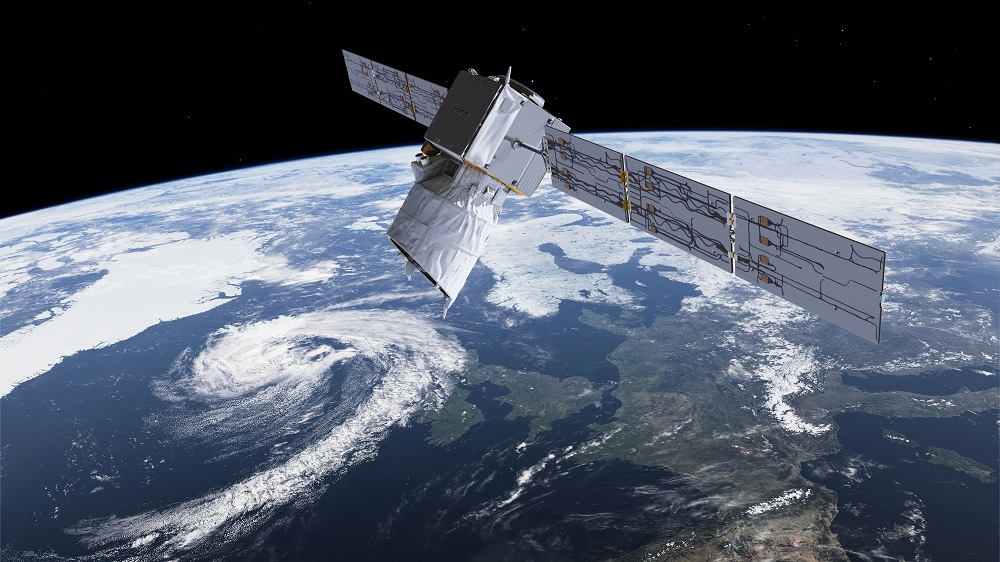
Artists Impression of ESA’s Aeolus wind mission. Image courtesy of ESA/ATG medialab.
This week we have details of new satellite launches, a problem on the James Webb Space Telescope, and the impending death of the Aeolus satellite – essentially various aspects of the life cycle of an instrument or satellite.
Satellite Births
On Saturday 22nd April, the Indian Space Research Organisation’s (ISRO) Polar Satellite Launch Vehicle rocket successfully put two Singaporean satellites into 586 km orbits from the Satish Dhawan Space Centre.
The two satellites were:
- TeLEOS-2 – a synthetic aperture radar Earth Observation (EO) satellite with a ground resolution of 1m. The satellite will be operated in partnership between the government of Singapore and ST Electronics, who built it, and the government using the data. ISRO also launched TeLEOS-1 on the 16th December 2015, which at the time, was Singapore’s first commercial EO satellite.
- LUMELITE-4 is a cubesat communications demonstrator of a VHF Data Exchange System for maritime users. This has the potential to be a long-term replacement for the Automated Identification System (AIS) currently use to identify the position of vessels. It is believed it may also offer improved safety at sea. It was co-developed by the National University of Singapore and Singapore’s Agency for Science, Technology and Research.
Problems
According to a NASA statement last week, there is a problem with a sensor on the James Webb Space Telescope. The problem affects only one of the seventeen modes, but routine maintenance noted that the Mid-Infrared Instrument (MIRI) is receiving less than the expected amount of light at the longest wavelengths. MIRI has both a camera and spectrograph, and further analysis showed the amount of light entering into the instrument has been decreasing since it was commissioned last year. However, no effect has been seen for MIRI imaging, and all other observation modes remain unaffected. NASA said there is no risk to the instrument.
NASA and partners are currently investigating the issue to determine what next steps to take. One mitigation strategy suggested would be taking slightly longer exposures at the affected wavelengths to increase the signal to noise ratio and, hopefully, produce better images.
Satellite Dying
This coming Sunday, 30th April, sees the end of operational data collection for the European Space Agency’s (ESA) Aeolus satellite.
It was the first satellite to capture wind profiles across the planet in near-real time and appropriately was named after Aeolus, who in Greek mythology was appointed ‘keeper of the winds’ by the Gods. It went into orbit on the 22nd August 2015, carrying a single instrument, the Atmospheric Laser Doppler Instrument (ALADIN).
This is a wind lidar that is a combination of lasers, a telescope, and a very sensitive receiver system that measures the winds in the bottom 30 km of the atmosphere. The lasers generate a series of short light pulses in the ultraviolet spectrum at 355 nm; this wavelength is used as backscatter from atmospheric molecules is particularly strong. The return signal of these pulses is captured by a 1.5 m wide telescope and directed toward the receiver.
As data on wind speeds are rare, Aeolus data is used by major weather forecasting services worldwide; it provided an insight into aerosols in volcanic plumes and provided a major metrological data source during Covid when the data from planes was no longer available. ESA’s estimates Aeolus has beamed down over seven billion laser pulses during its lifetime.
The instrument is still performing well due to a recent upgrade to the laser instrument, however, a lack of fuel together with increasing solar activity has brought the mission to an end; although an almost eight years mission is pretty good for a satellite with an expected life of only three years. It is expected that Aeolus will be brought down toward Earth in the coming weeks, where it will burn up in the atmosphere. There are already plans for a follow-on mission, Aelous-2.
Conclusion
Working in the space industry has its highs, lows, and problems to sort out – a bit like life!
