

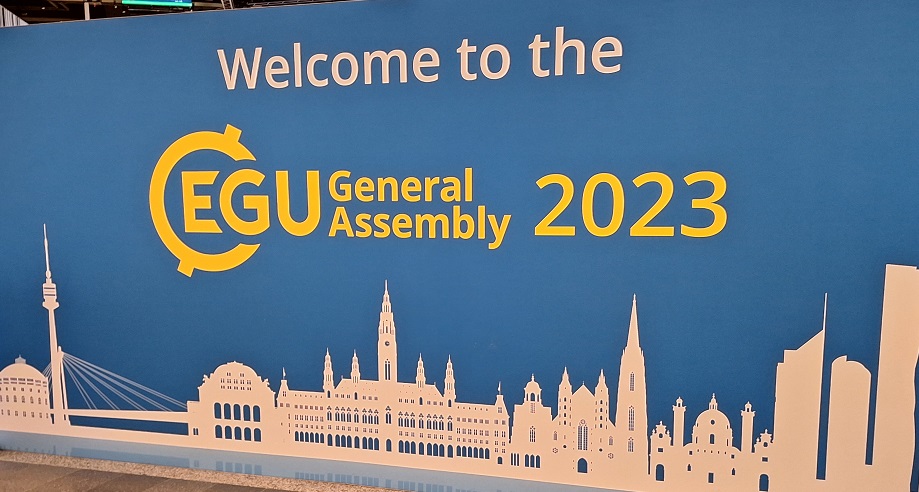
 Last week I was in Vienna attending the European Geosciences Union (EGU) General Assembly 2023, alongside 15,000 other people, and it was as extensive and diverse as I remember from previous events. This is demonstrated by the organisers reporting there were 16,357 presentations given in 938 sessions over the week! I can believe that as navigating around the venue was not easy with some many rooms holding sessions.
I was co-chairing one of these sessions, a PICO session on ‘Challenges and Opportunities for Findable, Accessible, Interoperable and Re-usable Training Dataset‘. Within the session, I also gave a presentation, ‘OGC Testbed-18 Machine Learning Training Datasets Task: Application of standards to Machine Learning training datasets’ on behalf of the team working on the Open Geospatial Consortium (OGC) Testbed-18 activity on Machine Learning (ML). The work by FrontierSI, Curtin University, and Pixalytics Ltd investigated the need for best practices and guidelines for generating, structuring, describing, and curating training datasets, together with providing recommendations on how OGC can leverage the creation of a future standard for ML training data for Earth Observation (EO) applications.
This session was in the Earth & Space Science Informatics programme, and it provided interesting and varied different interpretations of the session topic. It began with a presentation from the European Space Agency on their Earth Observation Training Data Lab (EOTDL). My presentation was followed by a second OGC talk on ‘The OGC Training Data Markup Language for Artificial Intelligence (TrainingDML-AI) Standard’. Together these presentations set the scene for the following ones that looked at how to curate training datasets, including setting up a community-maintained searchable table and creating websites so users can better understand the contents and ask questions. The session then moved into applications, considering point clouds, geological datasets, underwater images, and lithological mapping. The short talks were followed by an interactive session where the slides were available on touchscreen monitors to support interactive poster-style discussions.
Despite the diversity of talks, I was very much focused on ML and Artificial Intelligence (AI) at the event, so you can guess what I’m currently working on! I also attended the PICO session ‘Strategies and Applications of AI and ML in a Spatiotemporal Context‘, which gave insights into the new approaches and applications for ML. I was intrigued by a presentation on atmospheric plume modelling that reinforced the usefulness of Gaussian Processes for taking into account time in addition to spatial correlation. It’s not something I’ve tried before, but I’ve added it to my list of things to experiment with!
I caught up with past and current colleagues for the rest of the event, including former and current Pixalytics interns! I viewed various presentations alongside many posters, but I managed only a fraction of those on offer. It was an excellent insight into the state-of-art for EO and the topics everyone is working on.
Following getting back to attending events after the recent pandemic, I am striving to reduce my Carbon footprint. I opted for a combined bus/flight/train approach for EGU, as I’m also in Geneva for a meeting this week. It took two days to get there, which included trains starting from different stations than the booking said, although that was better than the booked train being cancelled! After completing the return journey to Switzerland over the weekend, I’ve concluded that train journeys were stressful and tiring! However, I will preserve and try carbon lite travel again!
