

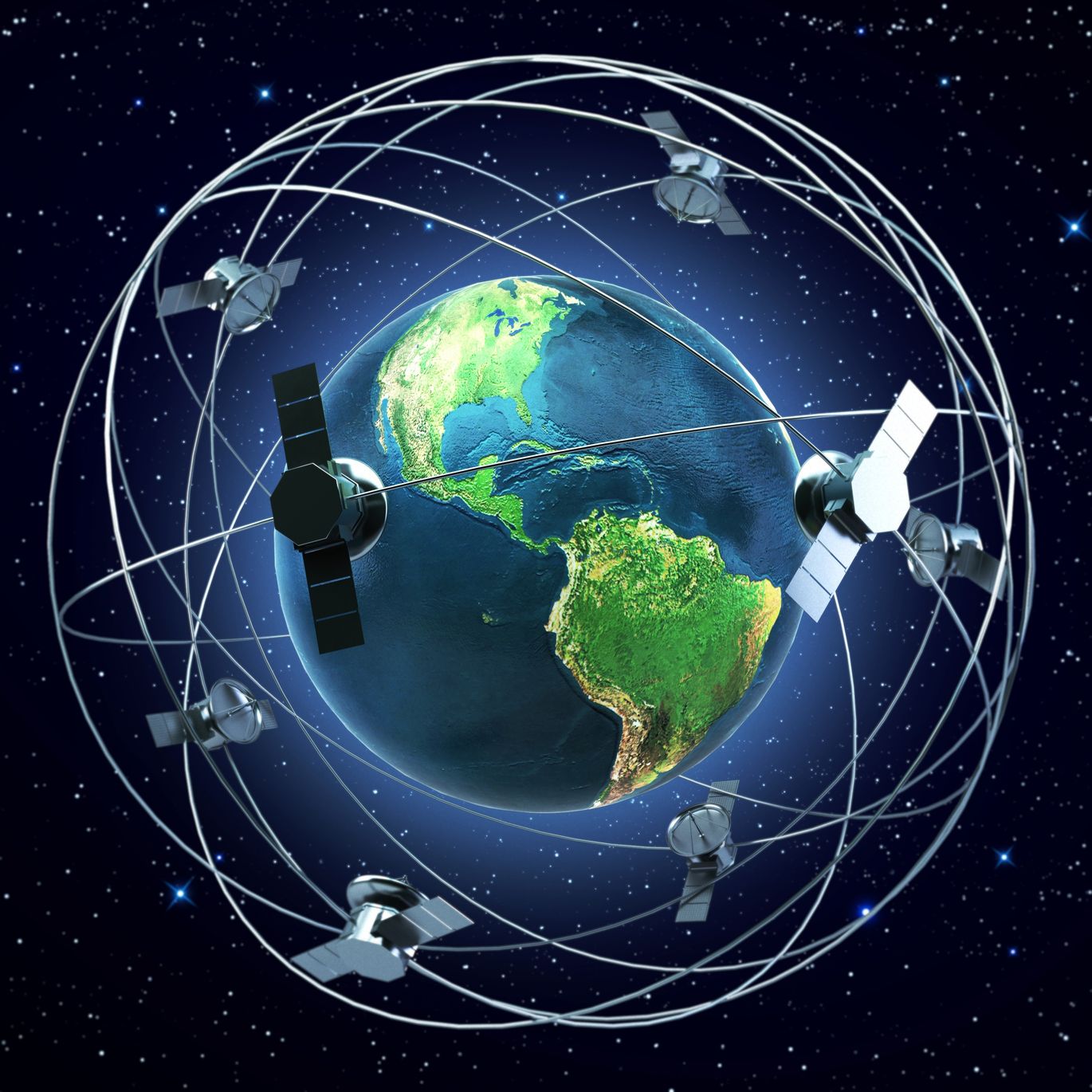
Artist’s rendition of satellites orbiting the Earth – rottenman/123RF Stock Photo
This week we’re looking at an usual case of satellite stalking, alongside a busy week for Chinese Earth Observation (EO) satellite launches.
Russian Stalking!
Last week there were reports of Russian satellite effectively stalking a commercial EO satellite. Reports described how the Russian-made satellite called Kosmos 2612 swooped towards the ICEYE-X36 satellite belonging to the Finnish commercial company, ICEYE.
Reports varied on how close the two satellites got with some suggesting as close 30 metres, others it was within 500 metres, others it was around 1,500 metres – all this indicates the difficulty of measuring of using geometry in space to measure this distance. The Russian satellite appeared to undertake a series of manoeuvres on the 15th and 16th October to reduce the distance between the two satellites from 350 kilometres to under 5 kilometres. The Russian satellite remained close for the next three days, before it began moving away.
However close the two satellites got to each other, this was an unusual move and the reason for this are not clear, although earlier this year other Russian satellites had aligned themselves with ICEYE-36. There are some reports that ICEYE-X36, which is SAR a satellite, was supporting Ukraine in the conflict with Russia and the proximity could involve electronic interference, although there is no evidence of this. However, given such orbital adjustments would take a lot of fuel, there was likely a purpose behind the move.
While there is a lack of clarity over this incident, it does demonstrate another issue of operating in space, and how commercial companies can defend themselves against potential threatening acts as there is no strict legal limit on how close satellites can fly together, although generally satellites avoid getting within six kilometres of each other for practical and safety reasons.
Chinese Satellite Launches
Last week was busy one for Chinese EO satellite launches. It began on Wednesday, 21st October, when the commercial Chinese company, Galactic Energy, launched the Xiguang-4 01 satellite (Wuyang Constellation Pilot A) from a Ceres-1 sea-launch rocket from waters near Shandong.
This is first satellite in a low-inclination constellation, which is forecast to have three pilot satellites and 25 operational satellites. Xiguang-4 01 has a 0.5-metre high-resolution camera with a wide-swath and is in orbit at around 540 kilometres. The commercial service will provide data for applications including natural resource monitoring, agricultural production, marine observation, ecological protection, flood and typhoon emergency response, disaster mitigation and urban governance. There will be a focus for services for the Guangdong-Hong Kong-Macao Greater Bay Area, South China, and low-latitude regions along the Maritime Silk Road – is the sea-based component of China’s Belt and Road Initiative (BRI), linking Chinese coastal ports through Southeast Asia, South Asia, East Africa, and the Middle East to European hubs via the Indian Ocean, the Suez Canal, and the Arctic.
This was followed by a pair of Long March rocket launches at the end of the week. It started on Friday 23rd October, a Yaogan 50C satellite was launched on a Long March 6A rocket from the Taiyuan Satellite Launch Center. This is the third of the Yaogan 50 series, following A and B satellites which were launched in January and March respectively. The applications for the data of this satellite are reported as land resource surveys, agricultural yield forecasts, alongside disaster prevention and mitigation.
The following day, Saturday 24th October, a further six Yaogan EO satellites were launched from the Jiuquan Satellite Launch Center on a Long March-4B rocket. The six satellites were:
- 3 x Yaogan-53 satellites, numbers -07, -08 & -09; plus
- 3 x Yaogan-56 satellites, numbers -19, -20, & -21.
According the official reports, these satellites will mainly support scientific experiments, land and natural-resource surveys, crop-yield estimation, alongside disaster prevention and reduction work.
As is usual with Yaogan satellites, no technical specifications for the satellites were released. This is because the satellites are reported to have a dual use; alongside the civilian/governmental uses described above, the satellites are also used for military reconnaissance.
Conclusion
An unusual and interesting week for the space sector, with some new satellite launches and some unusual manoeuvres. All of which shows how space is changing and difficult an environment it is to operate in.
