

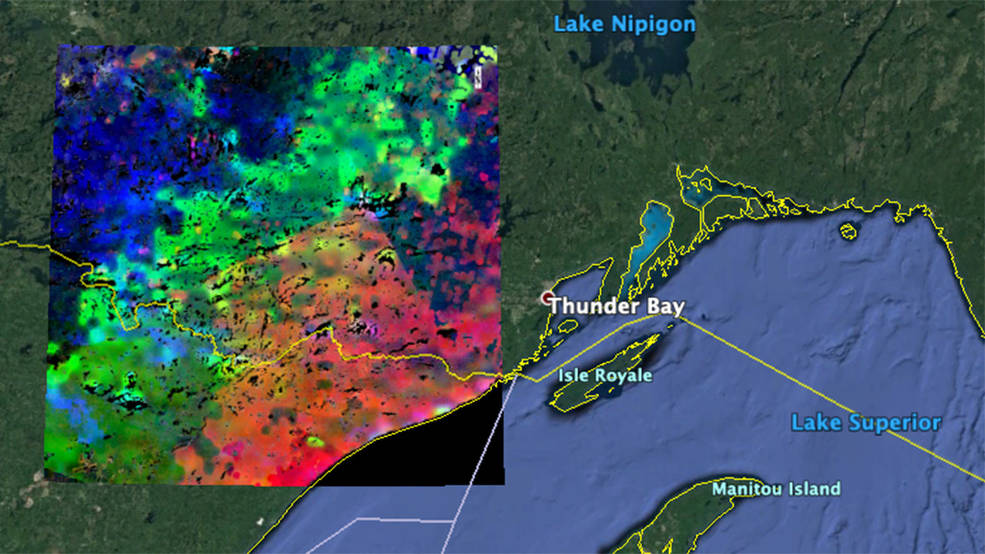
Plants “waking up” near Lake Superior. Red areas wake up at around 7 a.m. local time; green areas around 8 a.m.; and blue areas, at about 9 a.m. The data was acquired by ECOSTRESS during the summer season.
Credits: NASA/JPL-Caltech
Evapotranspiration is an area we’ve been working within for the last few years, and have previously written about, and so it was interesting to see a new article published last week in the Nature Climate Change journal. The paper, ‘Evapotranspiration frequently increases during droughts’, by Zhao and Liu et al uses satellite data to determine the impact of drought on plants and the evapotranspiration process.
Evapotranspiration is the total loss of water from the soil and plants through the two processes of evaporation and transpiration. Evaporation is the loss of surface water to the air, whereas transpiration is the loss of water plants gives off in water vapour through pores in their leaves – called stomata. This process is less understood in drought conditions, as some research has indicated that the process declines due to the lower soil moisture causing less evaporation, but other research suggests it could actually rise due to the increase in atmospheric moisture requirements. The researchers from Stamford University were looking to understand these previous studies and better determine how the process works in drought scenarios.
The team used satellite data from the Gravity Recovery and Climate Experiment (GRACE) and GRACE Follow-On (GRACE-FO) missions to determine the global total water storage, and combined this with Global Precipitation Climatology Project precipitation data to produce a global water balance. As Evapotranspiration is an indicator of water stress in plants, where a plant does not gather as much water as it loses, the researchers were able to identify large changes in water mass through this process. They found 44.4% of plants would lose more through evapotranspiration during a drought – almost double the currently accepted estimate of 25% – despite there being less water in the soil.
This an important discovery as it means that many Earth system models will not be estimating the correct values for the evapotranspiration process during droughts, and potentially also incorrectly take account of rain under high leaf canopies and changes in soil structures. Adjusting these variables may allow models to better predict flash flooding in drought areas.
Droughts are critical disasters for the planet, and any improvement in predictions or forecasting of their impacts is to be welcomed. Earlier this year, the United Nations Convention to Combat Desertification released their “Drought in Numbers 2022” report that estimated 55 million people globally are directly affected by droughts every year, and that it was the most serious hazard to livestock and crops in nearly every part of the world. In a twenty-year period between 1998 and 2017 droughts led to losses of US$124 billion.
It’s currently expected that this issue will only grow, and forecasts suggest that by 2050 drought will impact over 75% of the world’s population. This will have widespread and underestimated impacts on societies, ecosystems, and economies, but droughts are still underestimated; a concept explored further by Simon Clark in his EGU Blog this week ‘Why do we keep dismissing drought?’
The evapotranspiration products we’ve developed in Pixalytics are focused on small local changes, rather than the global picture as discussed by this report and paper. It is interesting and exciting to see the knowledge in this area being enhanced and further developed.
Paper Citation
Zhao, M., A, G., Liu, Y. et al. Evapotranspiration frequently increases during droughts. Nat. Clim. Chang. (2022). https://doi.org/10.1038/s41558-022-01505-3
