

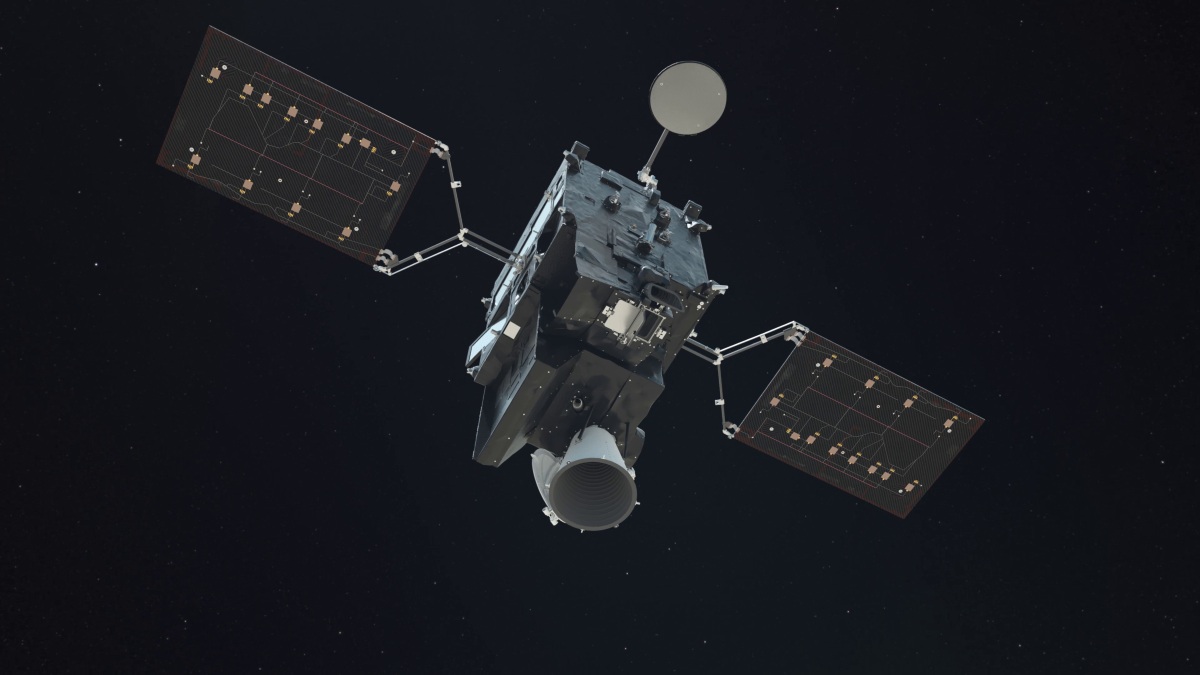
Artist’s impression of Copernicus Sentinel-4 mission carried on the Meteosat Third Generation Sounder (MTG-S) satellite. Image credit: ESA/Mlabspace
It has been a rollercoaster week for those of us involved in atmospheric satellite remote sensing. The positive side has seen the launch of Sentinel-4, but the flip side has seen the reported loss of MethaneSAT.
Sentinel-4 Launched
Copernicus Sentinel-4 was successfully launched last week, carried onboard EUMETSAT’s Meteosat Third Generation Sounder weather satellite (MTG-S1), into a geostationary orbit at an altitude of 36,000 kilometres by a SpaceX Falcon 9 rocket on the 1st July 2025.
Sentinel-4, which was built by Airbus, is an ultraviolet, visible and near-infrared spectrometer focused on monitoring air quality. It has a spatial resolution of 8 kilometres and a revisit time of one hour, and will provide information on a wide range of trace gases and pollutants over Europe and North Africa including nitrogen dioxide, ozone, sulphur dioxide, and formaldehyde, as well as aerosols.
This data will be used across Europe for monitoring air quality, forecasting air pollution events, and understanding long-term changes in the atmosphere. Like all Copernicus missions, the data from Sentinel-4 will be made freely and openly available to anyone who wants to use it.
Having Sentinel-4 integrated into a weather satellite allows scientists to simultaneously measure both weather phenomena and atmospheric chemical composition, which will help us better understand the interactions between these two aspects of the atmosphere and ultimately lead to more accurate weather forecasts.
MethaneSAT Lost
It has been reported that the MethaneSAT mission operations lost contact with satellite on 20th June 2025. Despite attempts to restore communications, last week the Environment Defense Fund (EDF), who oversee the satellite, declared that it had lost power and was likely not recoverable.
MethaneSAT was launched on the 4th March 2024, by SpaceX aboard a Falcon 9 rocket, which took the satellite into a sun synchronous 590-kilometre orbit. The satellite contained two passive littrow infrared spectrometers operating across slightly different wavelengths, and they had a ground resolution of 100 metres or 400 metres depending on which mode was being used, with a swath width of 200 kilometres.
The satellite aimed to detect releases of the methane from oil and gas production around the world, and had been regularly releasing global maps. Unlike several other methane monitoring satellites, much of its data was made publicly available. Due to the sensitivity of its spectrometers, it was able to identify smaller sources of methane; and in a paper published earlier this year in the journal Atmospheric Chemistry and Physics EDF Scientists found that 70% of United States oil and gas methane emissions came from smaller dispersed sources emitting less than 100 kilograms, which often wouldn’t show up under previous measurements.
It was expected to have a mission life of at least five years but, sadly, with the news last week, it only last sixteen months. EDF are currently undertaking an investigation to try and determine what happened and have promised to share what they learn.
Summary
It is exciting to see what data Sentinel-4 will produce, but truly sad to see the loss of MethaneSAT that was delivering exciting new insights into methane and its impact on the climate. The loss will impact the monitoring of this gas until a similarly sensitive sensor can be put into space.
