

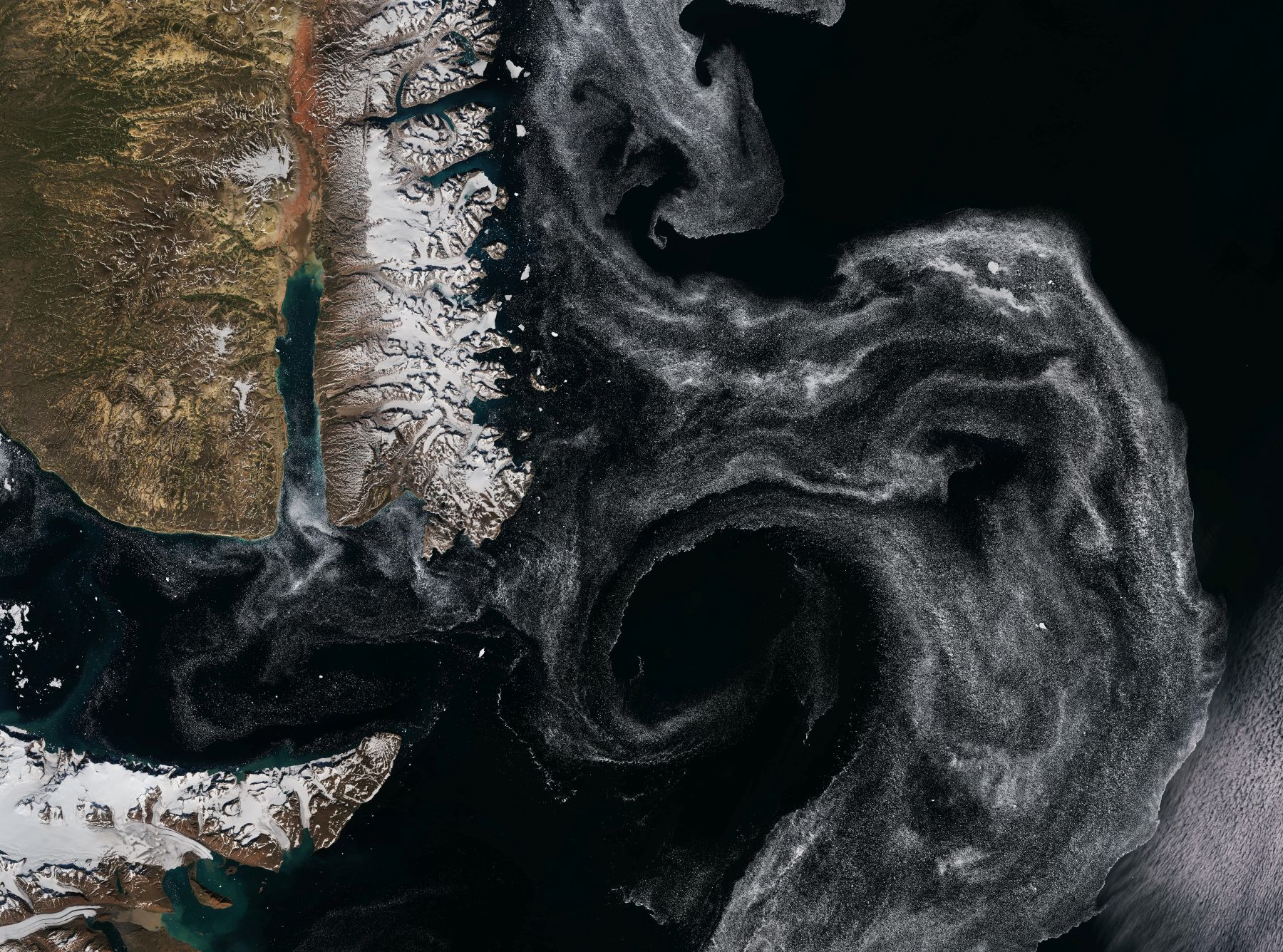
The Liverpool Land peninsula, on the east coast of Greenland. Image acquired by Copernicus Sentinel-2. Image
contains modified Copernicus Sentinel data (2022), processed by ESA. ©ESA.
Pixalytics is delighted to announce its participation in a critical research project about forecasting a major climate tipping point – the potential collapse of the Atlantic Subpolar Gyre.
Sitting just south of Greenland and Iceland, the Atlantic Subpolar Gyre is a key component of the global ocean’s circulation system, transporting heat around the planet, helping to regulate temperatures in Europe and North America. Its collapse could have a major global impact on our weather, food and security, but existing climate models and ocean observations are too limited to accurately forecast a tipping point which could signal its collapse.
Forecasting Tipping Points
On Sunday, the UK’s Advanced Research and Invention Agency (ARIA) announced a five-year, £81 million Forecasting Tipping Points programme covering eight projects focused on creating an early warning system capable of equipping the world with the information, understanding and time needed to accelerate proactive climate adaptation and mitigation.
Pixalytics is part of the Aerial Experimental Remote sensing of Ocean Salinity, heaT, Advection and Thermohaline Shifts (AEROSTATS) project which is being led by the UK’s National Oceanography Centre (NOC) – it is one of three interlinked projects led by NOC to detect early warning signs of a change in the Atlantic Subpolar Gyre.
AEROSTATS is an ambitious airborne earth observation project focused on observing fine-scale interactions between the air, ocean and ice in the Greenland sea ice margins. This will include exploring the use of airborne platforms such as airships or high-altitude pseudo-satellites to create cost-effective, long-term monitoring capabilities. Alongside NOC are partners NOVELTIS, Radarmetrics and Pixalytics Ltd.
“This is a truly bold airborne earth observation project,” said NOC’s project lead Professor Christine Gommenginger. “Our vision is cost-effective, long-term monitoring capabilities that support early warning of a potential Subpolar Gyre shutdown. With partners across diverse sectors, we’re a cross-disciplinary group bridging technology, climate science and a commitment to tackling climate challenges through innovation.”
“It’s exciting to be exploring the potential opportunities offered by novel earth observation platforms.” said Pixalytics Managing Director, Dr Samantha Lavender. “The project gives the possibility of observing the ocean in ways not achievable before, creating a suite of physical and biological focused measurements for a very challenging environment.”
ARIA was created to unlock technological breakthroughs that benefit everyone by funding scientists and engineers to pursue research at the edge of what is scientifically and technologically possible. ARIA’s Tipping Points Programme was launched by ARIA Chief Executive, Ilan Gur, on the BBC’s Sunday with Laura Kuenssberg last weekend, where he talked about the programme.
Alongside AEROSTATS, the two interlinked Forecasting Tipping Points projects led by NOC focused on the Atlantic Subpolar Gyre are:
- Full Ocean Fibre will develop the acoustic and fingerprinting techniques needed to identify ocean processes and provide an unprecedented view of the deep North Atlantic from existing cables, setting the scene for the next generation ocean and climate observing network enabled by the global network of subsea cables.
- Subpolar gyre Observations, models and artificial intelligence to Resolve Tipping points and provide Early warning Detection (SORTED) will use artificial intelligence (AI) and models to push the limits of existing ocean observations.
Conclusion
It’s incredibly exciting to be involved in cutting edge Earth Observation work, and we’re looking forward to seeing what opportunities and potential by these new EO platforms.
