

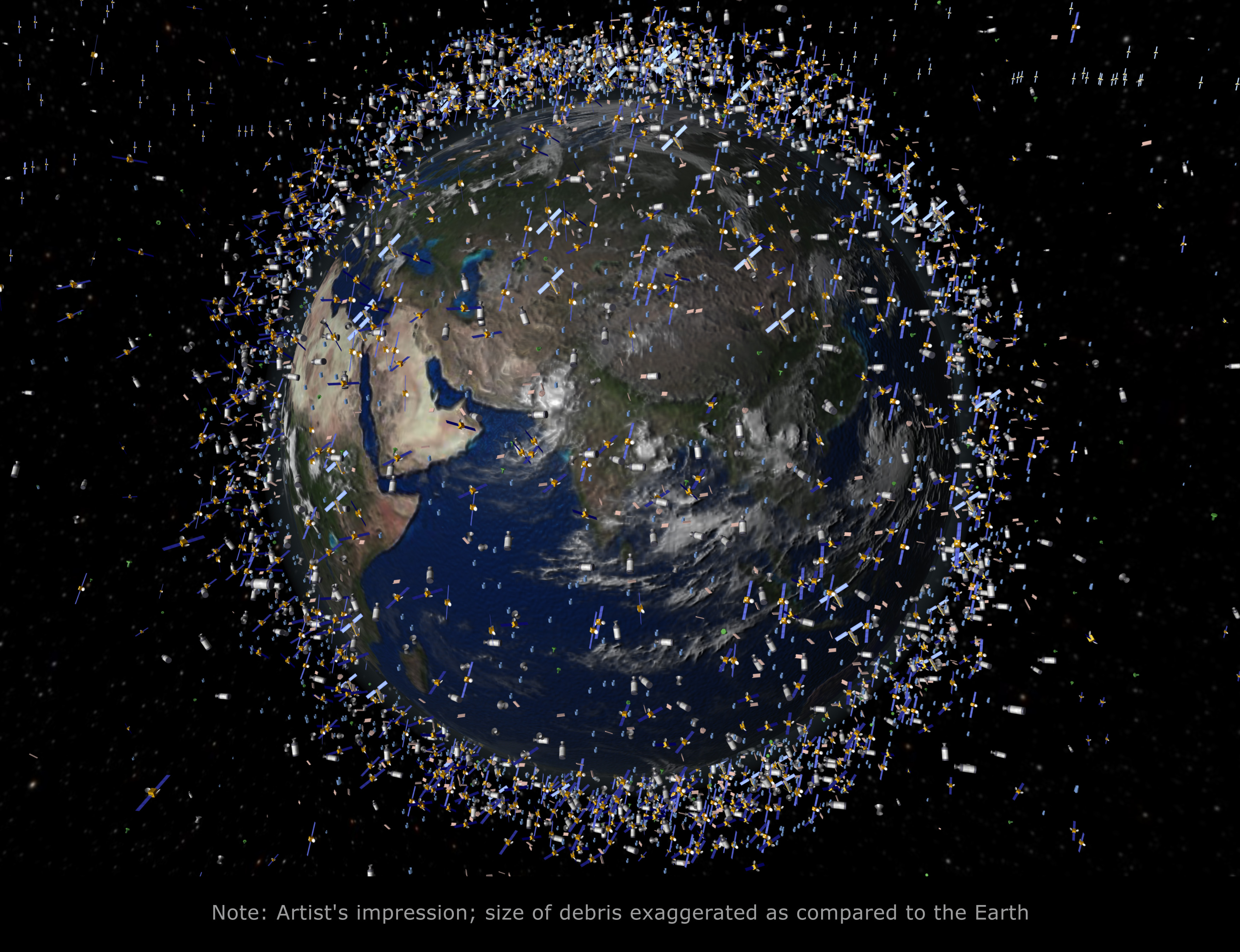
Image courtesy of ESA
Note: The debris field shown in the image is an artist’s impression based on actual data. However, the debris objects are shown at an exaggerated size to make them visible at the scale shown
The danger of being in space was highlighted in the last couple of weeks with the break-up of a Russian satellite creating hundreds of pieces of space debris, which can be a risk to other orbiting craft, including those with astronauts onboard.
According to the Online Index of Objects Launched into Outer Space maintained by the United Nations Office of Outer Space Affairs there are over 13,000 objects currently orbiting the Earth. While according to the European Space Agency, it is estimated that the number of space debris objects are approximately:
- 29,000 pieces of space debris larger than 10 cm in size,
- 670,000 pieces of space debris larger than 1 cm in size, and
- More than 170 million pieces larger than 1 mm in size.
Given that a 1 mm object could cause damage to systems onboard a spacecraft, a 1 cm piece could disable it, and a 10-cm piece could cause a satellite to fragment, the dangers are obvious.
Russian Resurs-P1 Satellite Breaks Up
It is reported that the Russian Earth Observation satellite Resurs-P1 broke up in orbit on the 24th June 2024.
Resurs-P1 was launched in June 2013 and it carried several high-resolution imagers, covering both visible and infrared spectral bands. Its mission ceased at the end of December 2021 due to onboard equipment failures. It had been expected to re-enter the Earth’s atmosphere at some point during this year, but instead it has broken up.
According to LeoLabs, a private Space Situational Awareness company who monitor space for threats, the break-up created more than two hundred detectable pieces of space debris – although this could rise. LeoLabs also reported their belief that this was caused by a low-intensity explosion either from a collision or within the spacecraft itself.
These pieces of debris will be tracked and monitored both by commercial companies, such as LeoLabs, as well as various Government Agencies. However, the potential impact of the debris is shown by the different actions taken by the astronauts onboard two space stations currently in orbit.
International Space Station
Two days after the Resurs-P1 satellite broke up, the crew onboard the International Space Station (ISS) were given instructions to shelter in the three respective return spacecraft in case any of the debris hit the space station. This was described as a standard precautionary measure.
The path of the debris was monitored, and the crews remained in their spacecraft for around an hour, before being told that they could go back on board the ISS and continue with their duties.
China’s Tiangong Space Station
Although there are no reports of concerns about the astronauts on board the Tiangong Space Station, on Wednesday 3rd July two astronauts on the China’s Tiangong space station undertook a spacewalk to add physical protective shielding to external cables and pipelines to minimise the risk of damage from space debris. The spacewalk took over six hours and was completed successfully.
This isn’t the first space debris protection installed on the Tiangong Space Station, as a spacewalk lasting longer than eight hours took place in late May to add various protection on the outside of one of the modules. It’s not clear whether the latest spacewalk was a reaction to the Resurs-P1 break-up, or simply the next phase of the protection being implemented.
Conclusion
Space debris is a danger, and we’ve written about it previously, and it is why there are ongoing efforts to try to find ways to effectively capture both debris and non-functioning spacecraft. The events this week demonstrate why these efforts must continue to ensure that space is as safe as it can be for the people and objects operating there.
