

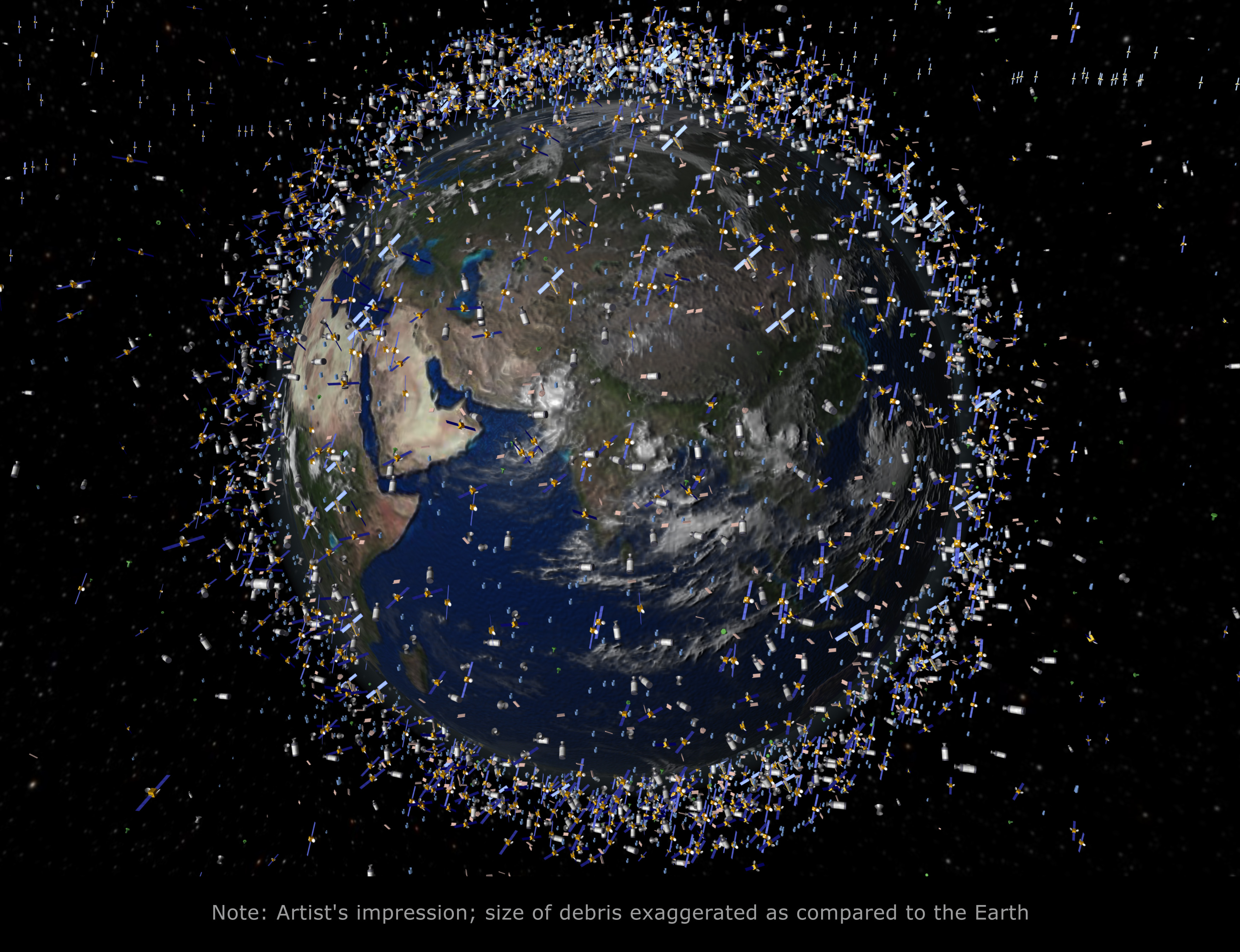
Image courtesy of ESA
Note: The debris field shown in the image is an artist’s impression based on actual data. However, the debris objects are shown at an exaggerated size to make them visible at the scale shown
This week we’re looking at two space debris satellite events occurring in the second half of this month, one coming down and the other going up!
End of ERS-2
It is anticipated that the European Space Agency’s (ESA) second European Remote Sensing (ERS-2) will re-enter the Earth’s atmosphere sometime during February 2024.
ERS-2 was launched on the 21st April 1995 from the Guiana Space Centre in Kourou, French Guiana, aboard an Ariane 4 rocket and was taken up into a sun-synchronous polar orbit at an altitude of 782 kilometres. ERS-2 was the follow-on mission from ERS-1, which was launched on the 17th July 1991. The instruments on both missions included:
- Active Microwave Instrument – Synthetic Aperture Antenna (AMI-SAR) using C-band.
- Active Microwave Instrument – Scatterometer (AMI-SCAT) also using C-band.
- Along-Track Scanning Radiometer (ATSR)
- Ku-band Radar Altimeter
In addition, ERS-2 was also equipped with:
- Global Ozone Monitoring Experiment (GOME); and
- Micro-Wave Radiometer (MWR)
The ERS missions were focused primarily on ocean observations, particularly looking at sea surface temperatures and winds, plus with the additional instruments on ERS-2 was involved in atmospheric ozone research.
These two missions blazed a trail for the later Copernicus satellites, for example, Sentinel-1, CryoSat & Sentinel-3 owe their sensors to the radar altimetry instrument on the ERS satellites. While GOME was the forerunner of Sciamachy on Envisat and GOME-2 on the MetOp weather satellites.
ERS-2 originally was planned for a three year mission, which it obviously significantly exceeded. However, the mission has not been without its issues. In 2001, with the failure of several on-board gyro systems, however, ESA engineers reconfigured the steering to allow the satellite to continue. While in 2003, a failure in the on-board data storage meant the mission became “real-time” only, with data directly relayed to ground at the time of acquisition.
Although the satellite was still operational, ESA declared the mission complete in early July 2011 and began the process of deorbiting. This began with lowering the satellite from its operational height, and set it into an orbital decay. After 13 years the process will finish this month as the satellite enters the Earth’s atmosphere where it is expected to burn up. ESA’s Space Debris Office is monitoring the reentry, and will provide updates including to ESA’s Reentry Predictions Page.
Launch of Space Debris Removal Satellite
Of course, not all satellites are as actively deorbited as ERS-2, particularly earlier satellites, and instead they are left up in space. These offer dangers to other satellites, and there is a lot of work currently ongoing to see how to remove this space debris.
One company looking to do is Astroscale Japan Inc., and they hope to have their Active Debris Removal by Astroscale-Japan (ADRAS-J) satellite launched by the Rocket Lab Electron rocket from New Zealand. The mission known as ‘On Closer Inspection’ has a fourteen day launch window opening on the 18th February.
This mission is for the Japan Aerospace Exploration Agency’s (JAXA), and is the first stage in demonstrating the technology of removing large-scale debris. This mission will require the satellite to be a very precise, and will have lower tolerances than other missions, and so the launch will only occur when all the conditions are right.
Once in its specific orbit, the ADRAS-J satellite will rendezvous with an Japanese H-2A upper stage rocket body that was left in a low Earth orbit after the launch of the GOSAT Earth observation satellite in 2009. ADRAS-J is due to fly around the derelict rocket body to demonstrate proximity operations, obtain images, deliver observational data to better understand the debris environment and to help identify potential methods for its future assisted return.
Conclusion
Space debris is a serious issue for the industry and these missions show two different approaches for addressing the problem. ERS-2 was managed in such a way as to allow it to be brought safely back to Earth at the completion of its mission, while ADRAS-J is looking at removing debris remaining in space. Both of these approaches are critical to ensure the sustainable use of space for future generations.
