

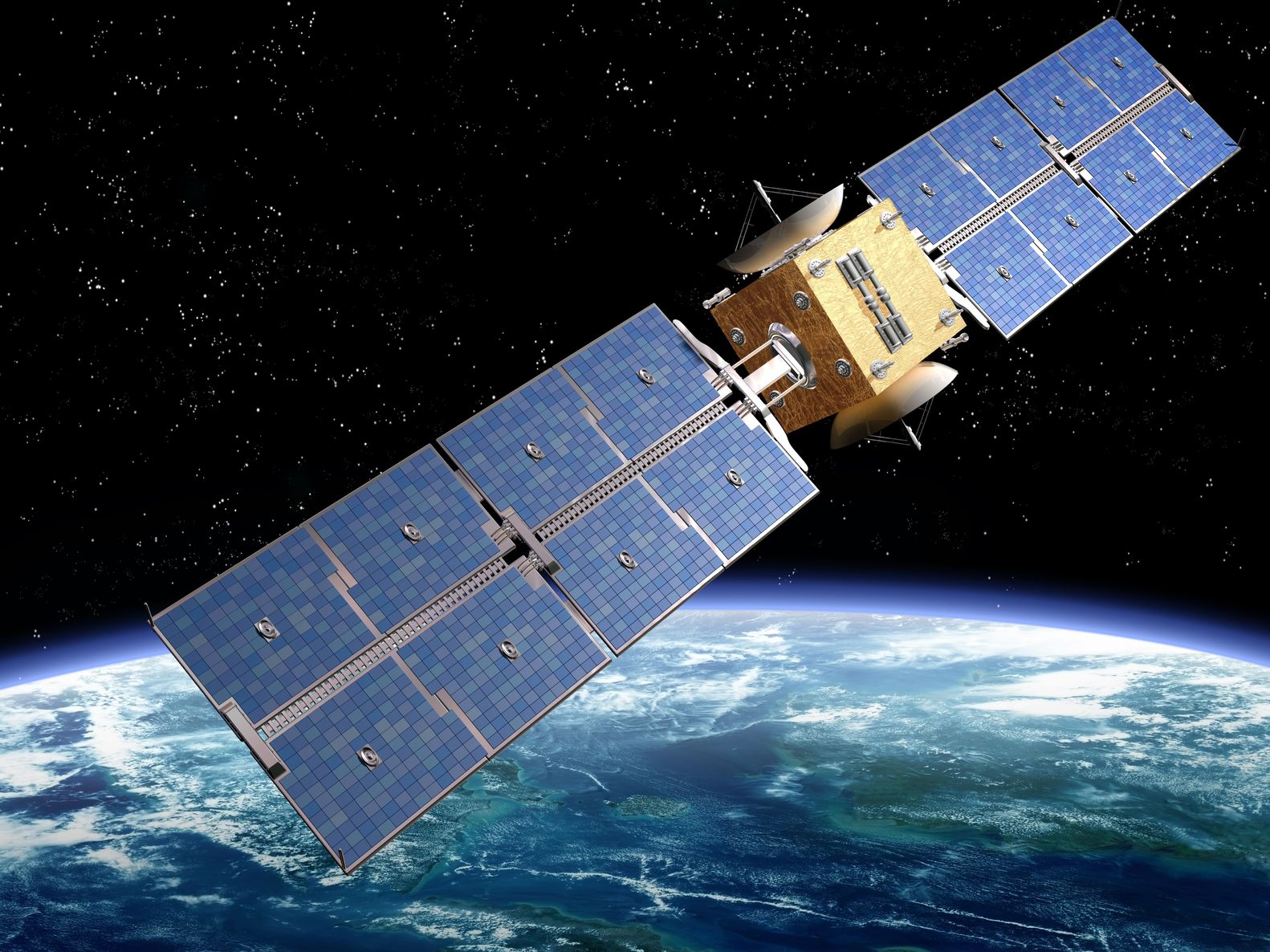
Artist’s rendition of a satellite – paulfleet/123RF Stock Photo
Looking at the latest Earth Observation (EO) launches in India and Japan together with an announcement on funding from the UK Space Agency.
India’ Earth Observation Launches
Last Friday, India’s Small Satellite Launch Vehicle (SSLV-D2) successfully put three satellites into a 450 km circular low Earth orbit. This is significant turnaround from the SSLV’s first flight in August last year, which was a failure as it put the two satellites, EOS-01 and AzaadiSat-1, into the wrong orbit resulting in their loss. The Indian Space Research (ISRO) organisation implemented a number of changes to prevent similar failures in the future, enabling a successful launch last week.
We wrote about the launch failure last year, as the AzaadiSat-1 satellite was built by 750 female students from 75 schools across India to promote women in STEM (Science, Technology, Engineering and Mathematics). It was such a shame that this satellite failed with its positive message, but we were delighted to see that one of the three payloads on this successful launch was AzaadiSat-2! Like its predecessor, AzaadiSat-2 was built 750 female students from across India in conjunction with Space Kidz India, and the payload includes:
- A LoRa transmitter to demonstrate the LoRa and Amateur Radio communication capabilities.
- A solid-state sensor to measure radiation levels in space
- 75 student experiments to measure various health data such as temperature, humidity, and pressure
We wish the students success with their experiments and look forward to seeing what they find out!
Alongside AzaadiSa-2, the other two satellites launched were:
- Earth Observation Satellite-07 (EOS-07): A technology demonstrator satellite developed by ISRO carrying new instruments, including a Millimeter-wave Humidity Sounder and Spectrum Monitoring Payload, on a year long mission.
- Janus-1: This is a technology-demonstration satellite by the USA company Antaris on their own software platform which enabled them to design and build the satellite featuring five payloads with a 75% cost saving over similar missions.
Japan’s Earth Observation
The Japanese Advanced Land Observing Satellite-3 DAICHI-3 (ALOS-3) is due to be launched this week. The launch was due to be on Sunday, but it was postponed to Wednesday due to technical issues. These were resolved, but it has been further postponed until Friday due to bad weather.
The launch will be undertaken by the Japanese Aerospace Exploration Agency’s (JAXA) new H3 rocket, which it is suggested can cut launch costs in half. It will be take off from the Tanegashima Space Centre in the south west of Japan, and is due to put the satellite into a sun-synchronous orbit at an altitude of 669 km.
DAICHI-3 is an optical EO mission with a six band multi-spectral imager offering a spatial resolution of 3.2m, while its panchromatic mode offers a spatial resolution of 0.8m. The satellite has a swath width of 70 km providing global land observations and the data is expected to be used to support disaster situations.
Post Blog Note: The launch was aborted at the last moment due to a technical issue.
New Funding In UK
On Valentine’s Day, the UK Space Agency showed a little love to the sector, by announcing £6.5 million of funding for 18 projects across the country.
The majority of the funding seems to have gone to space clusters around the country, rather than individual companies. Over half the money has gone towards the people who provide network opportunities and co-ordination, with:
- £2.22 million divided between nine space clusters to appoint Cluster Development Managers to co-ordinate the work within those clusters.
- £1.5 million for an expert consortium of business support providers, led by Entrepreneurial Spark, to work with UK entrepreneurs to help them get involved in the space sector.
There are also a series of so called ‘locally led high impact projects’ and, again, the majority of the money seems to have been given members of the nine space clusters. The projects are:
- £495,000 to oversee a pilot programme enabling space supply chain SMEs in Northern Ireland to engage with large companies.
- £483,000 to allow Space Hub Yorkshire to establish a network of organisations from across the space, finance, and agriculture sectors to embed the use of EO and geospatial data into the UK’s Green Finance ambitions and commitment to Net Zero.
- £500,000 for an R&D programme supporting small innovative engineering companies across the Midlands to get move into the UK’s growing space sector, focusing on the design and manufacture of spacecraft and the launch infrastructure.
- £406,000 to enable the Space South Central Cluster to open up engineering facilities and technical expertise to local companies to enable more high-quality space prototyping and manufacturing.
- £373,000 for Space Scotland to strengthen the Scottish space ecosystem by reducing environmental impact, addressing workforce skills challenges, and leveraging new opportunities.
- £36,000 to explore the potential for a dark sky space observatory and planetarium to be established at Spaceport Snowdonia.
- £20,000 for a project to explore how space technology could be deployed to tackle water leakage, seagrass habitat monitoring, and coastal erosion and stability in Cornwall.
- £20,000 for a scoping project to explore the potential for satellite data to improve emergency management in North East England.
- £18,000 for a study to identify regional space capabilities, skills and challenges in natural capital and ecosystem services monitoring and management.
Finally, there is also £485,000 for STFC RAL Space’s Chilbolton Advanced Satellite Tracking Radar to provide upgrades on its radar sensors used as part of its satellite tracking operations – although after the last week, they might be using it to track balloons too!
It is great to see the UK investing in the space sector, whether this sort of funding will create jobs and growth remains to be seen.
