

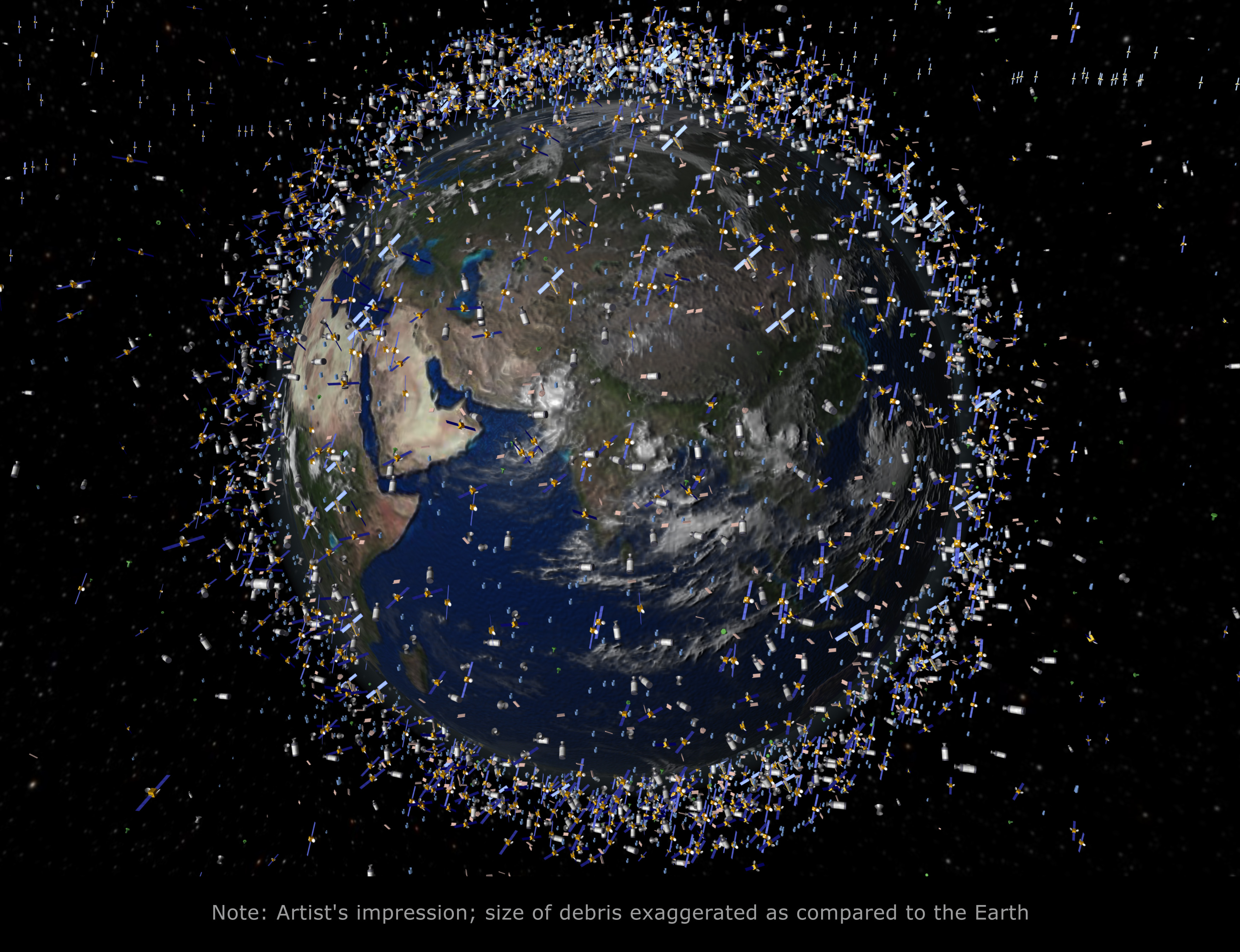
Image courtesy of ESA
Note: The debris field shown in the image is an artist’s impression based on actual data. However, the debris objects are shown at an exaggerated size to make them visible at the scale shown
Space is a difficult environment to work in, but even getting there is also difficult. We’re looking at some of those challenges with satellite launch failures, importance of data and why the UK is no closer to participating in the Horizon Europe and Copernicus Programmes.
Satellite Launch Failures
Last week we wrote about the scheduled launch of the Advanced Land Observing Satellite-3 DAICHI-3 (ALOS-3) by the Japan Aerospace Exploration Agency (JAXA). The launch had been delayed three times, but was due for lift off last Friday. While the rocket’s main engine ignited as expected during the countdown, the rocket did not leave the launch pad. JAXA later indicated that an anomaly was discovered during the first stage ignition, which automatically shut down the main engine and blocked the ignition signals to the boosters. JAXA is investigating further and hopes to have another launch by the end of next month. This setback follows the failure of the smaller Epsilon rocket, which was ordered to self-destruct shortly after taking off last October.
In the UK last month, Spaceport Cornwall attempted to launch the first satellite from UK soil. While the initial deployment went as expected, the missile failed to put the payload into orbit. Virgin Orbit has now reported the reason was that a fuel filter became dislodged, which caused the engine to overheat and eventually malfunction, ending the second stage thrust prematurely. The announcement also confirmed that the missile and the payloads fell back to Earth and landed in the Atlantic Ocean in the approved safety corridor. The investigation work is ongoing, together with the development of plans to prevent this from happening in the future, including installing a more robust fuel filter. The company said they are proceeding with caution towards their next launch.
Importance of Space Launch Data
In America, the United States Department of Transportation’s Federal Aviation Administration (FAA) has proposed a $175,000 penalty against SpaceX for failing to submit launch collision trajectory data to the agency prior to a 19th August 2022 launch from Cape Canaveral in Florida when a Falcon-9 rocket put 53 Starlink satellites into orbit.
The collision trajectory data is used to assess the probability of potential collisions between the launch vehicle and the thousands of objects orbiting the Earth, and should be submitted to the FAA 7 days ahead of any launch. SpaceX has 30 days to respond to the proposed penalty. The $175,000 is below the maximum penalty available of $262,666, and the FAA said the proposed lower penalty was appropriate after reviewing the case. However, the FAA will evaluate any response before determining the actual fine to be paid by the company.
Copernicus and Horizon Europe
The impacts of Brexit on the UK science and Earth Observation (EO) sectors have been highlighted again, as there is a discussion that the UK and the European Union could be edging towards a new agreement over the Northern Ireland Protocol. This is critical as the Protocol issue was behind the failure to agree the UK’s participation in the Horizon Europe and Copernicus programmes.
Despite the positive noises on the Protocol, it does not appear this will necessarily help the situation with the other two programmes. According to reports, the UK government wants to renegotiate a reduced fee for Horizon Europe participation to reflect it has not been part of the programme’s first two years. Whether the other parties will be happy to pick up the UK shortfall remains to be seen, while the UK Government has already removed the funds from the budget. It was reported this week that the funding had been removed in the Central Government Supply Estimates 2022-23 February 2023 document.
The UK Government has also been developing an alternative programme, but scientists have frequently said it will not be as useful or productive as the existing Horizon Europe, and there are concerns a further dispute could force the Government to go with its alternative. Participation in Copernicus is even more tenuous as many of the big contracts have already been awarded, and many UK companies have had to give up contracts, move to Europe or simply not bid due to Brexit.
All of these examples show that those working in the space and EO sectors face technological, regulatory and political challenges before we even get into orbit!
