

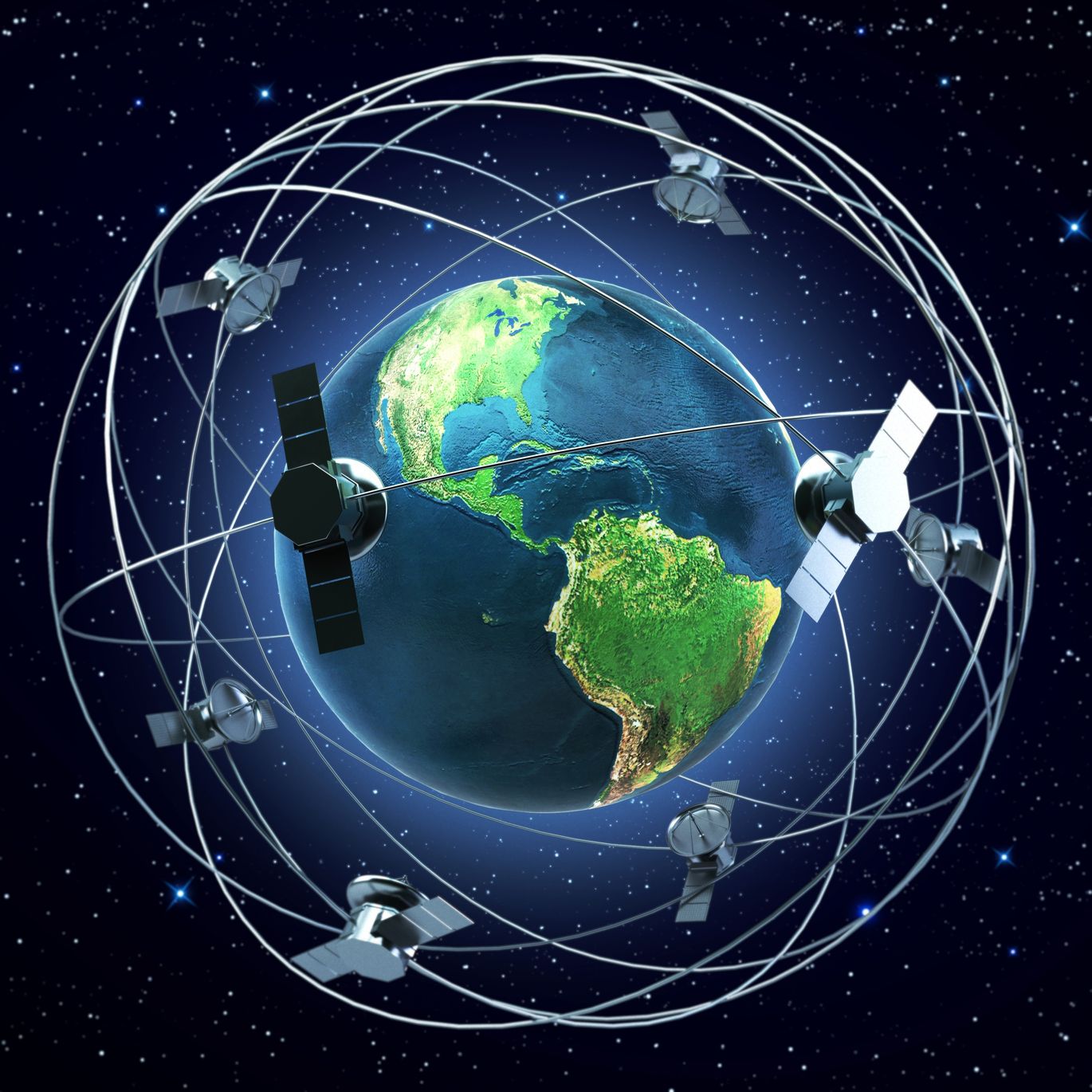
Artist’s rendition of satellites orbiting the Earth – rottenman/123RF Stock Photo
A couple of weeks ago the World Meteorological Organization (WMO) highlighted that the global pandemic was reducing the accuracy of weather and climate forecasts.
This isn’t because all the meteorological data scientists are working from home trying to run supercomputers on home broadband. It’s actually due to the significant reduction in global air traffic.
WMO’s Global Observing System provides a significant amount of data for weather forecasting facilities around the world, and this system uses sensors in a variety of places. Clearly there is a large chunk of observations from Earth Observation satellites, and in addition, there are observations from automated weather stations, weather buoys, and sensors on ships. However, there are also a significant number of sensors attached to planes, which are part of the WMO Aircraft Meteorological Data Relay programme (AMDAR). This programme contributes over three-quarters of a million high-quality measurements a day, and the sensors on planes measure ambient temperature, wind speed and direction in the atmosphere below 13 km.
There are several thousand planes, from 43 airlines, which contribute to the programme. According to Flight Radar, flights have dropped by almost seventy-five per cent since the start of this year, which has had a huge impact on aircraft measurements. Florian Pappenberger from the European Centre for Medium-Range Weather Forecasts (ECMWF) has reported a ninety-per cent reduction in aircraft observations across Europe, and globally the drop is around eighty-percent.
It’s not only the reduction in planes that’s causing problems. In many developing countries, the meteorological community still rely on manually recorded in-situ observations to support global weather and climate models. Covid-19 lockdown restrictions have reduced the ability for many people to capture, and submit, their observations in the normal manner. Therefore, the WMO has also seen a significant decrease in the submission of these types of manual observations.
Lars Peter Riishojgaard, Director, Earth System Branch in WMO’s Infrastructure Department has highlighted that over time the loss of these observations is likely to cause a gradual decrease in reliability of the forecasts.
European national weather services have been discussing ways to address this gap in observations, and are looking at two possible options:
- ESA’s Aeolus satellite mission: This is focussed on measuring wind profiles and measuring wind speed in the bottom 30 km of the atmosphere. In January this year, ECMWF started using Aeolus wind measurements in its models and is hoping that this can help fill the gap of the aircraft sensors. Measurements of temperature and humidity are also available from other satellites.
- Increased radiosonde launches: These are instruments flown on weather balloons that transmit meteorological measurements back during their flight, which is up to altitudes of 20 to 30 kilometres.
The longer the pandemic continues to ground flights, the quantity and quality of data feeding into weather forecast models will be reduced. Although, it is worth noting that even now there are still observations being collected from approximately:
- 200 satellites
- 10,000 manned and automatic surface weather stations
- 1,000 upper-air stations,
- 7 000 ships,
- 1,100 buoys.
So whilst the accuracy of scientific models for weather and climate forecasting is going to be impacted, we can still trust the weather forecasters – at least as much as we normally do!
