

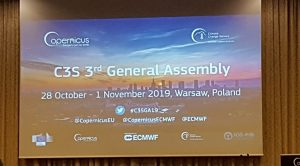
 Last week I was in Warsaw, Poland, at the 3rd General Assembly of the Copernicus Climate Change Service (often shortened to C3S) whose mission is to support European climate adaptation and mitigation policies by providing consistent and authoritative information, by building on existing capabilities and infrastructures and stimulating the market for climate services in Europe.
The event ran over four days from the 28th to the 31st October 2019, and it began with introductory presentations from the host country, European Centre for Medium-Range Weather Forecasts (ECMWF) and the European Commission Copernicus Unit. These presentations highlighted the successes of the initial C3S service operation, with over 25 000 users and in excess of 50 terabytes of data downloaded each day.
The next phase of Copernicus will put in place an operational budget with a strong focus on supporting the European Green Deal alongside wider activities. For example, there is a partnership with EuroNews and I was an end-user of this partnership whilst in Poland as this was only the English speaking European News channel in my hotel so I regularly saw Copernicus data!
Carlo Buontempo, the new head of C3S, discussed what’s going to be possible in the future with applications becoming visible on the C3S website, as well as the underlying data. The programme has a strong emphasis on delivering value to the users and a new development is an overarching activity focused on Evaluation and Quality Control which was described by Andre Obregon from ECMWF. There will be an additional visible tab for downloaded datasets which will indicate that validation that has been performed together with the supporting documentation enabling users to have sufficient information to both choose, and rely on, datasets for their own applications.
The resolution of the modelled data is improving, with the global historical reanalysis, which is a combination of observations and modelled data, now offered as ERA5; currently generated from 1979 to within 3 months of today, and soon to be within 7 days of today.
There were also presentations from the Sector Information Systems, who are seen as the enablers of downstream climate services, which included:
- Understanding the effects of windstorms by mapping storm tracks and assessing vulnerability then economic loss;
- Energy management through understanding spikes in electricity prices linked to the future availability of renewable energy such as solar and wind generation;
- Water management through meteorological data and hydrological models;
- Supporting health through looking a people’s exposure to high and low temperatures alongside pollen and potentially invasive mosquitos;
- Supporting fisheries through feeding regional climate models into oceanographic models and then looking at fish stocks, fronts and eutrophication;
- Supporting agriculture through bringing together models and satellite data to understand the biomass of the crop and water usage.
There were a couple of presentations from commercial entities working with the data. This is something that’s just beginning as the number of datasets available is increasing, and it certainly got me thinking. Betsy Weatherhead (Jupiter) outlined the broader commercial needs that included confidence in the data, good documentation, details on uncertainties, alongside regular, honest and direct communication. She suggested that also only 10% of users may be commercial, but they may serve hundreds of customers and so reach a much larger user base. Stelios Kotsopoulos (AgroApps PC) also showcased how the seasonal predictions could be used to forecast crop growth over 6 months.
The whole event was very interesting, but the lingering thought that stayed with me was that Pixalytics doesn’t use this data enough, and what products could we develop, enhance or deliver to our customers using C3S? It’s definitely something we’ll be exploring in 2020!
