

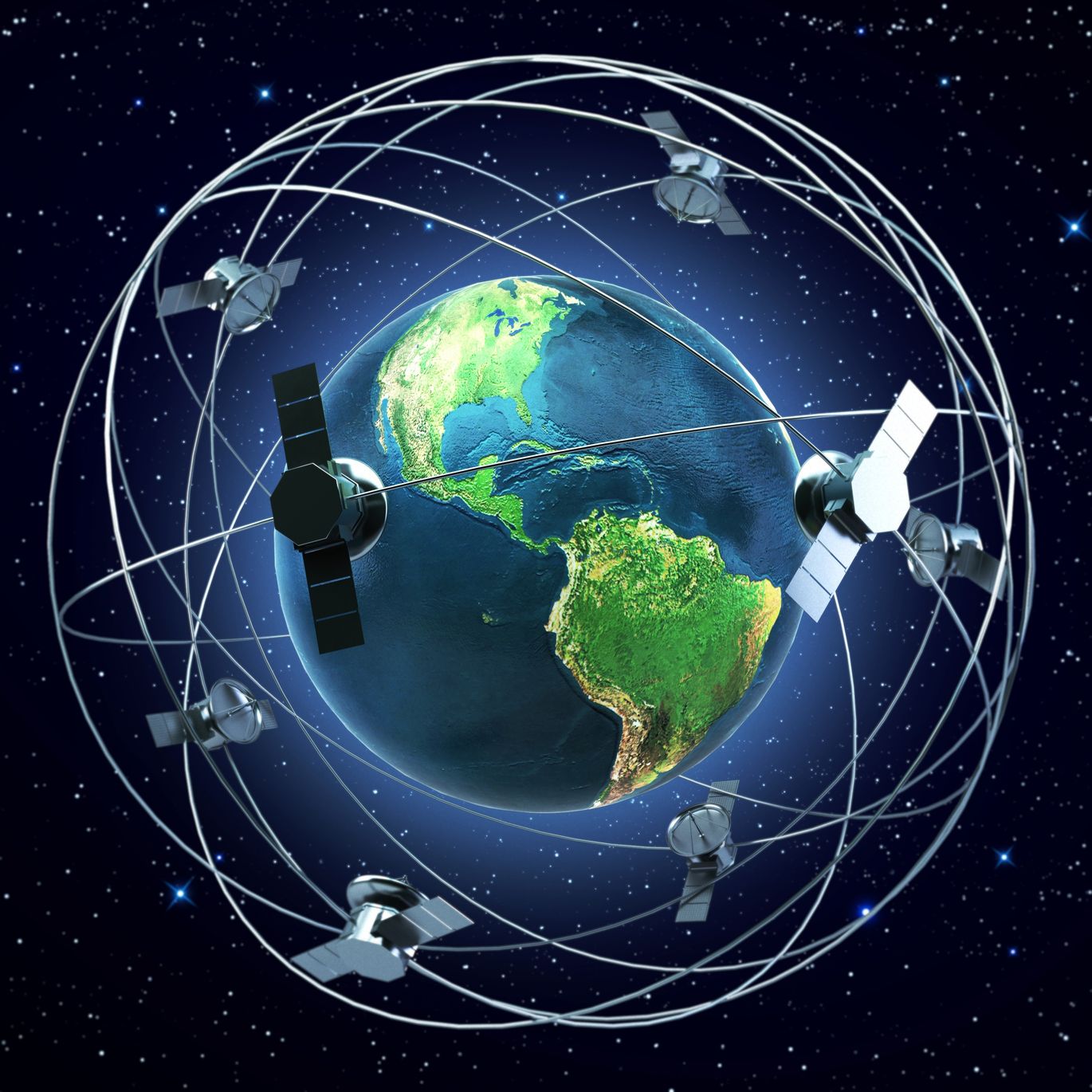
Artist’s rendition of satellites orbiting the Earth – rottenman/123RF Stock Photo
This week we’re looking at the latest Earth Observation launches, the heaviest geostationary satellite ever launched, and the end of the Aeolus satellite that re-entered the Earth’s atmosphere last Friday.
Earth Observation Satellite Launches
On Saturday seven satellites were successfully lifted into orbit by the Indian Space Research Organisation’s commercial arm on board their Polar Satellite Launch Vehicle from the Satish Dhawan Space Centre.
The main payload was a Synthetic Aperture Radar (SAR) Earth Observation (EO) satellite called DS-SAR. It was built by Israel Aerospace Industries on behalf of Singapore’s Defence Science and Technology Agency (DSTA), and it will be jointly operated jointly by DTSA and the Singapore company ST Electronics. No details on the instrument specification have been released, but it is believed that the data from the satellite will be used for government purposes such as maritime security and detection of oil spills, while ST Electronics will use the data for commercial imagery services.
There were six additional CubeSats onboard:
- ELOX-AM – An experimental microsat mission developed and operated by Singapore’s Nanyang Technological University (NTU) providing an opportunity for engineering students to participate in a multidisciplinary space project.
- SCOOB-II – Another satellite developed and operated by the students of NTU demonstrating space technology.
- ARCADE – Atmospheric Coupling and Dynamics Explorer (ARCADE), also known as INSPIRESAT 4, is a third satellite operated by NTU and this has four instruments onboard: a spatial heterodyne interferometer, a compact ionosphere probe, an atomic oxygen payload, and an earth imager.
- ORB-12 Strider is an in-orbit testing and demonstration satellite built by OrbAstro in partnership with Aliena-Aurora. It carries a number of instruments including:
- A semi-active multi-static SAR mission targeting 10 cm resolution 3D imaging using a Ka-band transmitter.
- Compact optical imaging system with a ground resolution of one metre.
- NuLIoN is a cubesat developed by NuSpace providing reliable regional data connectivity services in southeast Asia focused on Internet-of-things. Interestingly, NuLIoN carries a plate engraved with messages from the members of the public in Singapore.
- Galassia-2 is another educational Cubesat developed by undergraduate students at the National University of Singapore (NUS), which will offer imagery using a multi-spectral camera with green, red, red edge, and near infrared bands.
This week is also due to the see the launch of the Capella Acadia 1 satellite, also known as Capella 11, for the US company, Capella Space. The satellite is being launched by Rocket Lab, who has called the mission ‘We Love The Nightlife’. The launch was due to take place last Friday, but it was aborted during the engine ignition sequence. Poor weather conditions in New Zealand mean the launch is not currently scheduled to take place until later this week.
This commercial X-band SAR satellite is the first in the next generation of Capella’s Acadia satellites, offering increased radar bandwidth and improvements to reduce the time from imagery collection to downloading. A further 29 satellites are expected to be launched to form a 30 strong constellation to complement the other Capella constellations.
Communication Satellite Launch
Another launch of note, which also took place last Friday, but this time by SpaceX from the Kennedy Space Centre in Florida. This is not an EO satellite, but a communications one known as Jupiter 3 for the EchoStar Corporation. It is of note as it is the heaviest geostationary satellite ever launched and weighed in at a huge 9,200 kilograms! The satellite will reach an altitude of just under 36,000 kilometres above the Earth, and will provide a variety of communication and broadband services to the Americas.
Death of Aeolus
Last Friday saw the end of the European Space Agency’s Aeolus mission, as the satellite re-entered the Earth’s atmosphere around 19:00 GMT as confirmed by US Space Command. The re-entry was above Antarctica, following a series of manoeuvres to lower Aeolus’s orbit from 320 km to 120 km, allowing it be pulled back into the atmosphere. In addition to lowering the orbit, the satellite was positioned so that any pieces that were not burnt up on re-entry would fall safely within the satellite’s planned Atlantic ground tracks.
Aeolus, named after the ‘keeper of the winds’ in Greek mycology, was the first satellite to capture wind profiles across the planet in near-real time. Launched on the 22nd August 2015, it carried a single instrument, the Atmospheric Laser Doppler Instrument (ALADIN), which was a wind lidar.
The mission is considered one of ESA’s most successful, and the data was used by weather forecasting services worldwide. It also provided insights into aerosols in volcanic plumes and provided a vital source of meteorological data during Covid when the data from planes was no longer available. There are already plans for a follow-on mission, Aelous-2.
Summary
New satellites are launched and old satellites die, not quite the circle of life from the Lion King, but the closest we get in the space industry!
