

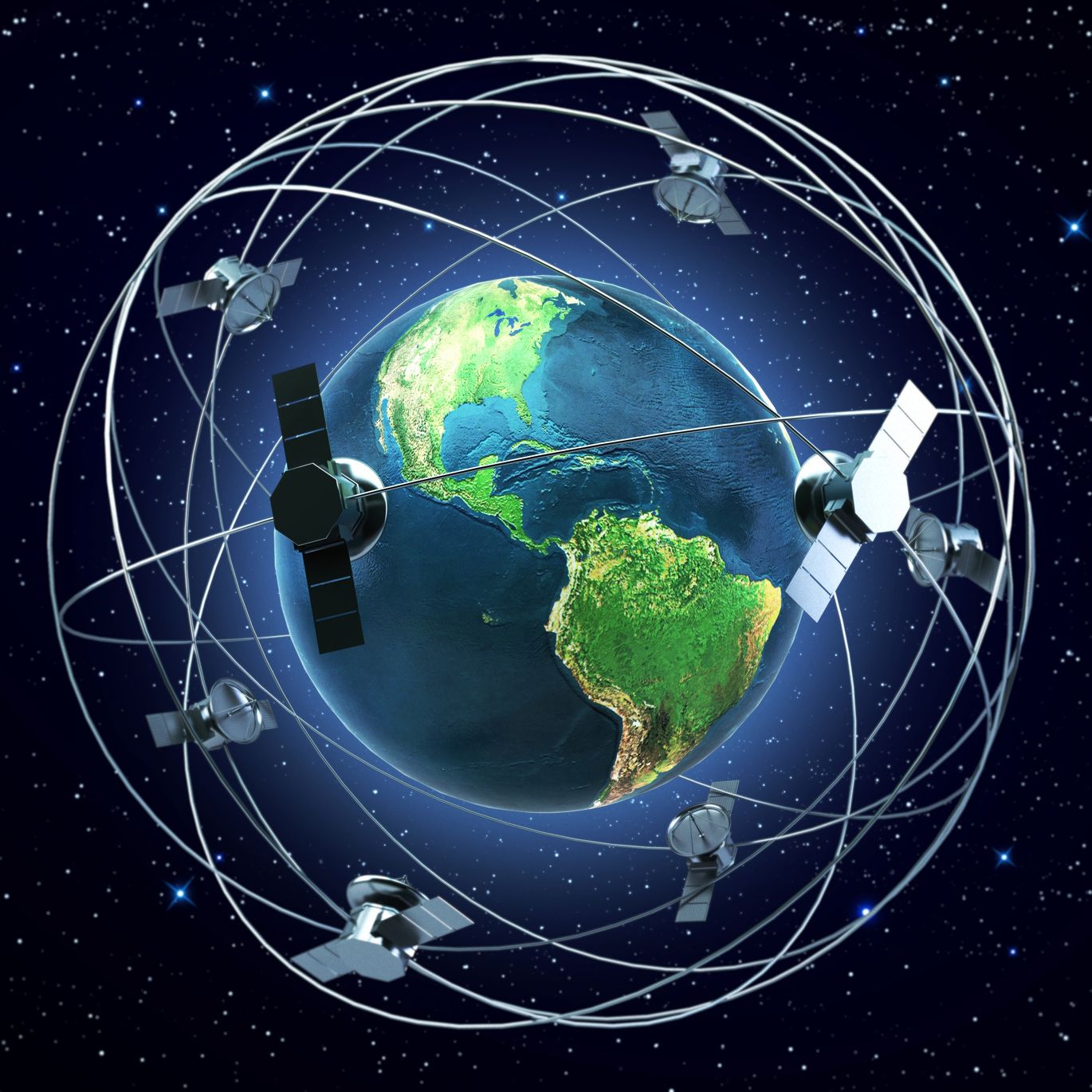
Artist’s rendition of satellites orbiting the Earth – rottenman/123RF Stock Photo
Next week is World Space Week and this year’s theme is ‘Satellites improve life’.
The origins of World Space Week can be found in Houston in America when, in 1980, the World Space Week Association co-ordinated the first ‘Spaceweek’ which took place in the middle of a July to commemorate the first Moon landing. Twelve months later they turned the week into a nationwide event, and over the following eighteen years it became established as an international event with over a dozen countries participating in ‘SpaceWeek’.
Its evolution began at the Third United Nations Conference on the Exploration and Peaceful Uses of Outer Space (UNISPACE III) which took place between 19th and 30th July 1999 in Vienna, Austria. At this conference, the participants decided ‘to invite the United Nations General Assembly to declare … World Space Week between the 4 and 10 October for the yearly celebration at the international level of the contribution that space science and technology can make to the betterment of the human condition.’ This was confirmed by the United Nations General Assembly on the 6th December later that year.
This week was chosen because:
- 4th October 1957 was the date of the launch of the first human-made Earth satellite, Sputnik 1, and
- 10th October 1967 was the date that the Treaty on Principles Governing the Activities of States in the Exploration and Use of Outer Space, including the Moon and Other Celestial Bodies including the Moon and Other Celestial Bodies, came into force.
Each year, World Space week has a different theme. For example, last year was ‘The Moon: Gateway to the Stars’, 2016 was ‘Remote Sensing–Enabling Our Future’ and 2006 was ‘Space For Saving Lives’. In 2020, the theme is ‘Satellites improve life’ to show how society is impacted by satellites every day, such as
- Communications for mobile telephone calls
- Navigation through GPS in phones, which tell you where you area and how to get to your destination
- Meteorology and the satellite pictures you see every day on weather forecasts
- Remote Sensing, of course, to support environmental monitoring or tracking transportation or supporting disaster relief scenarios.
There are lots of events, almost 1,000 at the latest count, taking place across the globe to celebrate World Space Week 2020. If you are interested in space or satellites, then there is bound to something you can take part in, you can find an event map, or an event list. Normally, a lot of these events take place physically and so you have to be close by to attend but, for obvious reasons, this year there is a lot of things going on virtually which you take part in wherever you are in the world. For example:
- STEMFest in Space is a virtual event from the UK taking place on the 8th October offering talks, events and activities.
- Space4Women: Using Satellites to Improve Lives is a Zoom meeting on the 5th October with five presenters giving talks on different aspects of the space and satellite field.
- Society for Space Education, Research and Development (SSERD): Offering a free online program across the entire week for students of all ages including lectures, workshops, competitions, and hackathons.
If you prefer not to take part in organised events, the World Space Week website has information on how you can see satellites from your back garden without a telescope of binoculars! Or, there are lots of educational resources that can be downloaded.
As anyone reading this blog will know, we are great supporters of satellites and would encourage everyone to get involved and learn more about this fascinating technology. It may surprise you to know just how much satellites impact your life!
